
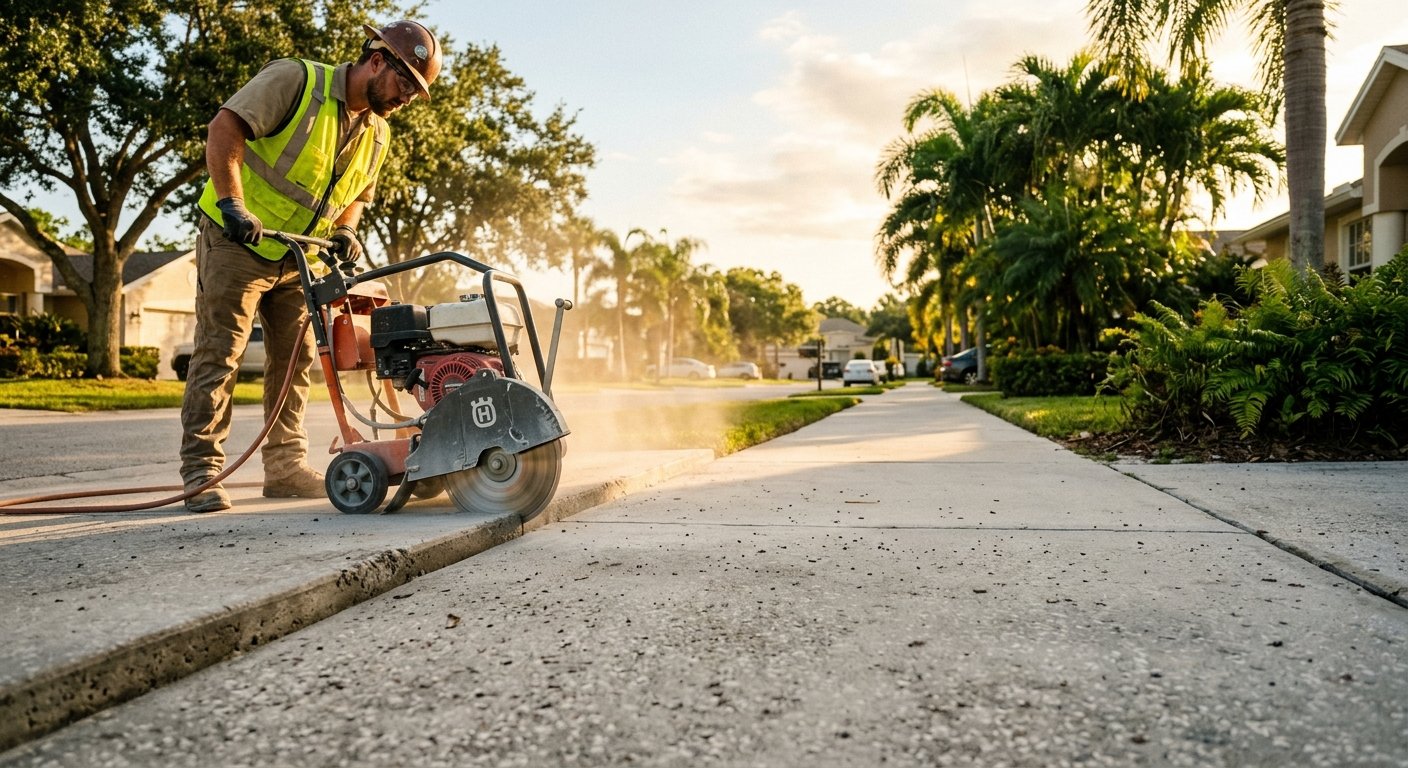
Precision concrete cutting shaves, bevels, or levels raised concrete edges on-site using patented equipment, producing an ADA-compliant surface in 15–30 minutes per location — at 70–90% less than full slab replacement. It is the preferred repair method for HOA communities, municipalities, schools, and commercial properties across Palm Beach County and Broward County where foot traffic is high and ADA enforcement is active.
- Precision cutting keeps the existing slab in place — no jackhammers, concrete trucks, or demolition debris.
- Repairs cost 70–90% less than full slab replacement and are open to pedestrian use immediately after completion.
- Every repair is verified against ADA vertical transition standards (max ½ inch change; transitions over ¼ inch beveled at 1:2 slope) before the crew leaves.
- Patented cutting equipment produces a cleaner, more durable finish than abrasive grinding and is easier to calibrate to ADA dimensions.
- Florida Sidewalk Solutions has delivered these results across South Florida for over 20 years.
What most decision-makers don’t realize is that the technology available to fix these hazards has advanced significantly. Precision concrete cutting isn’t a variation of older methods — it’s a fundamentally different approach that produces better results faster. In Palm Beach County and Broward County, where foot traffic is high and ADA enforcement is active, a single raised slab can expose a property owner to premises liability. Understanding how this process works helps property owners make smarter, more defensible decisions about sidewalk safety.
What Is Precision Concrete Cutting?
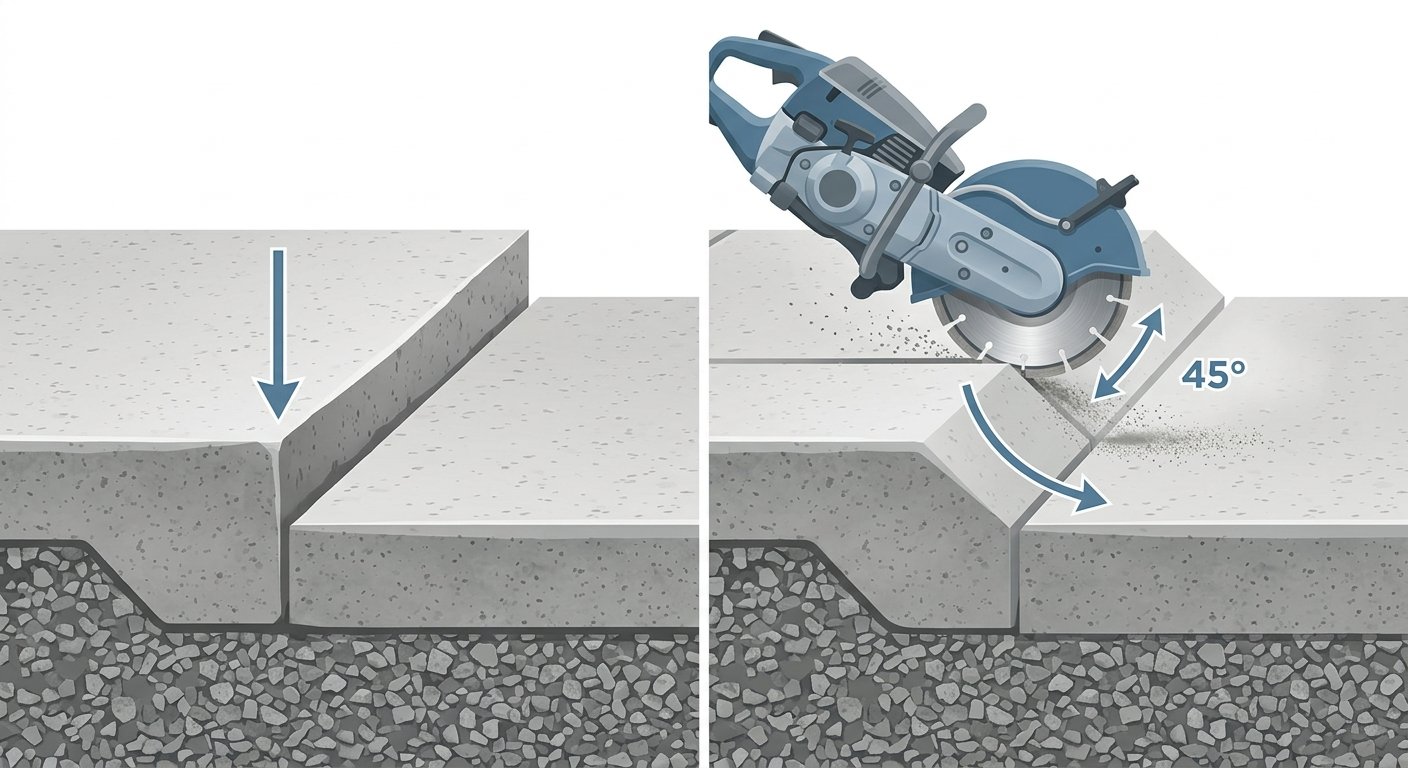
Precision concrete cutting is a specialized repair method that uses patented cutting equipment to shave, bevel, or level raised concrete edges directly on-site. Rather than breaking out and replacing damaged slabs — or grinding down the surface with abrasive equipment — the cutting process removes material with high precision, creating a smooth, sloped transition between uneven sections of sidewalk.
The result is a repaired surface that meets ADA accessibility guidelines for vertical changes in level, is structurally intact, and looks professionally finished. The slab itself remains in place. No jackhammers. No concrete trucks. No demolition debris hauled away.
At Florida Sidewalk Solutions, our patented precision concrete cutting technology has been refined through more than 20 years of sidewalk repair work specifically in South Florida’s conditions. The equipment is purpose-built for this task — not adapted from general construction tools — which is why it produces such consistent, clean results.
How the Process Works, Step by Step
Every precision cutting repair follows a consistent four-stage sequence designed to confirm ADA compliance before the crew ever leaves the site.
Site Assessment and Measurement
Before any equipment touches the sidewalk, a trained technician evaluates the trip hazard. This includes measuring the vertical displacement, assessing the underlying cause (root intrusion, soil settlement, thermal movement), and determining whether cutting is the appropriate repair method. Not every situation calls for cutting — but the vast majority of raised-edge trip hazards are excellent candidates.
Precision Setup and Alignment
The patented cutting equipment is positioned and calibrated to the specific dimensions of the repair. The cutting angle, depth, and bevel length are calculated to create a transition that complies with ADA vertical level-change requirements — specifically, changes no greater than half an inch, and transitions greater than a quarter inch must be beveled at a 1:2 slope per ADA Title II regulations.
The Cutting Operation
The cutting equipment removes concrete material cleanly and precisely. Unlike grinding, which uses abrasive wheels to wear down the surface and often leaves a rough, pitted texture, cutting produces a smooth, beveled edge. The operation is controlled, low-vibration, and relatively quiet — an important factor when repairs are happening near occupied buildings, schools, or active pedestrian areas.
Cleanup and Inspection
Cutting generates concrete dust and small debris, which are collected and cleared as part of the process. There is no demolition waste — no broken slab sections, no concrete rubble requiring disposal. Once complete, the repaired section is inspected against ADA measurements to confirm compliance before the crew leaves the site.
Precision Cutting vs. Grinding: Why It Matters
Many property managers encounter sidewalk grinding as a common alternative. Both methods keep the existing slab in place, but they differ significantly in quality, durability, and finish.
| Criterion | Precision Cutting | Grinding |
|---|---|---|
| Surface quality | Clean, smooth beveled edge | Rough, uneven texture prone to cracking and spalling |
| Accuracy | Engineered equipment hits specific dimensions consistently | Largely operator-dependent; difficult to calibrate precisely |
| ADA compliance | Bevel angle easy to achieve and verify | Grinding approximations may fall short of regulatory standards |
| Longevity | Load distributed effectively; less edge chipping | Ground surface more susceptible to deterioration |
| Appearance | Noticeably cleaner, more professional finish | Visibly rougher result |
For a deeper comparison of repair methods and when each applies, our sidewalk trip hazard repair resource covers the full decision framework.
Precision concrete cutting typically costs 70–90% less than full slab replacement — enough to change what’s actually achievable within a budget cycle.
The Cost Advantage: Why Cutting Beats Replacement
Slab replacement is sometimes the right answer — when a slab is severely cracked, sunken beyond repair, or structurally compromised. But for the typical raised-edge trip hazard, replacement is dramatically more expensive than necessary.
Precision concrete cutting typically costs 70–90% less than full slab replacement. For a municipality managing hundreds of sidewalk panels, or a property management company overseeing multiple communities in Broward County, that cost difference is significant enough to change what’s actually achievable within a budget cycle.
Replacement requires saw-cutting out the old slab, excavation, forming, pouring new concrete, and waiting for cure time before the area can be reopened — a process that can take multiple days and requires pedestrian detours. Precision cutting is typically completed in minutes per repair location, with the area ready for immediate use once the crew moves on.
For decision-makers accountable to boards, city councils, or ownership groups, the ability to show responsible stewardship of repair budgets while demonstrably reducing liability exposure is a compelling combination.
ADA Compliance: The Legal Reality in Florida
Florida property owners and municipalities operate under both federal ADA requirements and state accessibility standards. The Americans with Disabilities Act applies to public accommodations, commercial facilities, and state and local government facilities — meaning the liability exposure for non-compliance is broad.
Trip hazards don’t just create slip-and-fall risks for the general public. They create specific, documented barriers for individuals using wheelchairs, walkers, and mobility devices. ADA complaints and lawsuits increasingly target sidewalk conditions that would have once been considered minor maintenance issues.
Our ADA compliance work across Palm Beach County and Broward County is documented and measurable. Every precision cutting repair is verified against ADA vertical transition standards before completion. For properties that need a comprehensive compliance assessment, our ADA sidewalk compliance service provides that structured evaluation.
Trip hazards don’t resolve themselves. In South Florida’s environment, where tree roots are aggressive and seasonal ground movement is common, hazards tend to worsen over time. Every month a known hazard goes unaddressed is another month of accumulating liability exposure.
Who Benefits Most from Precision Concrete Cutting?
While virtually any property with concrete sidewalks can benefit, precision cutting is particularly well-suited for:
- HOA communities: High resident foot traffic, shared liability exposure, and board accountability to members make efficient, affordable, ADA-compliant repairs a priority.
- Municipal public works departments: Large sidewalk inventories, constrained budgets, and public accountability make cost-effective compliance essential.
- Schools and university campuses: Student and visitor safety, ADA obligations, and active use areas where minimizing disruption matters.
- Commercial property owners: Customer-facing liability, ADA compliance obligations, and the need for repairs that don’t disrupt business operations.
- Property management companies: Managing multiple properties across South Florida requires scalable, reliable repair solutions that can be deployed efficiently.
Frequently Asked Questions
How long does a precision concrete cutting repair take?
Most individual trip hazard repairs using precision cutting are completed in 15 to 30 minutes per location. A crew can typically address multiple repair sites in a single visit. Because there’s no concrete curing time required, the area is ready for pedestrian use immediately after the repair is finished.
Will the repaired area look different from surrounding sidewalk?
The repaired surface will have a clean, beveled edge that’s noticeably smoother than older grinding methods. Over time, concrete weathers uniformly, and the repair integrates visually with surrounding panels. Most property managers find the finish more professional-looking than they expect.
Is precision cutting appropriate for all types of trip hazards?
Precision cutting is most effective for raised-edge trip hazards where one slab has heaved or settled relative to an adjacent panel. It’s appropriate when the slab itself is structurally sound. Severely cracked, sunken, or damaged slabs may require different repair approaches. A professional site assessment determines the best solution for each specific condition.
Does precision concrete cutting meet ADA compliance standards?
Yes. The purpose of precision cutting is to create a compliant vertical transition between slab surfaces. Repairs are measured and verified against ADA requirements for vertical level changes and bevel angles before the job is considered complete.
How does precision cutting compare to full slab replacement in terms of cost?
Precision cutting typically costs 70–90% less than slab replacement for equivalent trip hazard remediation. For properties with multiple repair locations, the cumulative savings are substantial — allowing more hazards to be addressed within the same budget.
The Practical Choice for South Florida Properties
Precision concrete cutting provides a solution that’s technically superior to grinding, dramatically more cost-effective than replacement, and specifically engineered to meet ADA compliance standards. It’s the method that allows property managers, HOA boards, and public works directors to address safety issues completely, professionally, and within budget.
Florida Sidewalk Solutions has delivered these results across Palm Beach County and Broward County for over 20 years. Our licensed, insured team brings patented cutting technology and ADA compliance expertise to every job — and we stand behind the quality of every repair we complete.
Eliminate trip hazards and reduce your liability exposure
Contact Florida Sidewalk Solutions today for a professional site assessment — we’ll identify every hazard, provide a clear remediation plan, and get your sidewalks into safe, compliant condition with minimal disruption.

About Florida Sidewalk Solutions
Florida Sidewalk Solutions specializes in sidewalk safety, ADA compliance, and trip hazard prevention for Florida property managers, municipalities, and commercial property owners. Using patented concrete cutting technology, they deliver cost-effective repairs that are 70-90% less expensive than replacement, with minimal disruption and no demolition waste. With over 20 years of Florida-specific experience, they provide the expert solution for eliminating liability risks while meeting ADA standards and legal requirements. Visit floridasidewalksolutions.com →