Florida property managers have three primary sidewalk repair options: concrete cutting (also called precision concrete cutting), grinding, and full slab replacement. Cutting is typically the most effective and cost-efficient choice for eliminating trip hazards and achieving ADA compliance, while replacement is the most disruptive and expensive. Understanding the differences helps decision-makers protect their properties, budgets, and residents from liability.
- The ADA defines a trip hazard as any vertical displacement greater than 1/4 inch — even a small offset creates real legal exposure.
- Precision concrete cutting corrects trip hazards permanently without demolition, debris, or extended downtime.
- Concrete cutting is significantly less expensive than full slab replacement and produces a cleaner, safer result than grinding alone.
- Florida property managers in Palm Beach and Broward counties face specific compliance obligations under the ADA and Florida accessibility codes.
- Choosing the right repair method the first time prevents repeat costs and reduces long-term liability risk.
Why the Repair Method You Choose Matters Legally
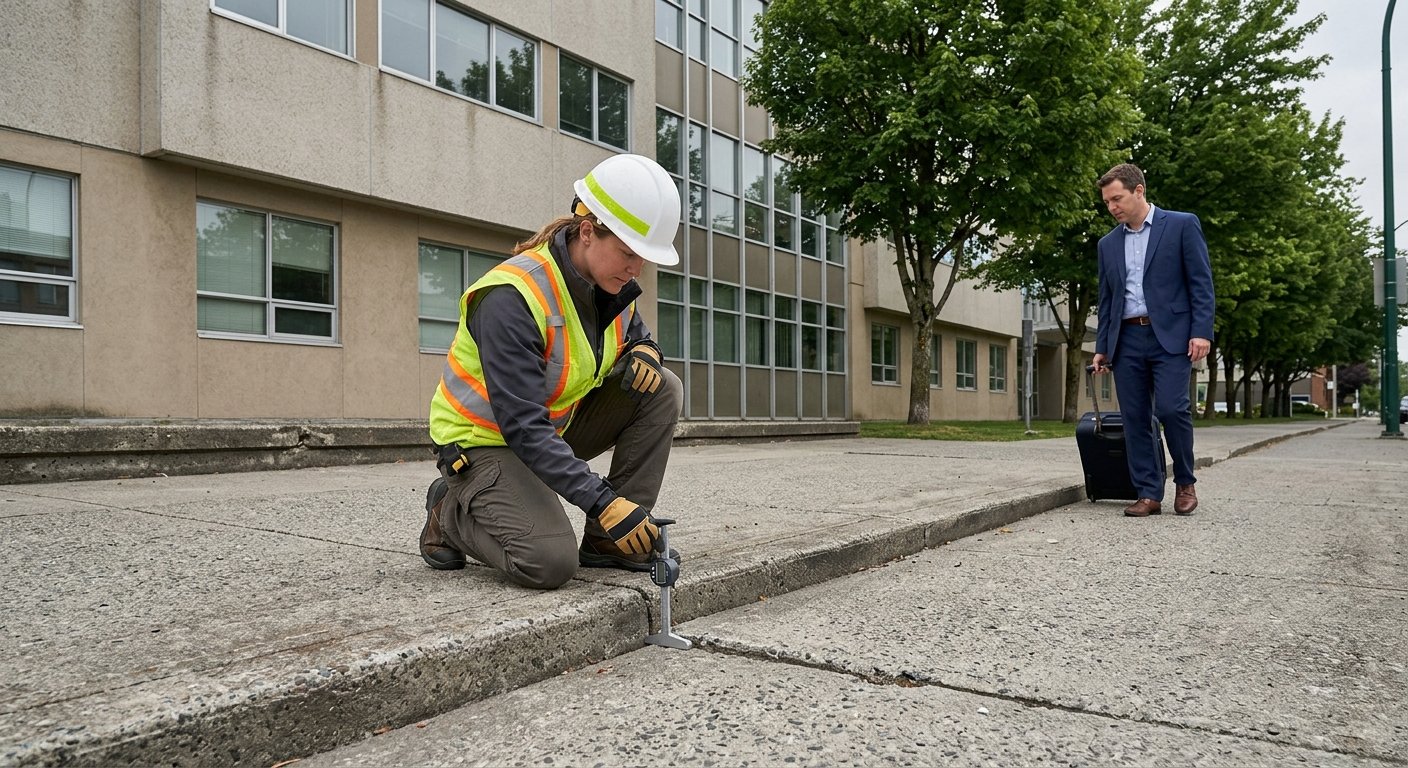
Under the Americans with Disabilities Act, any vertical change in a walking surface greater than 1/4 inch constitutes a trip hazard and an ADA violation. Changes between 1/4 inch and 1/2 inch must be beveled at no more than a 1:2 slope. Anything beyond that requires remediation — not a “watch your step” sign, not a painted warning stripe, but actual repair that brings the surface into compliance.
For property managers and HOA boards in Palm Beach County and Broward County, this is not a technicality. It is an active liability exposure. When a pedestrian trips and falls on a non-compliant sidewalk, the property record — including inspection logs, past repair requests, and any history of documented hazards — becomes central to the claim. Choosing an inadequate repair method, or delaying action, can significantly worsen that exposure.
A painted curb or cone does not constitute an ADA-compliant repair. Documenting a hazard without correcting it can actually increase your liability rather than reduce it. Remediation must meet the standard, not just acknowledge the problem.
The Three Main Sidewalk Repair Options
Each repair method has a different application, cost profile, and outcome. Here is what property managers in Florida need to understand before committing to any approach.
1. Full Slab Replacement
Replacement involves removing the damaged concrete panel entirely and pouring a new slab. It is the most expensive option, requires significant downtime for curing, generates demolition waste, and often disrupts surrounding landscaping, irrigation, and adjacent surfaces. Replacement is appropriate when a slab is structurally compromised — deeply cracked, sunken, or heaved beyond redemption. For isolated trip hazards on otherwise sound slabs, it is almost always overkill.
2. Concrete Grinding
Grinding uses an abrasive wheel to shave down the raised edge of a displaced slab. It is faster than replacement and produces no demolition debris, but it has meaningful limitations. Grinding leaves a sloped, roughened surface that may not achieve a clean bevel compliant with ADA slope requirements. On heavily trafficked surfaces, ground edges can wear unevenly over time. It is also less precise — the operator has limited control over the final geometry of the correction.
3. Precision Concrete Cutting
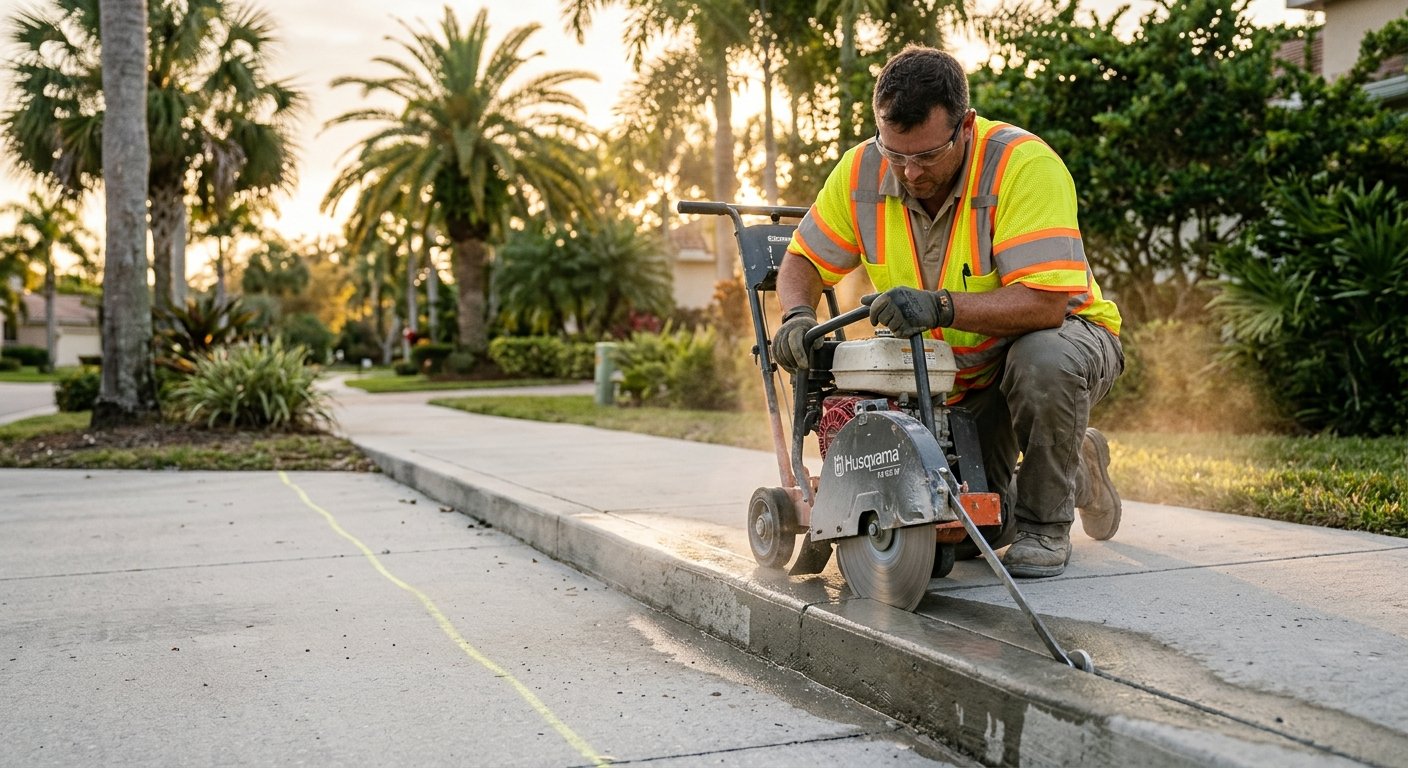
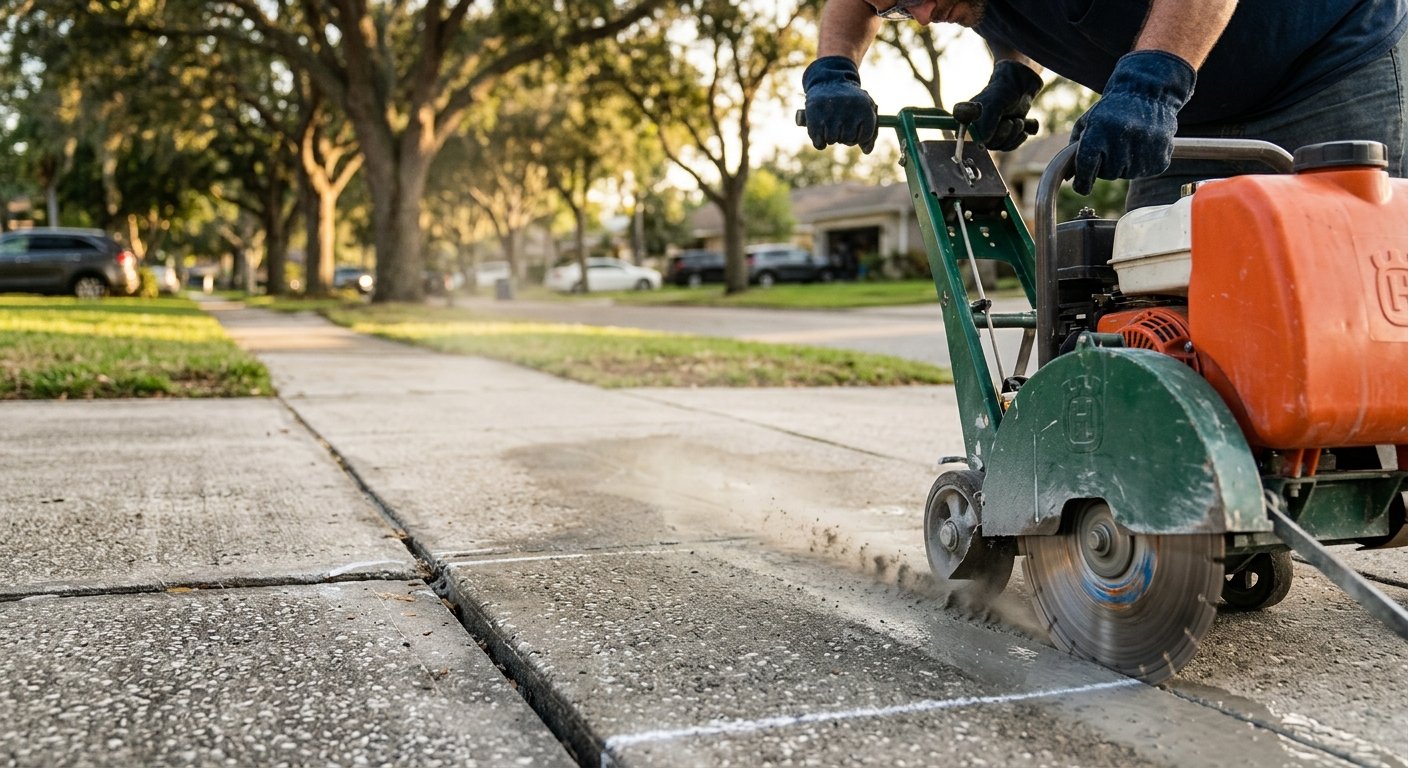
Precision concrete cutting uses a specialized diamond-blade saw system to create a controlled, beveled cut that removes the trip hazard and transitions the displaced edge to a compliant slope. Unlike grinding, cutting produces a clean, geometric finish that meets ADA specifications precisely. There is no demolition waste, no extended cure time, and no significant disruption to surrounding areas. The repaired section looks professional and is immediately walkable.
| Factor | Precision Cutting | Grinding | Slab Replacement |
|---|---|---|---|
| ADA Compliance Precision | High — controlled bevel geometry | Moderate — surface dependent | High — if properly installed |
| Disruption to Property | Minimal | Minimal | Significant |
| Demolition Waste | None | Minimal dust | Yes — full slab debris |
| Cure/Downtime Required | None — walkable immediately | None | Days to weeks |
| Finish Quality | Clean, professional | Roughened edge | New surface appearance |
| Best For | Trip hazards on sound slabs | Minor offsets on low-traffic areas | Structurally failed slabs |
What Makes Precision Concrete Cutting Superior for Florida Properties
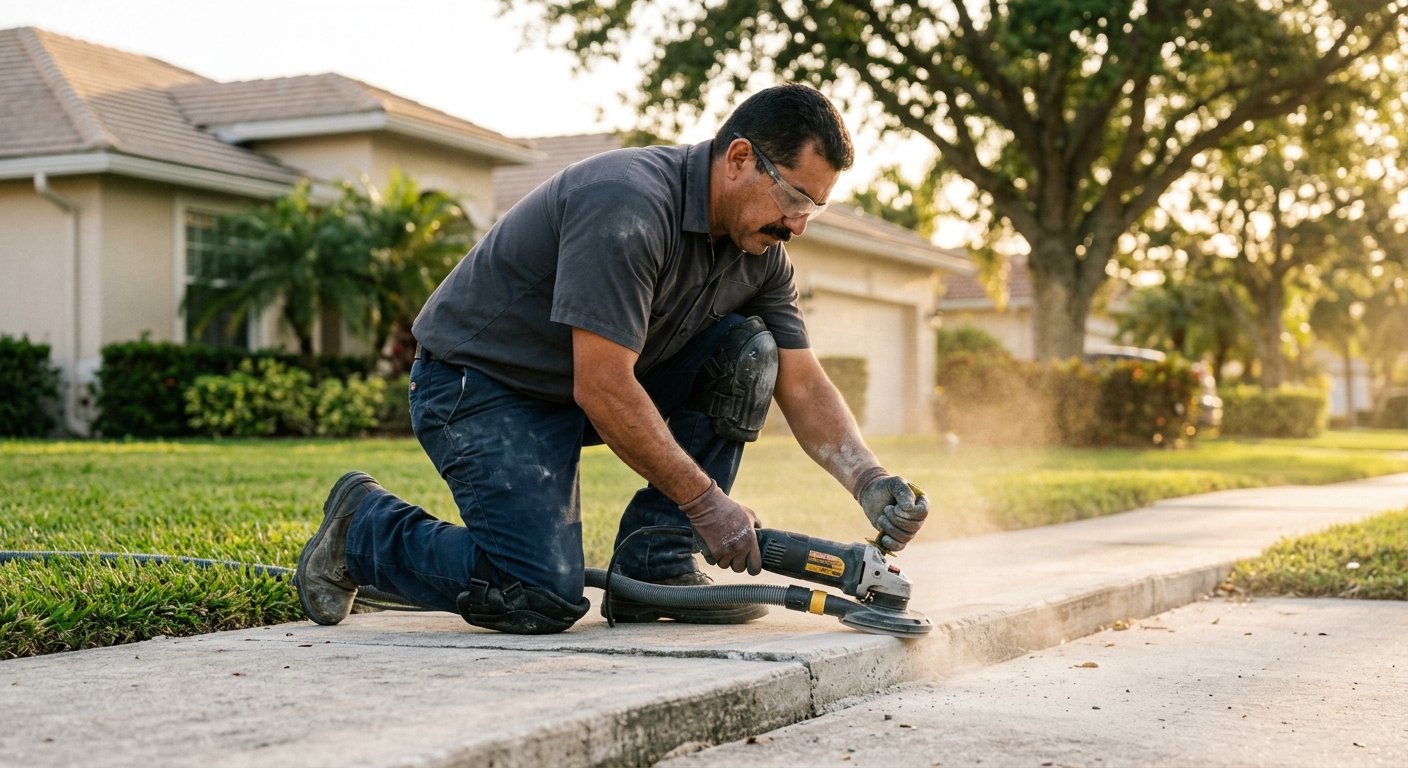
Florida’s soil conditions — expansive clay layers, high moisture content, and tree root activity from dense canopy coverage — mean sidewalk panels shift frequently. In communities throughout Palm Beach and Broward counties, it is common to find multiple trip hazards across a single property. When you are addressing several offsets at once, the method you choose has compounding consequences for cost, timeline, and disruption.
Precision concrete cutting, particularly when performed with patented cutting technology, allows crews to address multiple hazard points in a single visit with minimal setup and no heavy equipment staging. The result is a measurable reduction in the time residents or visitors are rerouted, and a cleaner, more consistent finish across the entire walkway system.
Choosing the right repair method the first time is always less expensive than correcting a poor repair later — and far less expensive than managing a liability claim.
For property managers responsible for large HOA communities, commercial campuses, or municipal sidewalk networks, this efficiency matters enormously. Repairs completed correctly on the first visit eliminate the cost of re-mobilization, minimize resident complaints, and create a documented compliance record that demonstrates due diligence.
After any sidewalk repair, maintain a written record of the date, location, method used, and the contractor’s credentials. This documentation is valuable if a claim is ever filed and demonstrates that your organization acted responsibly and promptly.
When Replacement Is Actually the Right Answer
Precision cutting resolves the vast majority of trip hazards on Florida properties — but not every situation calls for it. Full replacement is the appropriate choice when:
- A slab has deep structural cracking that compromises its load-bearing integrity
- The panel has sunk significantly below grade due to soil washout or subsidence
- Root intrusion has fractured the slab into multiple pieces with no stable surface remaining
- Displacement exceeds the correction range that a bevel cut can address while remaining ADA-compliant
An experienced contractor will assess each panel and recommend the right method — not the most expensive one. That transparency is what separates a compliance-focused partner from a vendor simply looking to maximize invoice value. For a deeper look at the tradeoffs, our sidewalk repair vs. replacement guide walks through exactly how to evaluate each situation.
ADA Compliance Is Non-Negotiable in 2026
The U.S. Access Board’s guidance on ground and floor surfaces reinforces that accessible routes must be stable, firm, and slip-resistant, with changes in level addressed through compliant beveling or ramping. For Florida property managers, this applies to every pedestrian walkway that connects accessible parking, building entrances, and public amenities.
Non-compliance is not just a regulatory concern — it is a budget risk. ADA lawsuits can result in injunctive relief requiring repairs under court supervision, plus attorney’s fees. Many commercial properties and municipalities have discovered that the cost of proactive repair is a fraction of the cost of reactive litigation. Our ADA sidewalk compliance resource explains the specific standards and how they apply to Florida properties.
If your property has identified hazards but has not yet acted on them, the window to demonstrate good faith is open — but it closes the moment someone falls. Understanding your trip hazard repair options is the first step toward closing that window responsibly.
Walk the Property
Conduct or commission a formal sidewalk inspection to identify all vertical displacements greater than 1/4 inch, paying special attention to accessible routes between parking areas and building entrances.
Assess Each Hazard
Determine whether each panel needs cutting, grinding, or replacement based on the severity of displacement and the structural condition of the slab.
Prioritize High-Traffic Areas
Focus first on accessible routes, building entries, and areas with the highest pedestrian volume — these carry the greatest liability exposure.
Engage a Qualified Contractor
Choose a licensed, insured contractor with demonstrated ADA compliance expertise and the right equipment for precision repair — not just a general concrete contractor.
Document the Work
Retain records of all repairs, including before-and-after measurements, contractor credentials, and completion dates. This file is your compliance defense.
Frequently Asked Questions
How do I know whether my sidewalk needs cutting or full replacement?
The key factor is structural integrity. If the slab is sound but has a raised edge creating a trip hazard, precision cutting is typically the right solution. If the slab is fractured, sunken, or unstable, replacement may be necessary. A qualified contractor should assess each panel individually before recommending a method.
Does precision concrete cutting actually meet ADA standards?
Yes — when performed correctly, precision cutting creates a beveled transition that complies with ADA requirements for changes in level. The cut must achieve the required slope (no more than 1:2 for transitions between 1/4 and 1/2 inch) with consistent geometry. This is where precision cutting outperforms grinding, which can produce inconsistent results.
How long does the repair process take?
Precision concrete cutting is completed quickly, often within hours per site, with no cure time required. Sidewalks are walkable immediately after the work is done. This is a major advantage over slab replacement, which requires days or weeks for new concrete to cure before the area can be safely used.
Will property managers in Palm Beach and Broward counties face different requirements?
The federal ADA standards apply uniformly, but Florida’s accessibility code and local municipal ordinances can add requirements on top of the federal baseline. Properties in both Palm Beach and Broward counties should verify compliance with both state and local standards in addition to the ADA.
How often should sidewalks be inspected for trip hazards?
Annual inspections are a reasonable baseline for most Florida properties, with additional checks after significant weather events or whenever root activity near walkways is observed. High-traffic properties — shopping centers, school campuses, municipal facilities — benefit from more frequent walkthroughs given the higher volume of pedestrian use and corresponding liability exposure.
Ready to Resolve Your Sidewalk Hazards?
Florida Sidewalk Solutions brings 20 years of South Florida experience, patented precision concrete cutting technology, and ADA compliance expertise to every project in Palm Beach and Broward counties — contact us today to schedule your assessment.
About Florida Sidewalk Solutions
Florida Sidewalk Solutions specializes in sidewalk safety, ADA compliance, and trip hazard prevention for Florida property managers, municipalities, and commercial property owners. Using patented concrete cutting technology, they deliver cost-effective repairs that are 70-90% less expensive than replacement, with minimal disruption and no demolition waste. With 20 years of Florida-specific experience, they provide the expert solution for eliminating liability risks while meeting ADA standards and legal requirements. Visit floridasidewalksolutions.com →