
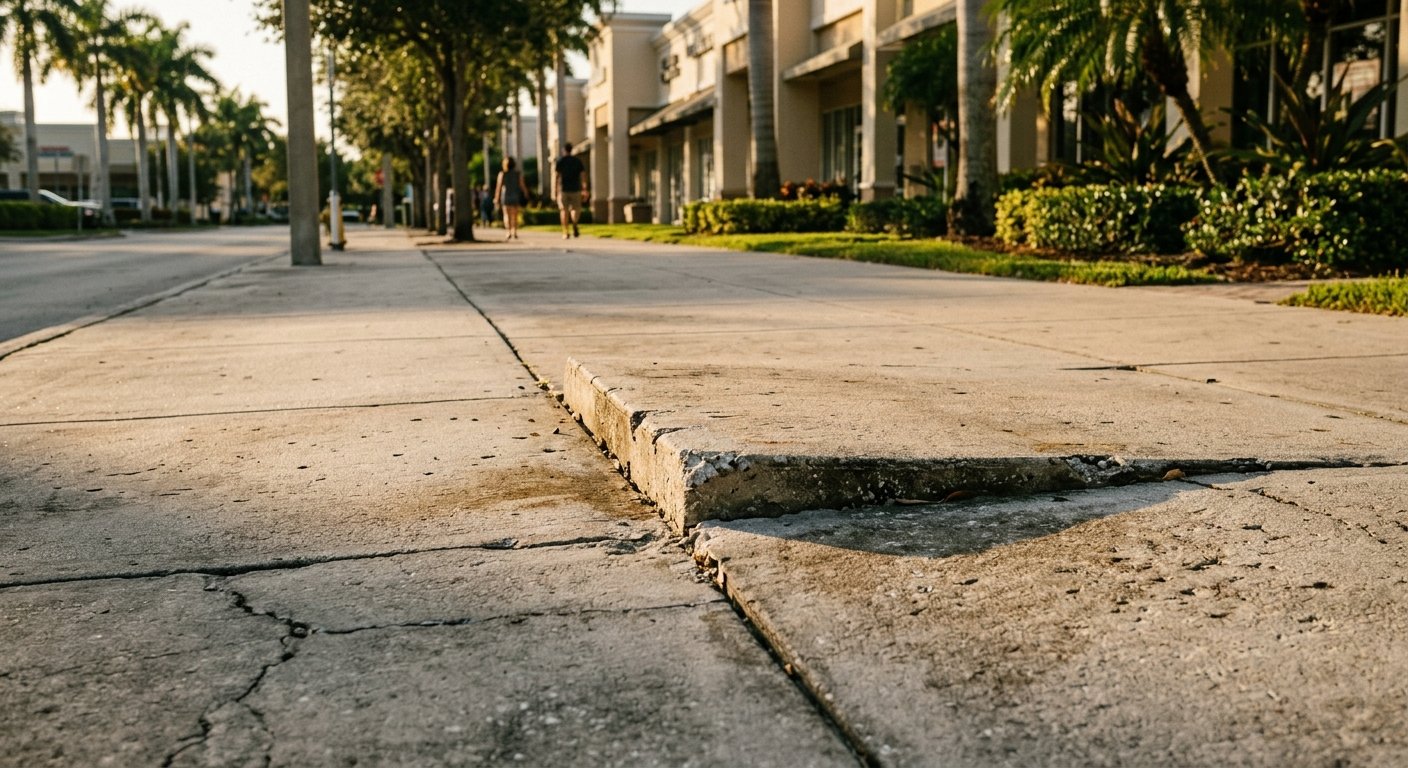
A single unlevel sidewalk panel is now one of the most expensive liabilities a property owner in South Florida can carry. In 2025 alone, ADA-related lawsuits against Florida municipalities and commercial property owners increased significantly, with many cases stemming directly from sidewalk defects that could have been repaired for a fraction of the eventual legal costs. If you manage property in Palm Beach County or Broward County, understanding what’s required in 2026—and what’s changed—isn’t optional. It’s essential risk management.
What ADA Sidewalk Compliance Actually Requires
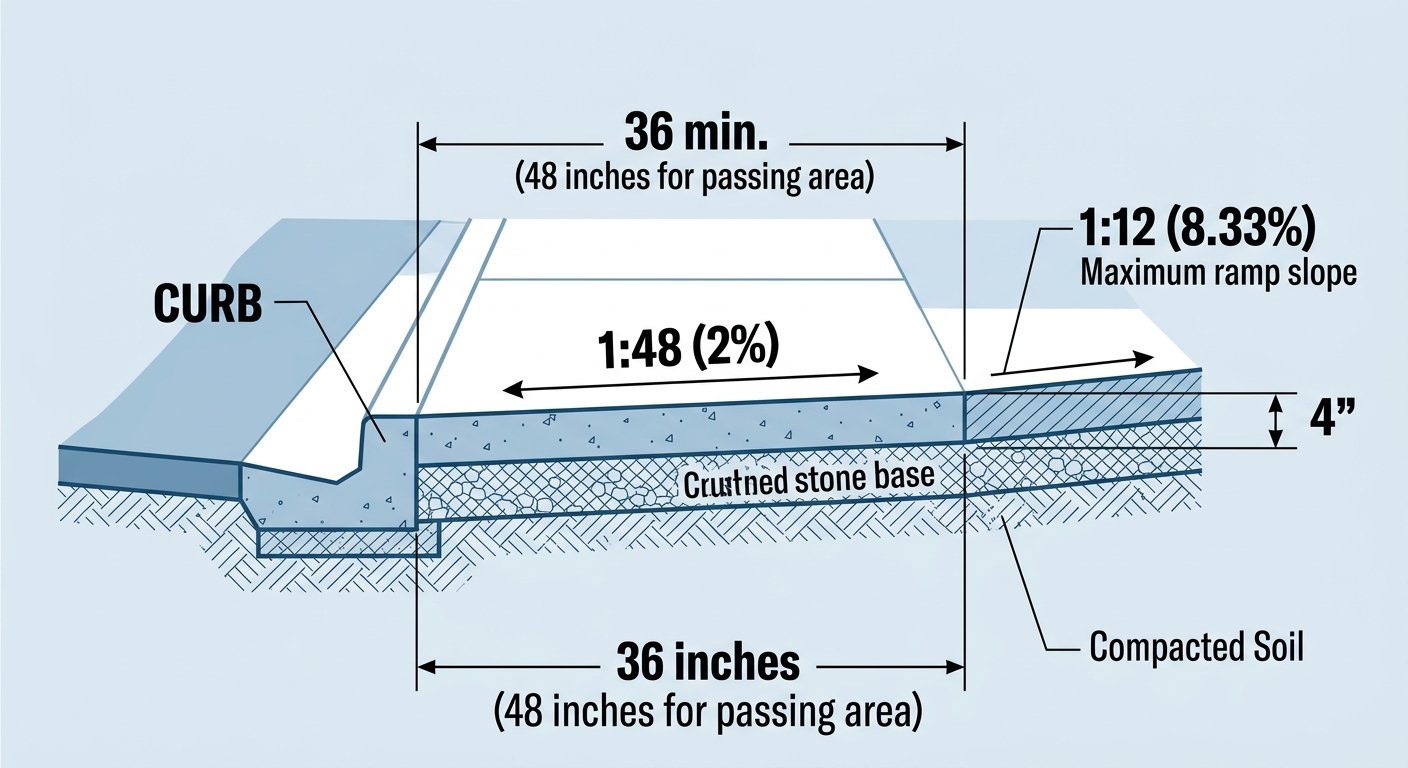
The Americans with Disabilities Act sets federal baseline requirements for accessible pedestrian routes. For sidewalks and walkways, the 2010 ADA Standards for Accessible Design remain the governing document, and they define several non-negotiable thresholds:
- Cross slope: No more than 1:48 (approximately 2%) perpendicular to the direction of travel
- Running slope: Generally no steeper than 1:20 (5%) along the path of travel
- Surface stability: Walkways must be firm, stable, and slip-resistant
- Vertical discontinuities: Changes in level exceeding ½ inch must be ramped; lips between ¼ and ½ inch must be beveled
- Clear width: Accessible routes must maintain a minimum 36-inch clear walking width
In practical terms, this means a concrete panel that has shifted even half an inch due to South Florida’s aggressive tree root growth or soil movement can place a property out of compliance—and directly into litigation territory.
What’s New for ADA Walkway Requirements in Florida in 2026
While the core ADA standards haven’t been overhauled, enforcement priorities and legal interpretations have shifted meaningfully heading into 2026. Florida municipalities, HOAs, and commercial property owners are seeing increased scrutiny in three key areas:
Proactive Inspection Requirements
Several Florida counties have strengthened their transition plan enforcement following federal guidance encouraging municipalities to conduct regular self-evaluations of pedestrian infrastructure. Property managers who lack documented inspection records are finding themselves in a weaker legal position when incidents occur, even if they claim ignorance of a defect.
Stricter Vertical Discontinuity Enforcement
The ½-inch threshold for trip hazards has always existed in ADA language, but local code enforcement in Palm Beach County and Broward County has become more aggressive about citing property owners for lips and rises that previously went unaddressed. If your sidewalks haven’t been professionally assessed recently, 2026 is the year to do it.
HOA and Private Property Accountability
A persistent misconception is that ADA compliance only applies to public sidewalks. In reality, any place of public accommodation—including HOA common areas, shopping centers, office parks, and mixed-use developments—falls under Title III of the ADA. This affects a significant percentage of properties throughout Palm Beach and Broward Counties.
The Real Cost of Non-Compliance
The financial exposure from non-compliant sidewalks is not theoretical. According to the U.S. Department of Labor’s Office of Disability Employment Policy, ADA violations in public accommodations can result in civil penalties up to $75,000 for a first violation and $150,000 for subsequent violations—before considering personal injury settlements.
Beyond federal penalties, a single slip-and-fall lawsuit in Florida can cost tens or hundreds of thousands of dollars in legal fees, settlements, and increased insurance premiums. The math is straightforward: proactive repair is dramatically cheaper than reactive litigation.
This is precisely where understanding your repair options matters. Learn more about the cost comparison between sidewalk repair vs. replacement and why most property managers are choosing the wrong approach.
Why Traditional Approaches Fall Short
When property managers discover sidewalk non-compliance, they typically consider two options: full concrete replacement or surface grinding. Both have significant drawbacks.
Full Concrete Replacement
Replacement involves demolishing the existing slab, hauling away debris, pouring new concrete, and waiting for it to cure. This process typically takes days or weeks, disrupts pedestrian access, generates substantial demolition waste, and costs significantly more than alternatives. For a property with multiple defective panels, the budget impact can be severe.
Surface Grinding
Grinding removes material from the raised section of concrete to eliminate the lip. While faster than replacement, grinding creates an uneven, rough texture that can itself become a trip hazard over time. It also removes the hardest, densest layer of the concrete surface, leaving the underlying material more vulnerable to weathering.
Precision Concrete Cutting: A Superior Alternative
Florida Sidewalk Solutions uses patented precision concrete cutting technology that addresses trip hazards by creating a clean, beveled cut that meets ADA specifications without demolition or material replacement. The result is a smooth, professional finish that satisfies both the visual and functional requirements of ADA compliance.
This approach costs 70–90% less than full replacement, requires no demolition waste disposal, and can often be completed in a single visit with minimal disruption to pedestrians or nearby businesses. For a detailed look at how this compares, visit our trip hazard repair page.
ADA Sidewalk Slope Requirements: A Closer Look
Slope non-compliance is among the most commonly overlooked issues because it isn’t always visible to the naked eye. A sidewalk can appear perfectly flat while actually exceeding ADA cross-slope tolerances.
Professional assessment using calibrated measuring tools is the only reliable way to identify slope violations. Key considerations include:
- Cross slope violations are particularly hazardous for wheelchair users, who must exert constant corrective force to stay on course
- Running slope violations often occur where sidewalks approach driveways, parking areas, or curb ramps
- Composite slope—the combination of cross and running slopes—must also remain within accessible limits
- Settled panels can introduce slope problems even in previously compliant sidewalks
For comprehensive guidance on ADA compliance standards specific to Florida properties, our ADA compliance resource page provides detailed information for property managers and municipalities.
Who Carries the Liability in South Florida?
Liability for sidewalk non-compliance in South Florida depends on the type of property and the applicable ordinances. General principles that apply across Palm Beach and Broward Counties include:
- Commercial property owners are generally responsible for sidewalks adjacent to and within their property
- HOAs typically carry responsibility for common area walkways and paths
- Municipalities are responsible for public sidewalks but may have ordinances that shift responsibility to adjacent property owners for maintenance
- Facilities managers at schools, government buildings, and healthcare facilities face heightened scrutiny given the vulnerable populations they serve
Documenting your inspections and repair history is critical regardless of property type. If an incident occurs, demonstrating a consistent maintenance program provides meaningful legal protection.
Frequently Asked Questions
What is the ADA trip hazard threshold for sidewalks?
The ADA considers a vertical change in level greater than ½ inch to be a non-compliant trip hazard. Changes between ¼ and ½ inch must be beveled at a 1:2 slope. Any rise under ¼ inch is generally considered acceptable. However, even lips under the ADA threshold can create liability exposure under Florida premises liability law if they contribute to a fall.
Does ADA compliance apply to private property and HOAs in South Florida?
Yes. Title III of the ADA applies to places of public accommodation, which includes many private properties such as shopping centers, office buildings, restaurants, and recreational facilities. HOA common areas that are open to the public or serve residents with disabilities are also subject to ADA requirements. Private single-family homes are generally exempt.
How do I know if my sidewalk slopes violate ADA standards?
Visual inspection is unreliable for slope assessment. A professional evaluation using calibrated digital levels is required to accurately measure cross slope and running slope. Florida Sidewalk Solutions provides assessments for properties in Palm Beach and Broward Counties, identifying specific panels or sections that fall outside ADA tolerances.
Is concrete cutting a permanent solution to ADA trip hazard violations?
Precision concrete cutting provides a durable repair that eliminates the specific vertical discontinuity causing non-compliance. Like all sidewalk repairs, long-term performance depends on factors including soil stability, tree root activity, and ongoing maintenance. A professional assessment can identify whether the underlying cause of displacement needs to be addressed alongside the surface repair.
How quickly can ADA sidewalk repairs be completed?
Most individual trip hazard repairs using precision concrete cutting can be completed within a few hours per location. Large-scale property assessments and multi-panel repair programs can typically be scheduled and completed within days, not weeks, making this method significantly faster than full replacement and far less disruptive to property operations.
Take Action Before a Problem Becomes a Lawsuit
The gap between a compliant sidewalk and a liability claim is often measured in fractions of an inch. With enforcement tightening across Palm Beach and Broward Counties in 2026, waiting for a formal citation—or worse, an injury—is a risk no property manager should accept.
Florida Sidewalk Solutions brings over 20 years of Florida-specific sidewalk safety experience to every assessment and repair project. Our licensed and insured team uses patented precision concrete cutting technology to deliver ADA-compliant results that are 70–90% less expensive than replacement, with no demolition, no extended closures, and a professional finish that reflects well on your property.
Contact Florida Sidewalk Solutions today to schedule your sidewalk compliance assessment. Serving Palm Beach County and Broward County, we’re ready to help you get compliant, stay protected, and keep your pedestrian infrastructure safe for everyone who uses it.