
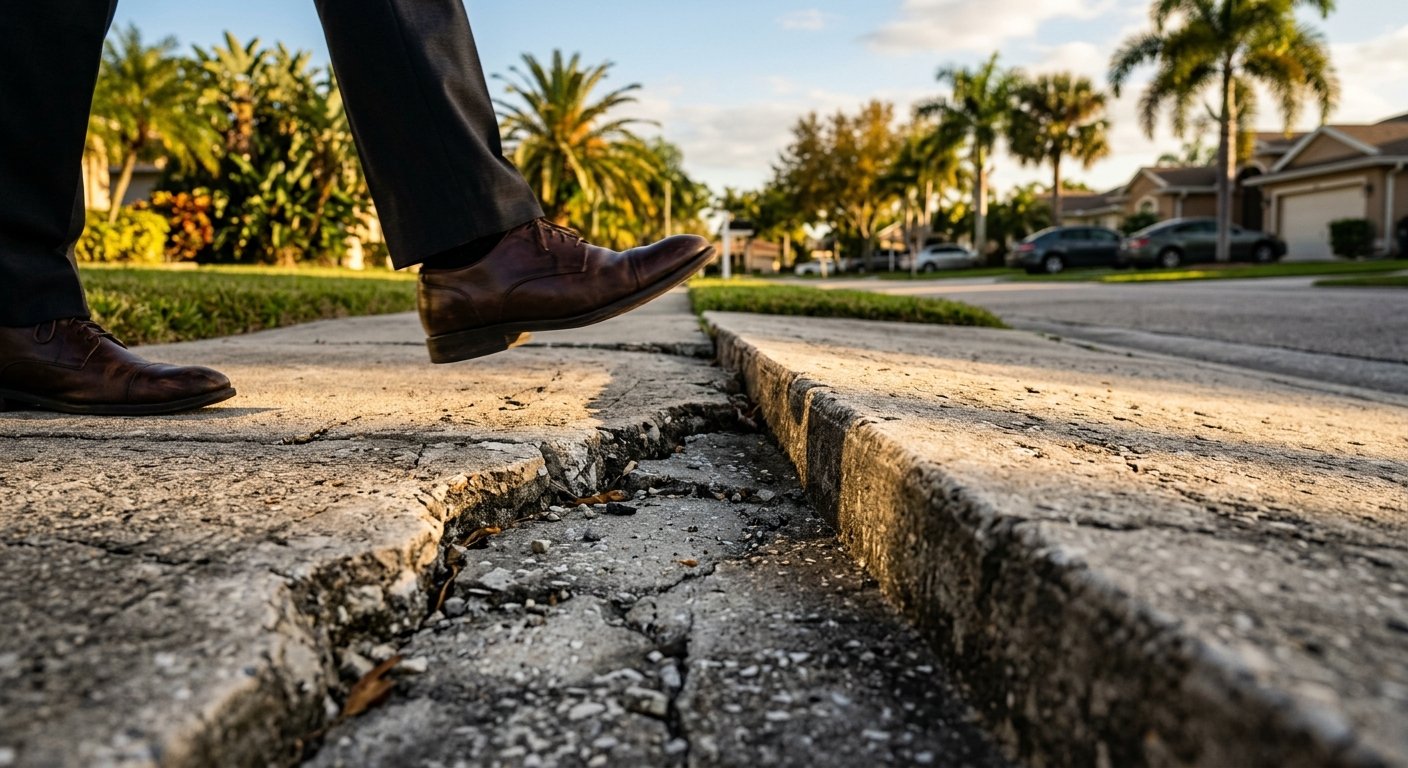
For property managers and HOA boards in Palm Beach County and Broward County, every month a non-compliant sidewalk goes unaddressed increases financial exposure. A single trip-and-fall lawsuit can cost far more than the repair that would have prevented it — yet proactive repair using precision concrete cutting typically costs 70 to 90% less than full panel replacement.
- Any vertical rise greater than ¼ inch between concrete panels is a trip hazard under the ADA; ¼–½ inch must be beveled, and anything over ½ inch requires full correction.
- Precision concrete cutting resolves most hazards at 70–90% less cost than full concrete replacement.
- ADA complaints can be filed by anyone who encounters a barrier, whether or not they were injured.
- Documented inspections and timely repairs are the strongest legal defenses available to HOAs and property owners.
Understanding why delay is so expensive — and what ADA sidewalk compliance actually requires in Florida — is the first step toward making a smart, defensible decision for your property.
What ADA Sidewalk Requirements Actually Mean for Florida Properties
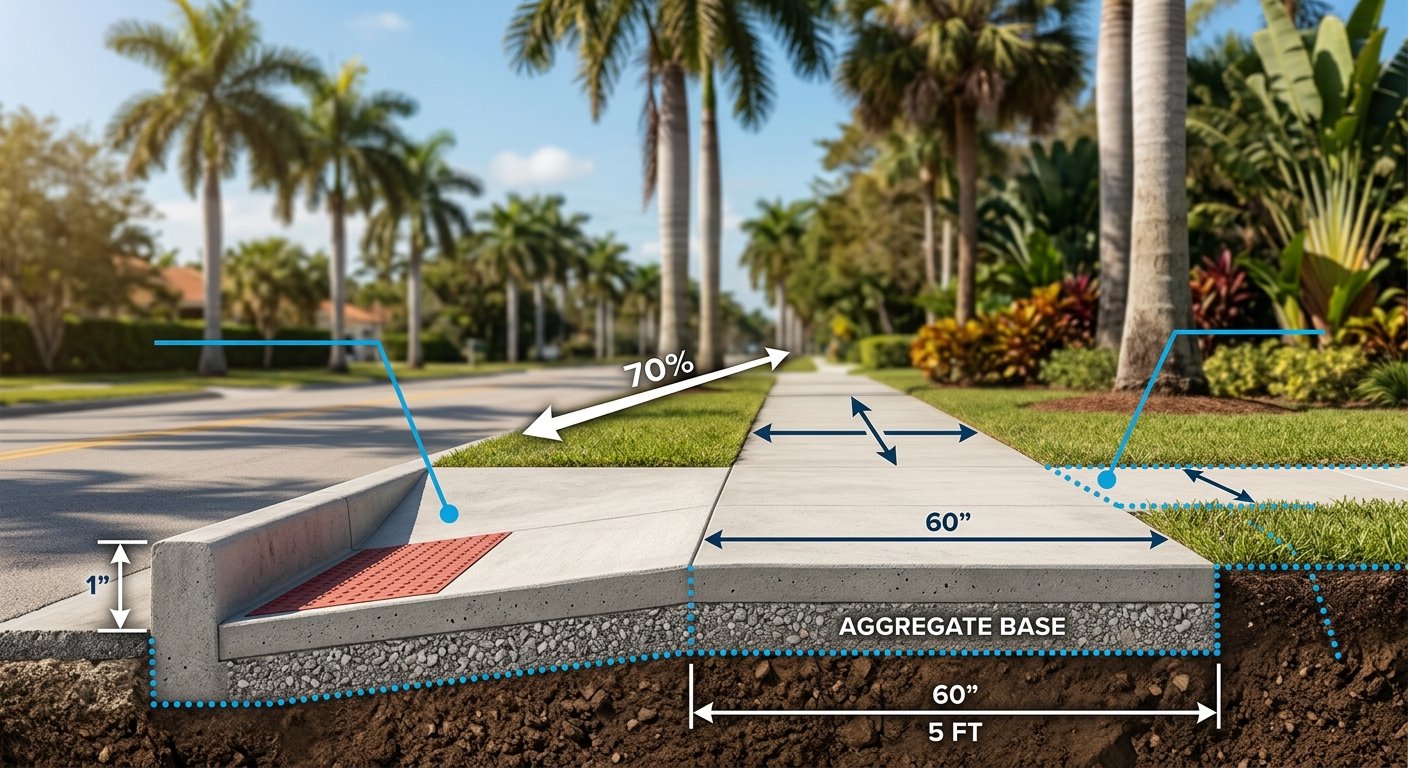
The Americans with Disabilities Act sets federal accessibility standards that apply to public accommodations, commercial facilities, and local government properties. Under the ADA Title II and Title III regulations, sidewalks must provide a continuous accessible route free of barriers, abrupt changes in level, and surface irregularities.
Specifically, the standards that matter most in sidewalk maintenance include:
- Vertical level changes: Any vertical rise greater than ¼ inch between adjoining concrete panels is considered a trip hazard under the ADA (¼–½ inch must be beveled at 1:2; anything over ½ inch requires full correction)
- Surface slope: Cross-slopes must not exceed 2% (1:50 ratio) along accessible routes
- Surface stability: Walking surfaces must be stable, firm, and slip-resistant
- Clear pathway width: Accessible routes require a minimum 36-inch clear width, though 60 inches is preferred
For HOAs, commercial property owners, and municipalities in South Florida, these aren’t optional guidelines — they carry legal weight. Non-compliant sidewalks expose properties to both ADA enforcement actions and personal injury liability. Understanding the full scope of ADA sidewalk compliance in South Florida is essential before deciding to delay repairs.
The Hidden Financial Costs of Non-Compliance

Litigation Exposure Compounds Over Time
Florida’s legal environment is notably plaintiff-friendly when it comes to premises liability. Property owners have a duty to maintain safe conditions for visitors, tenants, and the public. When a trip and fall occurs on a documented hazard — especially one that has been reported or inspected previously — that documentation can become evidence of negligence.
Legal defense costs add up even when a case is ultimately dismissed or settled favorably — and any settlement or verdict comes on top of that.
Delay transforms a correctable maintenance issue into documented negligence.
What makes delay particularly costly is that it transforms a correctable maintenance issue into documented negligence. If a hazard was identified in a property inspection, flagged by a resident, or noted in board meeting minutes — and no action was taken — that paper trail significantly strengthens a plaintiff’s case.
Learn more about the specific legal dynamics affecting property owners in our detailed overview of Florida sidewalk liability and lawsuits.
Insurance Premiums and Policy Complications
Property insurers are increasingly scrutinizing sidewalk conditions during renewals and audits. Unaddressed ADA violations and known trip hazards can affect coverage terms, trigger policy exclusions for known hazards, or prompt premium increases. Some insurers are declining to renew policies for properties with documented deferred maintenance on pedestrian pathways.
For HOA boards, failing to act on known sidewalk deficiencies may not only expose the association to lawsuit liability — it could also leave the association underinsured when a claim occurs, because some insurers are now excluding known hazards from coverage entirely.
ADA Enforcement Actions and Complaint Investigations
ADA complaints can be filed directly with the U.S. Department of Justice or through private litigation. Unlike a personal injury lawsuit that requires an injured plaintiff, ADA accessibility complaints can come from any individual who encounters a barrier — whether or not they were injured. Municipalities, HOAs, and commercial properties alike can face investigation, required remediation plans, and potential civil penalties for willful non-compliance.
Why Sidewalk Replacement Isn’t the Only — or Best — Answer
A common assumption among property managers and facilities directors is that addressing ADA sidewalk deficiencies means tearing out and replacing concrete panels. This assumption is both expensive and unnecessary in the majority of cases.
Full concrete replacement is the more expensive route. It also involves demolition, disposal of concrete debris, an extended timeline that closes portions of the property to pedestrian traffic, and a curing period before the surface can be used again.
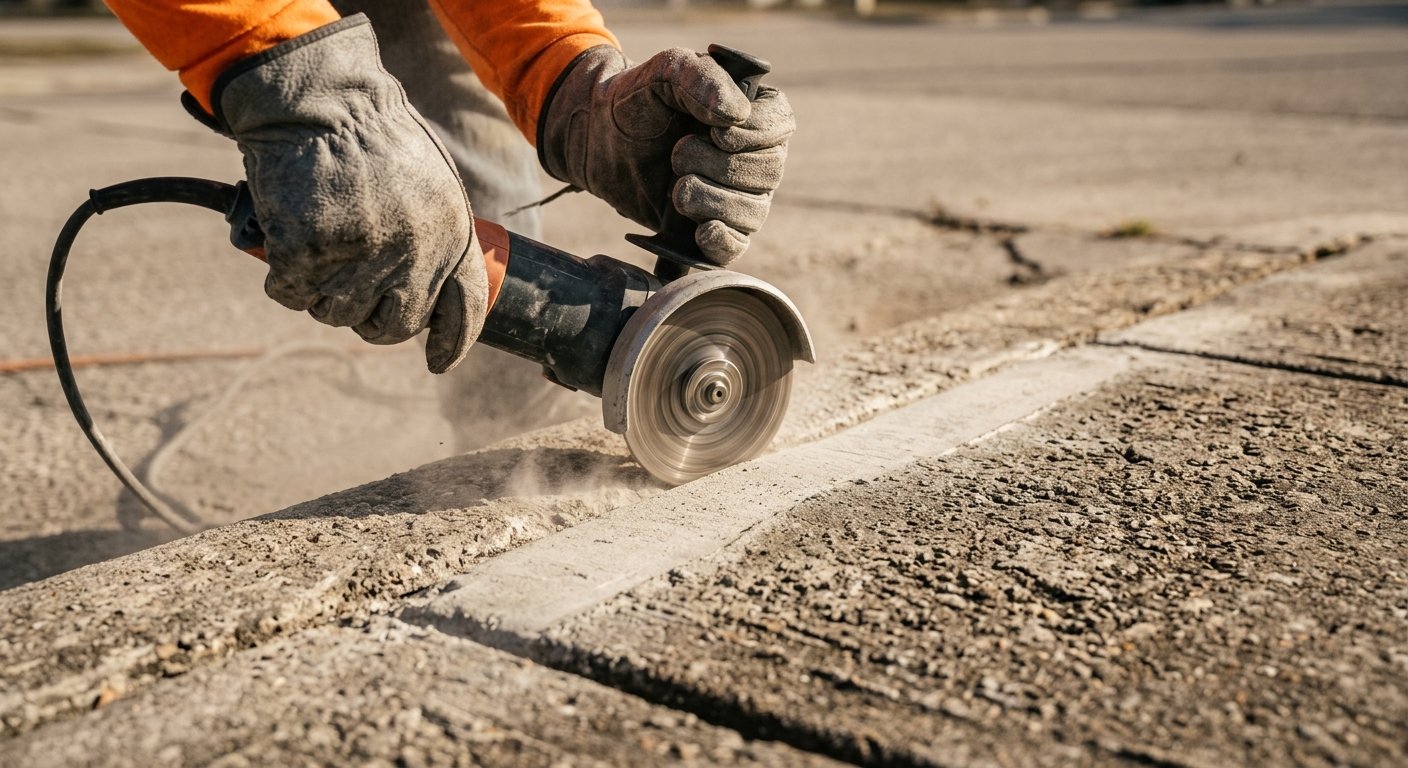
There is a better approach for the vast majority of trip hazards: precision concrete cutting. Florida Sidewalk Solutions uses patented concrete cutting technology that removes the raised edge or surface irregularity without breaking up or replacing the existing slab. The result is an ADA-compliant, smooth transition between panels — at a cost that is typically 70 to 90% less than full replacement.
The comparison matters enormously when you’re managing a large property with dozens or hundreds of flagged hazards. For HOA sidewalk liability in Florida, that cost difference is the difference between a proactive, budget-friendly compliance program and a deferred maintenance crisis. For a deeper look at the repair options available, see our guide to sidewalk trip hazard repair in Florida.
Cutting vs. Grinding: Understanding the Difference
| Criterion | Concrete Grinding | Precision Concrete Cutting |
|---|---|---|
| ADA surface compliance | May not meet standards for stability and slip resistance | Meets ADA specifications for vertical transitions and surface texture |
| Finish quality | Rough, beveled — can look unfinished | Clean, tapered, smooth and professional |
| Slab integrity | Can weaken the slab edge | Removes only what is necessary |
| Equipment required | Standard grinding tools | Patented specialized equipment, trained technicians |
Precision concrete cutting creates a clean, tapered reduction that meets ADA specifications for vertical transitions and surface texture. Because the technology is patented and requires specialized equipment operated by trained technicians, not every contractor can offer it — but for properties in Palm Beach County and Broward County, Florida Sidewalk Solutions has delivered this solution over the last 20 years.
Who Bears the Risk: HOAs, Municipalities, and Commercial Owners
The answer depends on property configuration, but generally:
- HOAs are responsible for sidewalks within common areas and, in many communities, the full right-of-way adjacent to units. HOA sidewalk liability in Florida is a growing area of litigation as communities age and concrete settles.
- Municipalities are responsible for public rights-of-way but may shift liability to adjacent property owners under local ordinance — making it critical for both parties to understand their obligations.
- Commercial property owners face ADA Title III obligations for any facility open to the public, including the walkways and parking lot pathways that lead to their buildings.
- Schools and universities must maintain accessible routes throughout their campuses under both ADA and Section 504 of the Rehabilitation Act.
In each case, the legal standard is essentially the same: known hazards that go unaddressed create liability. Documented compliance efforts — including regular inspections and timely repairs — reduce exposure substantially.
The Right Time to Act Is Before a Claim Is Filed
There is a clear pattern in how sidewalk liability cases develop. A deficiency is identified — through a resident complaint, a routine inspection, or an internal audit. The property manager or board acknowledges the issue, often with the intention of addressing it in the next budget cycle. Months pass. Then a fall occurs, and the acknowledgment of the issue becomes evidence that the hazard was known and ignored.
Acting before a claim is filed is the most cost-effective risk management strategy available. The cost of a proactive repair program is predictable. The cost of litigation, settlements, and premium increases is not.
Florida Sidewalk Solutions works with property managers, HOA boards, and municipal public works departments across Palm Beach County and Broward County to conduct thorough sidewalk assessments, document existing conditions, and prioritize repairs based on severity of hazard and compliance urgency. As a licensed, insured contractor with 20 years of experience in Florida, we deliver repairs efficiently — with minimal disruption to residents, tenants, and the public.
Frequently Asked Questions
What qualifies as an ADA violation on a sidewalk in Florida?
Any vertical level change greater than ¼ inch between concrete panels (over ½ inch requires full correction), cross-slopes exceeding 2%, surfaces that are unstable or cracked, or pathways narrower than 36 inches can constitute ADA violations on a sidewalk. These standards apply to commercial properties, HOA common areas, and public rights-of-way throughout Florida.
Is sidewalk repair always cheaper than replacement?
In the vast majority of cases, yes — particularly when the issue is a raised panel edge or localized surface defect. Precision concrete cutting resolves these conditions at 70 to 90% less cost than full panel replacement. Replacement becomes necessary only when a slab is severely cracked, structurally undermined, or beyond the point where surface correction is viable.
Can an HOA be sued for a trip and fall on a community sidewalk?
Yes. HOAs in Florida have a legal duty to maintain common area sidewalks in a reasonably safe condition. If a resident or visitor sustains an injury on a known hazard that was not repaired, the association can face premises liability claims. Documented inspection records and timely repair programs are the strongest defenses available.
How long does sidewalk trip hazard repair take?
Precision concrete cutting repairs are typically completed within hours per location, and the surface is immediately accessible — there is no curing period as with poured concrete replacement. Large-scale repair programs across multi-building communities can often be completed in a single day or over a short scheduled period with minimal disruption.
Does concrete cutting meet ADA specifications?
Yes. When performed using patented precision cutting technology, the resulting surface transition meets ADA standards for vertical level changes and surface stability. Florida Sidewalk Solutions documents repairs to support compliance records for property managers, municipalities, and HOA boards.
Schedule Your No-Obligation Sidewalk Assessment
Get a clear picture of your property’s compliance status — before a problem becomes a claim.

About Florida Sidewalk Solutions
Florida Sidewalk Solutions specializes in sidewalk safety, ADA compliance, and trip hazard prevention for Florida property managers, municipalities, and commercial property owners. Using patented concrete cutting technology, they deliver cost-effective repairs that are 70-90% less expensive than replacement, with minimal disruption and no demolition waste. With 20 years of experience in Florida, they provide the expert solution for eliminating liability risks while meeting ADA standards and legal requirements. Visit floridasidewalksolutions.com →