
Florida property owners face mounting pressure in 2026 as trip hazard insurance claims continue to escalate, with average settlement costs now exceeding $45,000 per incident. The convergence of stricter ADA enforcement, heightened liability awareness, and insurance companies scrutinizing sidewalk maintenance records has created a perfect storm of financial risk for unprepared property managers and HOAs.
Understanding the landscape of sidewalk trip hazard liability in Florida is no longer optional—it’s essential for protecting your property, your budget, and your organization from devastating legal consequences.
The Rising Cost of Trip Hazard Insurance Claims
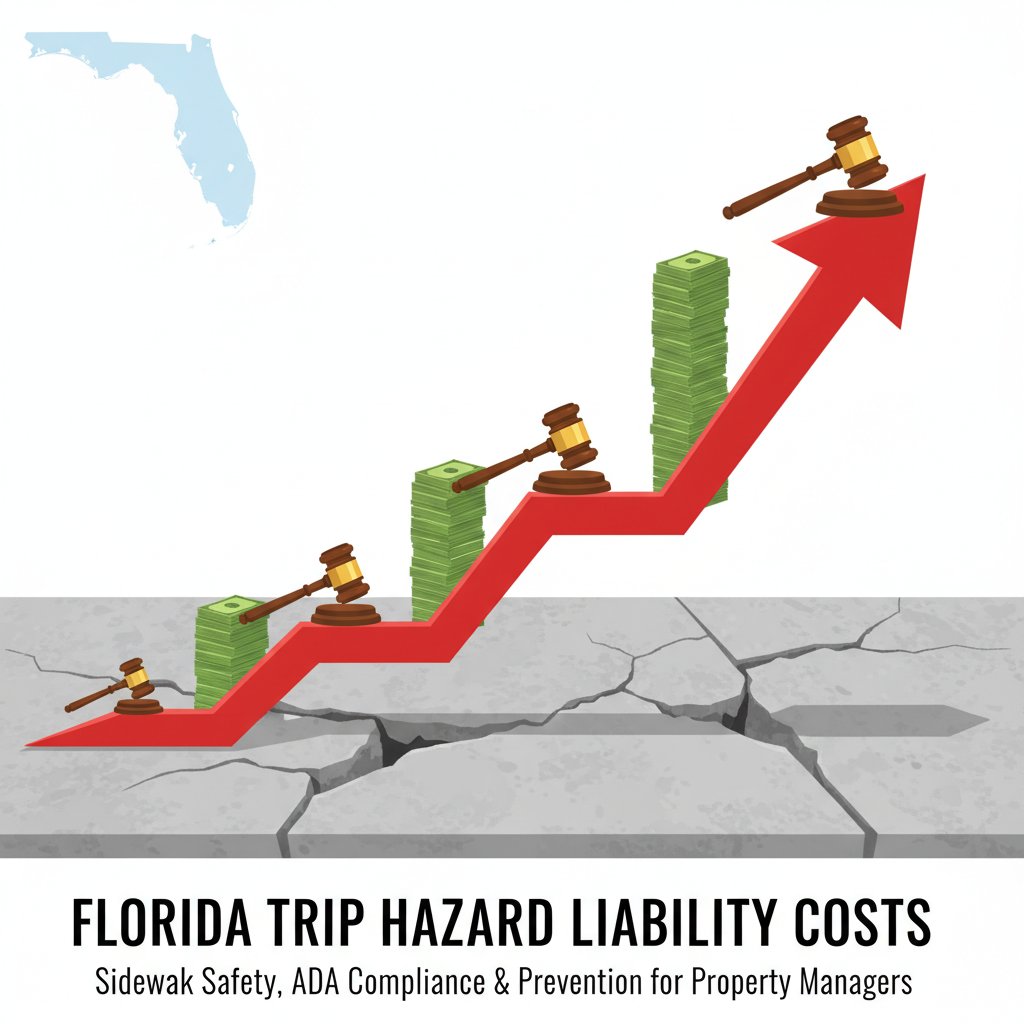
Trip and fall lawsuits represent one of the fastest-growing liability exposures for Florida property owners. Recent data from Florida’s court systems shows premises liability cases involving sidewalk defects increased 34% between 2023 and 2025, with no signs of slowing.
The financial impact extends far beyond settlement amounts. Property owners facing trip hazard insurance claims typically encounter:
- Legal defense costs averaging $15,000-$30,000 even when claims are dismissed
- Insurance premium increases of 25-60% following a single claim
- Policy non-renewals forcing expensive specialty coverage
- Loss of coverage for sidewalk-related incidents after repeat claims
- Personal liability exposure when coverage limits are exceeded
For HOAs and commercial property owners, a single unaddressed trip hazard can transform into a six-figure financial disaster within months.
Property Owner Sidewalk Liability Under Florida Law
Florida premises liability law places clear responsibility on property owners to maintain safe walking surfaces. The legal standard requires property owners to address known hazards or hazards they “should have known about” through reasonable inspection practices.
This “constructive knowledge” standard creates significant risk. Courts have consistently ruled that property owners cannot claim ignorance when sidewalk defects are visible during routine inspections. If a trip hazard exists and a reasonable inspection would have discovered it, property owners bear liability regardless of whether they actually knew about the specific defect.
What Constitutes a Legally Actionable Trip Hazard?
Florida courts generally consider vertical displacements of 1/4 inch or greater as potentially dangerous conditions. However, ADA standards set an even stricter threshold of 1/2 inch for public accommodations and commercial facilities. Property owners should understand that:
- Vertical height differences of 1/4 inch can support negligence claims
- ADA violations occur at 1/2 inch vertical displacement
- Environmental factors (weather, lighting, traffic patterns) influence liability determinations
- Documentation of inspection and maintenance programs provides crucial defense evidence
The gap between these thresholds creates confusion, but prudent property managers use the more conservative 1/4 inch standard for proactive maintenance decisions.
HOA Sidewalk Liability: Special Considerations in Florida
Homeowner associations face unique challenges regarding sidewalk trip hazard liability in Florida. Unlike commercial property owners with dedicated facilities staff, HOAs often rely on volunteer boards managing complex liability exposures with limited expertise.
HOA sidewalk liability extends to all common areas and often includes sidewalks along community streets even when the association doesn’t own the underlying land. Florida statutes governing HOAs create affirmative duties to maintain safe conditions throughout the community.
Board Member Personal Liability Concerns
HOA board members increasingly worry about personal exposure when trip and fall incidents occur. While HOA governing documents and Florida law typically provide some protection, board members can face personal liability when:
- The board ignored documented hazards or resident complaints
- Maintenance decisions were arbitrary or unreasonable
- The association failed to maintain adequate insurance coverage
- Board actions demonstrated gross negligence or willful misconduct
Establishing documented inspection protocols and responding promptly to identified hazards provides essential protection for both the association and individual board members.
Trip and Fall Lawsuit Prevention Strategies
Preventing trip hazard insurance claims requires systematic approaches rather than reactive responses. Property owners who successfully minimize liability exposure implement comprehensive programs addressing inspection, documentation, and remediation.
Regular Inspection Protocols
Documented inspection programs form the foundation of any effective trip and fall lawsuit prevention strategy. Courts view regular inspections favorably, often reducing liability even when hazards exist, because they demonstrate reasonable care.
Effective inspection programs include:
- Quarterly comprehensive sidewalk assessments by trained personnel
- Written documentation with dates, locations, and conditions observed
- Photographic evidence of identified hazards
- Priority ranking systems for remediation scheduling
- Follow-up verification after repairs are completed
Digital inspection tools and mapping software now enable property managers to create defensible documentation systems that insurance companies and courts recognize as evidence of reasonable care.
Immediate Response to Known Hazards
Once a trip hazard is identified—whether through inspection, resident complaint, or incident report—the clock starts ticking on legal liability. Property owners must take prompt action to either remedy the hazard or implement temporary protective measures.
Temporary measures might include warning signs, caution tape, or barricades, but these provide only short-term protection. Courts view extended reliance on warnings rather than actual repairs as evidence of negligence. Permanent solutions must be implemented within reasonable timeframes, typically 30-60 days depending on hazard severity.
The Insurance Company Perspective on Sidewalk Maintenance
Insurance carriers have become increasingly sophisticated in evaluating sidewalk trip hazard liability risks. Underwriters now routinely request maintenance records, inspection logs, and remediation documentation during policy renewals.
Properties with documented maintenance programs receive preferential rates, while those lacking systematic approaches face:
- Higher premiums reflecting elevated risk profiles
- Coverage exclusions for sidewalk-related claims
- Mandatory risk improvement requirements as conditions of coverage
- Policy non-renewals forcing placement in high-risk markets
Forward-thinking property managers recognize that investing in proactive sidewalk maintenance directly reduces insurance costs while protecting against claim exposure.
Cost-Effective Solutions for Florida Properties
Traditional sidewalk replacement creates budget-breaking expenses that delay necessary repairs, leaving properties exposed to ongoing liability. Replacement costs typically range from $8-$15 per square foot, making comprehensive sidewalk rehabilitation financially impossible for many Florida properties.
Advanced concrete cutting technology offers a superior alternative, addressing trip hazards at 70-90% less cost than replacement. This patented process precisely removes the raised portion of displaced concrete panels, eliminating vertical height differences while preserving the structural integrity of existing sidewalks.
Why Cutting Outperforms Grinding
Property owners evaluating remediation options often compare cutting versus grinding methods. While both address vertical displacements, cutting delivers superior results:
- Clean, finished appearance matching surrounding concrete profiles
- Complete hazard elimination rather than partial reduction
- No rough, ground-down surfaces that accelerate deterioration
- Minimal noise and dust during application
- Faster completion enabling same-day traffic restoration
The precision cutting approach has proven effective across thousands of Florida properties over two decades, establishing a track record that grinding cannot match.
ADA Compliance and Federal Liability
Property owners with public accommodations or commercial facilities face additional liability under the Americans with Disabilities Act. ADA violations create federal causes of action separate from state premises liability claims, multiplying legal exposure.
ADA standards require walking surfaces to maintain vertical height differences no greater than 1/2 inch. Properties that fail to meet this standard face:
- Department of Justice enforcement actions
- Private lawsuits from individuals with disabilities
- Mandatory remediation orders with compliance deadlines
- Attorney’s fees for prevailing plaintiffs
- Ongoing monitoring requirements
Unlike premises liability claims requiring proof of injury, ADA violations exist simply when non-compliant conditions are present. This creates liability exposure even without actual incidents.
Documentation That Protects Your Property
When trip hazard insurance claims arise, documentation determines outcomes. Property owners who maintain comprehensive records successfully defend claims or achieve favorable settlements, while those lacking documentation face presumptions of negligence.
Essential documentation includes:
- Inspection reports with dates and inspector identification
- Photographs of conditions before and after remediation
- Work orders and completion certificates from contractors
- Resident complaint logs with response documentation
- Budget allocations demonstrating commitment to maintenance
- Board meeting minutes showing safety discussions and decisions
Digital documentation systems enable property managers to quickly produce evidence demonstrating reasonable care when claims arise.
Taking Action in 2026
Florida property owners cannot afford to delay sidewalk safety assessments. With insurance companies tightening underwriting standards and plaintiffs’ attorneys aggressively pursuing premises liability cases, the window for proactive remediation is closing.
Properties that address trip hazards now benefit from reduced insurance costs, eliminated liability exposure, and ADA compliance—all while avoiding the escalating expenses of emergency repairs after incidents occur.
Protect Your Property with Proven Solutions
Florida Sidewalk Solutions has protected Florida properties from trip hazard insurance claims for over 20 years using patented Precision Concrete Cutting technology. Our process eliminates sidewalk trip hazards at a fraction of replacement cost while providing the professional finish and complete hazard removal that property owners require.
Don’t wait for a lawsuit to force action. Schedule a comprehensive sidewalk assessment today and discover how cost-effective professional remediation protects your property, your budget, and your peace of mind. Contact Florida Sidewalk Solutions for a free evaluation and detailed proposal showing exactly how we’ll eliminate your trip hazard liability exposure.