

A single 1-inch height difference in a concrete sidewalk meets the legal definition of a trip hazard in Florida. When property managers discover these issues, they face a critical financial decision: repair or replace? The cost difference is staggering. Traditional sidewalk replacement averages $8-15 per square foot in South Florida, while precision concrete cutting repairs typically cost $3-5 per square foot—representing savings of 70-90% on most projects.
Understanding these cost differences isn’t just about saving money. It’s about making informed decisions that protect your property investment, eliminate liability exposure, and ensure ADA compliance without draining capital improvement budgets.
The True Cost of Sidewalk Replacement in Florida
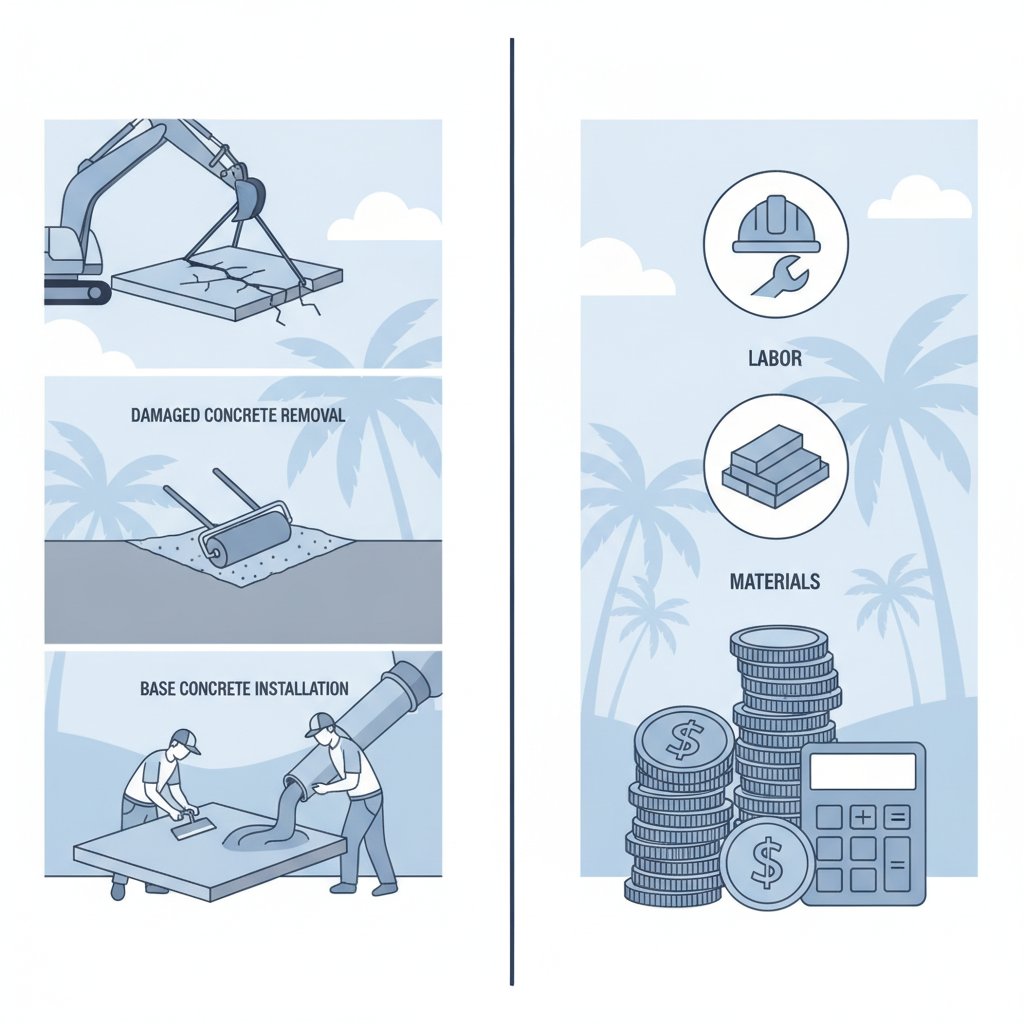
Sidewalk replacement involves complete removal of damaged sections, proper base preparation, new concrete installation, and finishing work. In Palm Beach County and Broward County, several factors drive replacement costs higher than national averages:
- Labor and materials: Current concrete prices and skilled labor rates in South Florida add 15-25% to project costs compared to other regions
- Demolition and disposal: Removing and hauling old concrete typically adds $2-4 per square foot to project totals
- Curing time: New concrete requires 7-14 days before pedestrian traffic, creating extended disruption and potential liability during closure periods
- Property damage: Heavy equipment often damages landscaping, irrigation systems, and adjacent pavers, adding unplanned restoration expenses
- Permit requirements: Municipal permits for replacement projects can cost $200-800 depending on scope and jurisdiction
For a typical 100-square-foot section of raised sidewalk, property owners face replacement costs between $800-1,500, plus indirect costs from business disruption, temporary access accommodations, and potential ADA violation citations during the extended repair period.
How Sidewalk Repair Technology Reduces Costs
Precision concrete cutting technology addresses trip hazards by removing the raised portion of concrete slabs rather than replacing entire sections. This targeted approach solves the safety problem while preserving the existing structural integrity of the sidewalk.
The process uses specialized diamond-blade equipment to cut vertically through raised concrete sections, removing only the elevated portion that creates the hazard. The result is a smooth, level transition that meets ADA standards requiring no more than 1/2 inch vertical displacement.
Cost advantages become immediately apparent:
- Material elimination: No new concrete purchases required
- Zero demolition waste: Minimal material removal means significantly lower disposal fees
- Same-day completion: Most projects finish within hours, not weeks
- Immediate use: Sidewalks are accessible to pedestrians as soon as cutting is complete
- No collateral damage: Precision equipment leaves surrounding landscape and hardscape intact
That same 100-square-foot raised section costs $300-500 to repair using concrete cutting technology—a difference of $500-1,000 per section compared to replacement.
When Repair Makes Financial Sense
Not every sidewalk issue qualifies as a repair candidate, but the majority of trip hazards in Florida result from soil settlement, tree root pressure, or erosion—conditions where the concrete itself remains structurally sound.
Repair delivers optimal return on investment when:
- Concrete shows no significant cracking, crumbling, or structural failure
- The primary issue is vertical displacement between adjacent slabs
- Settlement has stabilized and underlying causes have been addressed
- Multiple trip hazards exist across a property, making replacement costs prohibitive
- Budget constraints require prioritizing safety improvements across larger areas
Property managers often discover they can address three to four times as many trip hazards with repair compared to replacement for the same budget allocation. This expanded coverage dramatically reduces overall premises liability exposure.
When Replacement Becomes Necessary
Certain conditions require complete sidewalk replacement despite the higher costs. Severely deteriorated concrete with extensive cracking, spalling, or crumbling throughout the slab thickness cannot be effectively repaired through cutting methods.
Replacement becomes the appropriate choice when:
- Concrete has reached the end of its service life with widespread structural failure
- Thickness is insufficient to meet current load-bearing requirements
- The base layer has failed, causing ongoing settlement issues
- Width does not meet current ADA requirements for accessible routes
- Property improvement plans include comprehensive hardscape renovation
Even in replacement scenarios, strategic planning matters. Combining necessary replacement sections with precision cutting repairs on viable sections optimizes budget allocation and maximizes safety improvements per dollar spent.
The Florida Liability Cost Factor
Financial analysis of repair versus replacement must include liability considerations specific to Florida premises liability law. Property owners who know about trip hazards—or should reasonably have known—face significant legal exposure when injuries occur.
According to the Florida Statutes on premises liability, demonstrable knowledge of dangerous conditions creates duty to remedy or warn. Trip hazard injuries generate average settlement costs between $25,000-150,000 when they proceed beyond initial insurance claims.
The financial equation changes dramatically when liability risk enters the calculation:
Scenario comparison: A property manager identifies 15 trip hazards during an inspection. Replacement cost: $12,000-22,500. Repair cost: $4,500-7,500. However, deferring action for 6-12 months while budgeting for replacement exposes the property to potential injury claims that dwarf either repair option.
Speed to resolution becomes a hidden cost advantage of repair methods. Completing all hazard corrections within days rather than phasing replacement projects over months or years substantially reduces the liability exposure window.
Long-Term Performance and Maintenance Costs
Property managers rightfully question whether lower upfront repair costs translate into higher long-term maintenance expenses. Two decades of performance data from precision cutting repairs in Florida conditions provide clear answers.
Properly executed concrete cutting repairs perform for 10-15+ years when underlying settlement causes have been addressed. This longevity matches or exceeds new concrete installations in comparable conditions, since the existing concrete has already weathered initial curing stresses and dimensional changes.
New replacement concrete faces unique challenges in South Florida:
- Curing in high heat and humidity increases cracking risk during the first year
- Color matching with adjacent older sections rarely succeeds, creating aesthetic concerns
- Fresh concrete joints represent new points for future settlement and displacement
- Initial settlement of new sections often occurs within 2-5 years as base materials compact
The maintenance cost advantage of repair becomes particularly pronounced when soil conditions remain stable. Since repair preserves the existing concrete that has already completed its settling process, future displacement risk often decreases compared to new installations on the same soil conditions.
Environmental and Operational Considerations
Beyond direct financial comparisons, repair technology delivers value through reduced environmental impact and operational advantages that translate into indirect cost savings.
Concrete production generates significant CO2 emissions—approximately 900 pounds of carbon dioxide per ton of concrete produced. Avoiding unnecessary replacement reduces environmental footprint while supporting corporate sustainability initiatives increasingly important to HOAs and commercial property managers.
Operational benefits include:
- No pedestrian closure requirements: Work proceeds with minimal disruption to daily activities
- Reduced equipment footprint: Smaller machinery means less landscape protection and restoration work
- Quiet operation: Precision cutting generates significantly less noise than demolition and concrete pouring
- Weather flexibility: Repairs can proceed in conditions that would delay concrete curing
- Immediate compliance: Properties meet ADA standards within hours rather than weeks
For schools, healthcare facilities, retail centers, and residential communities, these operational advantages prevent revenue loss, maintain property access, and preserve resident satisfaction—benefits that carry real economic value beyond simple cost-per-square-foot calculations.
Making the Right Decision for Your Property
The repair versus replacement decision ultimately depends on specific property conditions, budget constraints, timeline requirements, and risk management priorities. Professional assessment identifies which sections qualify for cost-effective repair and which require replacement.
Smart property managers request comprehensive site evaluations that provide:
- Section-by-section condition analysis with repair viability assessment
- Detailed cost comparison between repair and replacement options
- Priority ranking based on liability exposure and pedestrian traffic
- Timeline projections for both approaches
- Long-term performance expectations given site-specific conditions
This data-driven approach enables informed decisions that optimize safety improvements within available budgets. Many properties discover that hybrid strategies—replacing severely damaged sections while repairing viable areas—deliver the best overall value and fastest risk reduction.
Frequently Asked Questions
How much does sidewalk repair cost compared to replacement in Florida?
Precision concrete cutting repairs typically cost $3-5 per square foot in South Florida, while complete replacement averages $8-15 per square foot. This represents cost savings of 70-90% for most projects. A typical 100-square-foot raised section costs $300-500 to repair versus $800-1,500 to replace, not including additional costs for demolition, disposal, and extended project timelines.
How long do concrete cutting repairs last in Florida climate?
Properly executed precision cutting repairs perform for 10-15+ years in Florida conditions when underlying settlement causes have been addressed. The existing concrete has already weathered initial curing stresses and dimensional changes, often making it more stable than new replacement concrete that must cure in South Florida’s heat and humidity.
Can all trip hazards be repaired, or do some require replacement?
Trip hazards where concrete remains structurally sound qualify for repair through precision cutting methods. Sidewalk sections with extensive cracking, crumbling, spalling throughout the slab thickness, or insufficient thickness for current load requirements need complete replacement. Professional assessment determines which approach suits each specific section based on concrete condition and underlying structural factors.
Does repairing trip hazards instead of replacing them meet ADA requirements?
Yes, precision concrete cutting repairs meet ADA accessibility standards by reducing vertical displacement to 1/2 inch or less, the same requirement new installations must meet. The U.S. Access Board standards focus on eliminating the hazard and ensuring accessible routes, not on whether the solution involves new or existing concrete.
How quickly can trip hazards be repaired compared to replacement timelines?
Most precision cutting repair projects complete within hours, and sidewalks are immediately accessible to pedestrian traffic. Replacement projects require demolition, base preparation, concrete pouring, and 7-14 days of curing before pedestrian use. For properties with multiple hazards, repair technology can address all issues in one or two days versus weeks or months for phased replacement.
Professional Assessment for Your Property
Every property presents unique conditions requiring expert evaluation. Soil composition, concrete age and condition, traffic patterns, and budget realities all influence the optimal approach to sidewalk safety and ADA compliance.
Florida Sidewalk Solutions provides comprehensive site assessments throughout Palm Beach County and Broward County. With patented precision concrete cutting technology and 20+ years of Florida-specific experience, we deliver cost-effective solutions that eliminate trip hazards, ensure ADA compliance, and protect property owners from liability exposure.
Our licensed and insured team evaluates your property’s specific conditions, provides detailed cost comparisons between repair and replacement options, and recommends the approach that delivers optimal safety improvements within your budget and timeline requirements.
Contact Florida Sidewalk Solutions today for a professional assessment of your sidewalk trip hazards. Discover how precision cutting technology can reduce costs by 70-90% compared to replacement while delivering immediate ADA compliance and liability protection for your South Florida property.