

A single trip-and-fall lawsuit in Florida can cost a property owner anywhere from $30,000 to well over $500,000 when legal fees, settlements, and increased insurance premiums are factored in. For HOA boards, property managers, and municipal officials in Palm Beach and Broward counties, that’s not a hypothetical risk — it’s a documented reality playing out in Florida courtrooms every week.
The good news: most sidewalk trip-and-fall claims are entirely preventable. Understanding Florida’s premises liability law, recognizing the warning signs on your property, and acting before an incident occurs is the most effective risk management strategy available. Here’s what decision-makers need to know heading into 2026.
How Florida Premises Liability Law Works
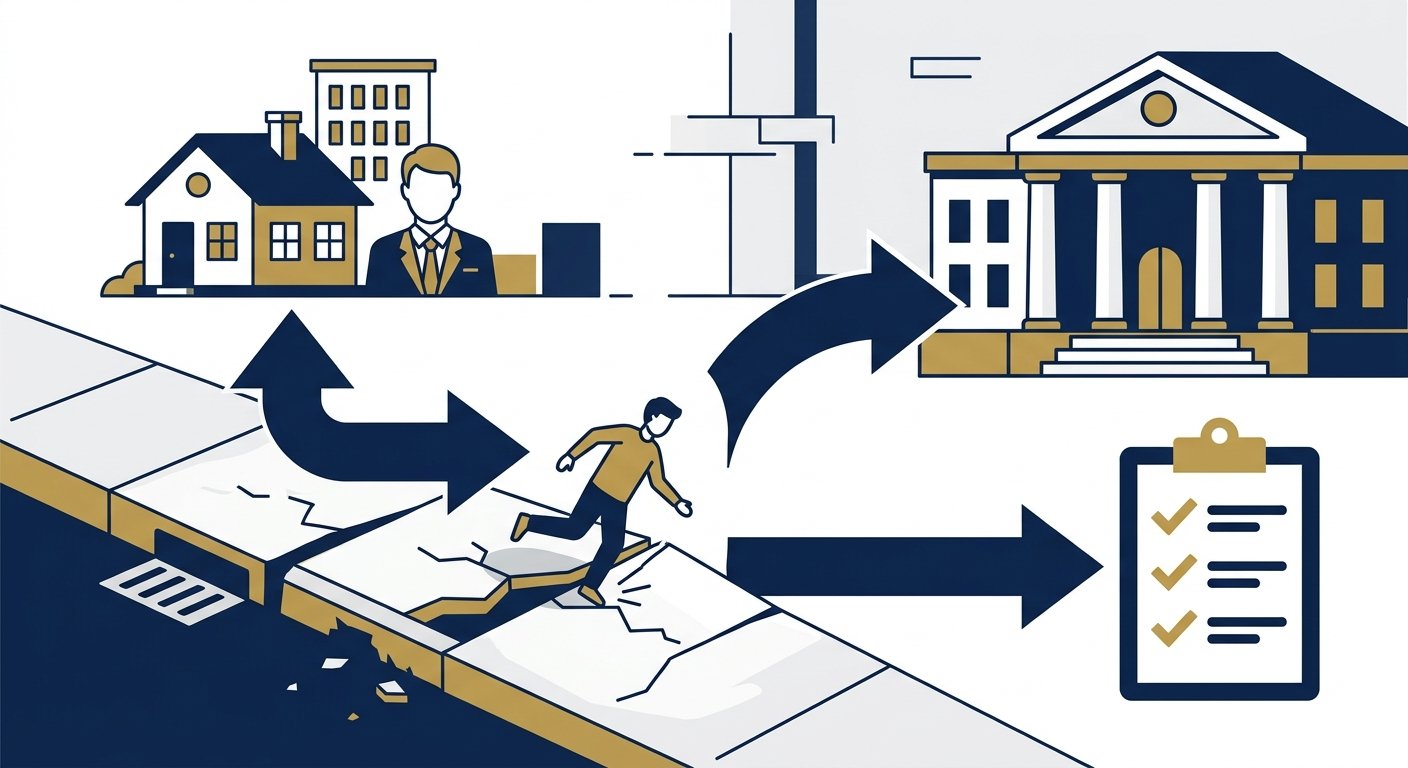
Florida’s premises liability framework holds property owners and managers legally responsible for maintaining safe conditions for visitors, tenants, and the public. When a sidewalk defect causes injury, the injured party typically must prove that the property owner knew — or reasonably should have known — about the hazard and failed to correct it.
This “knew or should have known” standard is critical. It means that ignorance of a cracked or raised sidewalk slab is not a legal defense. Courts expect property owners to conduct regular inspections. If you haven’t walked your sidewalks recently, a plaintiff’s attorney likely will — right after an incident.
Florida’s comparative negligence statute, updated under Florida Senate legislation in recent years, shifted the state to a modified comparative fault system. Under this framework, a plaintiff can only recover damages if they are found less than 51% at fault. While this offers some protection, it also means that a well-documented case of property owner negligence — like an unrepaired sidewalk defect — can still result in substantial liability.
What Triggers Sidewalk Liability Claims
Not every crack creates legal exposure, but certain conditions consistently appear at the center of successful trip-and-fall claims. Property managers and HOA boards should treat the following as red flags:
- Vertical displacement of ½ inch or more — when one concrete panel rises above the adjacent slab, creating an abrupt edge that catches a foot
- Cracked or sunken panels — broken or settled slabs that create uneven walking surfaces
- Tree root upheaval — one of the most common causes of raised sidewalks in South Florida’s landscaped communities
- Surface spalling and deterioration — pitting or flaking that creates loose material underfoot
- ADA non-compliant surfaces — cross-slopes, missing tactile warning strips, or transitions that exceed allowable gradients
The ½-inch threshold matters legally. Florida courts and ADA guidelines both recognize this measurement as the point at which a surface elevation change becomes a recognized hazard. If your sidewalks have lips or raised edges that meet or exceed this threshold, the clock is already running on your liability exposure.
For a deeper look at how Florida courts handle sidewalk injury cases, visit our detailed resource on Florida sidewalk liability lawsuits.
The HOA Liability Picture in 2026
Homeowners associations occupy a uniquely exposed position under Florida law. When an HOA maintains common area sidewalks — as most do — it assumes the same duty of care as any commercial property owner. HOA board members often underestimate this exposure, assuming that general liability insurance will cover any claim without consequences.
In practice, a poorly maintained sidewalk network can lead to:
- Substantial increases in HOA insurance premiums after a claim
- Insurance carriers declining to renew or reducing coverage limits
- Personal liability concerns for board members who were aware of documented hazards and failed to act
- Special assessments when reserves haven’t been allocated for preventive maintenance
The most defensible position an HOA can take is a documented inspection program paired with prompt, professional repair of identified hazards. A paper trail showing proactive maintenance is one of the strongest defenses available in a premises liability case.
Municipalities and Public Right-of-Way: Shared Responsibility
For municipal public works directors and city managers in Palm Beach and Broward counties, sidewalk liability involves an additional layer of complexity: determining who owns what. In Florida, sidewalks in the public right-of-way may be maintained by the municipality, the county, or — in many cases — the adjacent property owner, depending on local ordinances.
Municipal governments are not immune from trip-and-fall claims. Sovereign immunity caps in Florida limit damages against government entities, but these caps are not unlimited, and the volume of potential claims across a large sidewalk network creates meaningful aggregate risk.
Proactive municipal sidewalk programs that systematically identify and repair trip hazards are increasingly viewed as best practice — and for good reason. The cost of repairing a raised panel is a fraction of the cost of defending a single injury claim.
ADA Compliance: A Separate but Related Obligation
Beyond premises liability, property owners and municipalities face obligations under the Americans with Disabilities Act. ADA non-compliance on public sidewalks and accessible routes creates exposure to federal complaints, Department of Justice investigations, and civil litigation that operates entirely separately from state slip-and-fall law.
The ADA National Network maintains that accessible routes must meet strict standards for surface condition, cross-slope, running slope, and width. A sidewalk that passes a casual visual inspection may still be non-compliant when measured against these technical requirements.
For commercial properties and public facilities in South Florida, ADA compliance is not optional — and it’s increasingly enforced. Our comprehensive guide to ADA sidewalk compliance in South Florida covers the specific standards that apply to your property type.
Why Concrete Cutting Outperforms Grinding and Replacement
When a trip hazard is identified, property owners typically face three repair options: grind the raised edge, cut and level the displacement, or replace the affected slabs. Each approach has different cost, durability, and compliance implications.
Grinding removes material from the raised edge to reduce the height difference, but it creates a beveled surface rather than a level one. The result is often a cosmetically acceptable repair that fails to meet ADA standards for surface cross-slope and may not hold up long-term as the underlying cause — typically root pressure or soil movement — continues.
Full slab replacement addresses the problem definitively but at significant cost: demolition, disposal, new concrete, curing time, and restoration of surrounding surfaces. For a large HOA or municipality managing hundreds of problem areas, replacement-based programs can quickly exhaust maintenance budgets.
Precision concrete cutting — the patented technology Florida Sidewalk Solutions has deployed across Palm Beach and Broward counties for over 20 years — takes a different approach. Rather than removing material or replacing slabs, the cutting process precisely levels the displacement, creating a flush, ADA-compliant transition that addresses both the cosmetic and compliance requirements of the repair.
The result is a repair that costs 70–90% less than full slab replacement, generates no demolition waste, requires no curing time, and leaves a clean, professional finish that meets ADA standards. For budget-conscious decision-makers managing large sidewalk networks, the math is straightforward.
Learn more about the repair process and what to expect on our sidewalk trip hazard repair page.
Building a Defensible Prevention Strategy
For property managers, HOA boards, and municipal officials, trip-and-fall prevention is ultimately a documentation and response discipline. The following framework reflects best practices for 2026:
- Schedule annual sidewalk inspections — walk every linear foot of your managed sidewalk network, ideally with a licensed professional who can identify ADA compliance issues alongside visible defects
- Document everything — photographs, measurements, dates, and repair records create the paper trail that demonstrates reasonable care
- Prioritize by severity — vertical displacements of ½ inch or more and any ADA violations at accessible routes should be addressed first
- Repair, don’t just flag — temporary cone placement or warning signs do not substitute for actual repair and may actually increase liability by confirming knowledge of the hazard
- Choose cost-effective, compliant repair methods — solutions that restore ADA compliance at a fraction of replacement cost allow you to address more hazards within existing budget cycles
Frequently Asked Questions
What is the minimum sidewalk height difference that creates legal liability in Florida?
Florida courts and ADA guidelines generally recognize a vertical displacement of ½ inch (approximately 13mm) as the threshold at which an elevation change is considered a recognizable hazard. Below that threshold, liability claims are harder to sustain — but documentation of any defect is still advisable to demonstrate proactive maintenance.
Can an HOA be sued for a sidewalk trip-and-fall in a common area?
Yes. HOAs that maintain common area sidewalks carry the same duty of care as commercial property owners under Florida premises liability law. An HOA that knew or should have known about a sidewalk defect and failed to repair it faces meaningful legal exposure. Documented inspection and repair programs are the most effective defense.
Is concrete cutting ADA-compliant as a repair method?
When performed correctly using precision equipment, concrete cutting creates a flush, level transition that meets ADA surface standards. This is one of the primary advantages over grinding, which produces beveled surfaces that may not satisfy ADA gradient requirements. Florida Sidewalk Solutions’ patented process is specifically designed to achieve compliant results.
How long does a precision concrete cutting repair take?
Most individual trip hazard repairs using precision concrete cutting can be completed in a matter of hours, with no curing time required. There’s no wet concrete, no debris removal, and no extended closure of the repaired area. For property managers and HOA boards concerned about disruption to residents or tenants, this is a significant operational advantage.
Does proactive sidewalk repair actually reduce lawsuit risk?
Yes — significantly. The presence of documented inspections, identified hazards, and completed repairs is one of the strongest defenses available in a premises liability case. It demonstrates reasonable care, which is the central question in negligence claims. Conversely, unrepaired hazards combined with evidence that the property owner was aware of the issue are among the most damaging facts a plaintiff can present.
Take Action Before a Claim Does It for You
The sidewalk defects that generate costly lawsuits rarely appear overnight. They develop gradually — root pressure builds, slabs settle, edges rise — until the day someone trips and everything changes. For property managers, HOA board members, and municipal officials across Palm Beach and Broward counties, the most cost-effective risk management decision is also the most straightforward: inspect, document, and repair.
Florida Sidewalk Solutions brings over 20 years of Florida-specific experience and patented precision concrete cutting technology to every project. We help property owners and municipalities eliminate trip hazards, achieve ADA compliance, and reduce liability exposure — at a cost that makes proactive maintenance realistic within real-world budgets.
Contact Florida Sidewalk Solutions today to schedule a professional sidewalk assessment for your Palm Beach or Broward County property. Don’t wait for a demand letter to tell you what a walk-through would have revealed months earlier.