
Property managers and municipal officials across Florida face a common challenge: deteriorating sidewalks creating liability risks and compliance headaches. The critical question isn’t whether to address these hazards—it’s how to do it without draining your budget. In 2026, understanding the true cost differences between repair methods can save your organization tens of thousands of dollars while maintaining safety and ADA compliance.
Understanding Sidewalk Repair vs Replacement Cost
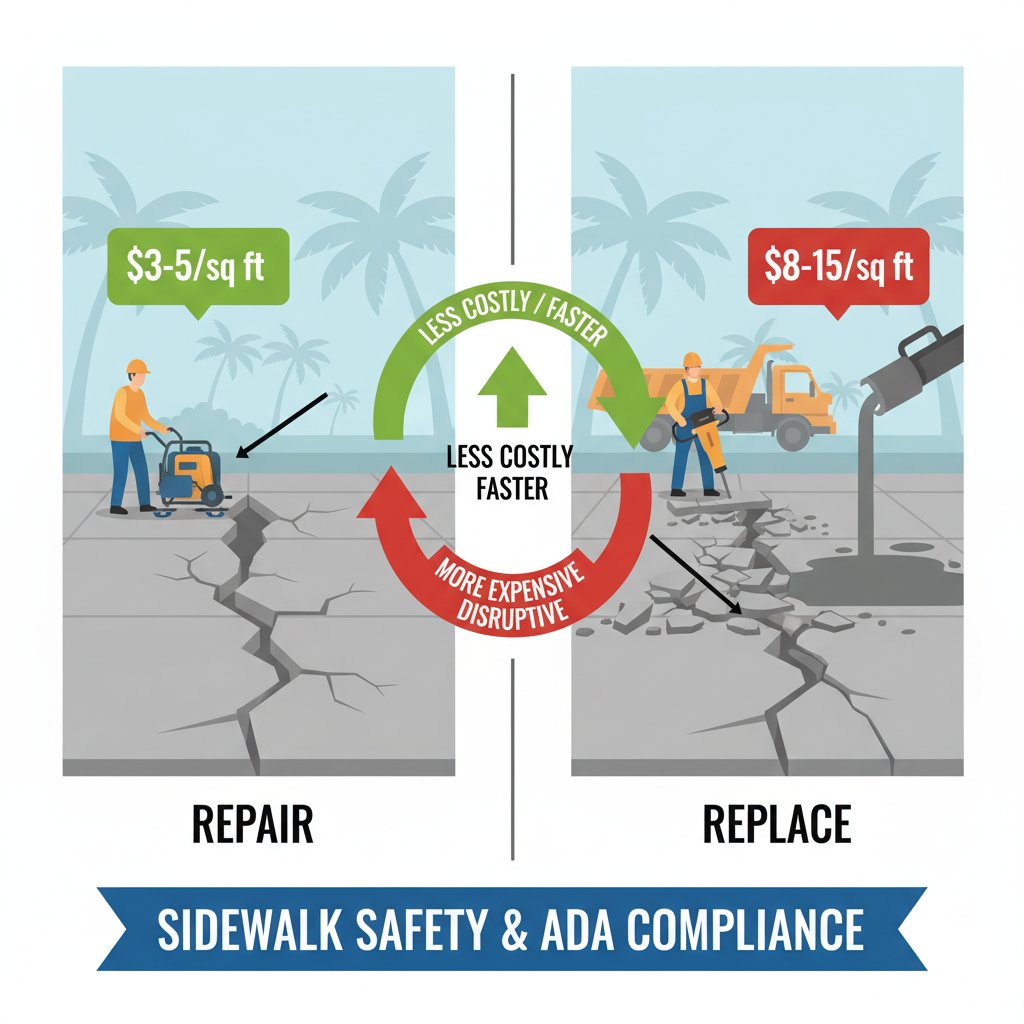
The financial gulf between traditional replacement and modern repair technologies is substantial. Traditional concrete replacement typically costs between $8 and $15 per square foot in Florida, with expenses climbing higher in urban areas or when disposal fees increase. For a standard 1,000 square foot sidewalk section, you’re looking at $8,000 to $15,000—a significant capital expenditure that requires budget approval and careful planning.
Modern precision cutting repair methods change this equation dramatically. These techniques typically run $2 to $4 per square foot, representing savings of 70-90% compared to replacement. That same 1,000 square foot section? You’re investing $2,000 to $4,000 instead—a difference that allows you to address multiple problem areas within the same budget cycle.
Hidden Costs of Replacement
The sticker price rarely tells the complete story. Traditional sidewalk replacement carries hidden expenses that inflate the true cost:
- Demolition labor and equipment rental (jackhammers, saws, hauling equipment)
- Concrete disposal fees, which have increased 15-20% in Florida since 2024
- New material costs subject to market fluctuations
- Extended timeline requiring additional traffic control and safety measures
- Landscaping restoration after removal damages surrounding areas
- Lost business revenue or resident inconvenience during multi-day closures
These ancillary costs can add 25-40% to the base replacement price. A project quoted at $10,000 easily becomes $12,500 to $14,000 once all factors are included.
Cost Effective Sidewalk Repair Options in 2026
Florida property managers now have several repair alternatives, each with distinct cost profiles and appropriate applications.
Concrete Grinding
Grinding down raised concrete sections costs approximately $3 to $6 per square foot. While cheaper than replacement, grinding creates several problems that affect long-term value. The process produces a rough, sloped surface that collects water, accelerating deterioration. The beveled transition often exceeds ADA slope requirements, creating compliance issues rather than solving them. Within 2-3 years, many ground sections require additional intervention, making the initial savings illusory.
Precision Concrete Cutting
Patented precision cutting technology represents the optimal balance of cost, quality, and compliance. At $2 to $4 per square foot, this method removes the raised portion of displaced concrete slabs, creating a smooth, level surface that meets ADA standards. The process takes hours rather than days, requires no curing time, and produces a professional finish indistinguishable from new concrete. Unlike grinding, properly executed cutting addresses the root cause of displacement and provides a permanent solution.
Slab Jacking or Mudjacking
For sunken slabs, injection methods cost $4 to $8 per square foot. This approach lifts settled concrete by pumping material underneath. While effective for certain situations, it doesn’t address raised sections—the most common trip hazards—and may not provide permanent solutions in areas with ongoing soil settlement issues common throughout Florida’s coastal and reclaimed areas.
Concrete Sidewalk Repair Florida: Regional Cost Factors
Florida’s unique conditions influence sidewalk repair pricing in ways that property managers must consider when budgeting.
Tree Root Interference
Florida’s aggressive tree root systems, particularly from live oaks, ficus, and palms, cause the majority of sidewalk displacement issues. Properties with mature landscaping face ongoing displacement problems. Replacement that doesn’t address root interference fails within 3-5 years, requiring repeated investment. Precision cutting accommodates minor ongoing movement while maintaining level surfaces, providing better long-term value in tree-heavy areas.
Soil Conditions and Settlement
Sandy soils, limestone substrates, and areas with high water tables throughout Central and South Florida create settlement patterns that traditional replacement can’t always solve. New concrete poured over unstable soil often settles unevenly, recreating the original problem. Repair methods that level existing slabs without adding weight or disturbing the base often prove more durable than replacement in these conditions.
Geographic Price Variations
Metropolitan areas like Miami, Tampa, and Orlando see pricing at the higher end of ranges due to increased labor costs and disposal fees. Conversely, the cost advantage of repair methods over replacement grows in urban areas where disposal fees are highest and access constraints increase replacement complexity.
Budget Planning for Sidewalk Repair Options Florida
Strategic budget allocation requires understanding both immediate costs and lifecycle expenses.
Immediate Cost Comparison
For a typical commercial property with 2,500 square feet of sidewalk requiring attention:
- Full Replacement: $20,000 to $37,500 (including hidden costs)
- Grinding: $7,500 to $15,000
- Precision Cutting: $5,000 to $10,000
The precision cutting approach delivers immediate savings of $15,000 to $27,500 compared to replacement—capital that can address other property needs or extend sidewalk maintenance to additional areas.
Five-Year Total Cost of Ownership
Looking beyond initial investment reveals the true value proposition. Replacement typically requires no additional work within five years, maintaining the $20,000-$37,500 investment. However, grinding often needs re-treatment or escalation to cutting or replacement within 3-4 years, potentially doubling costs to $15,000-$30,000 total.
Quality precision cutting, performed by experienced contractors using proven methods, typically requires no additional intervention within five years, keeping total investment at the initial $5,000-$10,000. This represents a 50-75% total savings over the planning period.
ADA Compliance and Legal Cost Considerations
Federal ADA standards require that vertical displacement exceeding 1/4 inch be addressed. Florida property owners face legal exposure for injuries occurring on non-compliant walkways, with settlements regularly reaching six figures.
The Americans with Disabilities Act mandates maximum slopes of 1:12 for accessible routes. Grinding that creates beveled transitions frequently exceeds this threshold, leaving properties technically non-compliant despite spending thousands on “repairs.” This creates liability exposure that negates any cost savings.
Precision cutting creates level transitions under 1/4 inch or properly beveled ADA-compliant transitions, depending on the displacement severity. This ensures legal compliance and reduces liability—a benefit with significant financial value beyond the repair cost itself.
Insurance and Risk Management Value
Many Florida property insurers now require documented sidewalk maintenance programs. Properties with unaddressed trip hazards may face coverage exclusions for slip-and-fall claims or increased premiums. The cost of compliance through effective repair is minimal compared to potential claim exposure or insurance complications.
Making the ROI Case for Sidewalk Replacement Alternatives
When presenting budget requests to boards, councils, or ownership groups, focus on total value rather than just upfront cost.
Operational Continuity Benefits
Precision cutting repairs are completed in hours with immediate usability. Residents, customers, and employees experience minimal disruption. Replacement requires 3-7 days including curing time, necessitating detours, closures, and potential business impact. For retail properties, hotels, or medical facilities, this operational continuity has direct revenue implications that dwarf repair cost differences.
Environmental Considerations
Demolition-free repair eliminates concrete disposal—significant given Florida’s limited landfill capacity and increasing disposal costs. Properties with sustainability goals or LEED considerations gain measurable environmental benefits. Some municipalities now factor environmental impact into vendor selection, making low-waste repair methods competitively advantageous for contractors seeking public work.
Scalability Within Budget Constraints
The 70-90% cost advantage allows property managers to address all identified hazards rather than prioritizing only the worst sections. Comprehensive remediation reduces liability exposure across the entire property while staying within allocated budgets. This complete-solution approach provides better risk management than piecemeal replacement of only the most severe hazards.
Selecting Cost-Effective Sidewalk Repair Contractors
The lowest bid rarely delivers the best value. When evaluating concrete sidewalk repair Florida contractors, consider:
- Proven experience with the specific repair method (grinding vs. cutting produce very different results)
- Understanding of ADA compliance requirements and ability to provide compliant solutions
- Equipment quality and proprietary technologies that affect finish quality
- Liability insurance adequate for your property type and exposure
- References from similar properties (commercial, municipal, HOA) in Florida
- Warranty terms that reflect contractor confidence in durability
Contractors with 15-20 years of Florida-specific experience understand regional conditions affecting repair longevity—tree species behavior, soil types, drainage patterns—that impact long-term results.
2026 Budget Planning Recommendations
Smart property managers are taking these steps:
Conduct comprehensive sidewalk audits identifying all sections with quarter-inch or greater displacement. This provides accurate scope for budget requests and prevents mid-year emergency expenditures.
Request multiple quotes specifying different repair methods for direct comparison. Ensure quotes include all ancillary costs for accurate evaluation.
Prioritize ADA compliance areas first—building entrances, parking lot connections, public access routes—where liability exposure is highest.
Consider multi-year contracts for properties with ongoing displacement from tree roots. Scheduled maintenance programs often secure better per-unit pricing than reactive emergency repairs.
Document everything for liability protection. Maintained records of regular inspection and prompt remediation demonstrate reasonable care in potential litigation.
Invest in Cost-Effective Solutions
Florida sidewalk repair costs vary dramatically based on chosen methods, but the math is clear: precision cutting technology delivers 70-90% savings compared to replacement while providing ADA-compliant, durable results. For property managers, HOA boards, and municipal decision-makers working within tight 2026 budgets, this cost advantage allows comprehensive hazard remediation rather than compromise solutions.
Florida Sidewalk Solutions brings over 20 years of Florida-specific experience with patented Precision Concrete Cutting technology. Our approach delivers the cost-effectiveness of repair with the quality and compliance of replacement—the optimal solution for budget-conscious properties that won’t compromise on safety or liability protection. Contact us for a free assessment and detailed cost comparison specific to your property. Discover how much you can save while eliminating trip hazards and achieving full ADA compliance.