
A single non-compliant curb ramp can expose a Florida property owner to serious liability. Yet many HOA boards, commercial property managers, and municipal public works departments still operate without a systematic approach to ADA sidewalk compliance — often discovering deficiencies only after a complaint or lawsuit has already been filed.
This checklist is designed for decision-makers in Palm Beach County and Broward County who want to get ahead of that risk. Whether you manage a shopping center in Boca Raton, oversee a residential community in Pembroke Pines, or direct public works for a municipality in West Palm Beach, the standards below apply to your walkways, ramps, and pedestrian paths.
Why ADA Sidewalk Compliance Matters in Florida
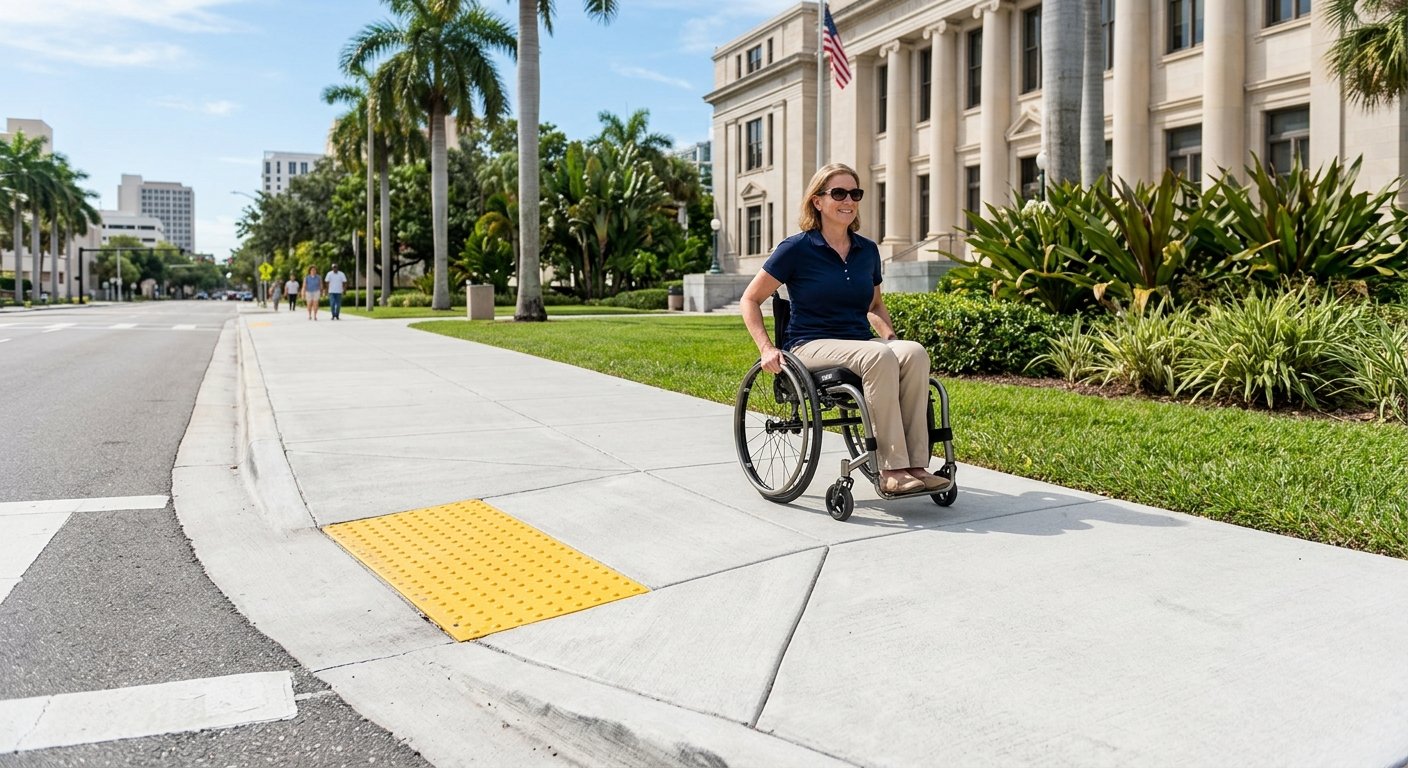
The Americans with Disabilities Act requires that public accommodations and commercial facilities maintain accessible routes for people with disabilities. For Florida property owners, this isn’t an abstract federal mandate — it’s actively enforced through civil litigation, DOJ complaints, and municipal code inspections.
According to the U.S. Department of Justice’s 2010 ADA Standards for Accessible Design, accessible routes must be stable, firm, slip-resistant, and free of changes in level that exceed specific thresholds. These requirements apply to new construction and alterations, and they create a baseline for what courts and plaintiffs use to evaluate existing conditions.
Florida adds another layer. The Florida Building Code incorporates ADA accessibility standards and applies them to a broad range of property types. A trip hazard that might seem minor — a half-inch of concrete uplift from a tree root — can constitute both an ADA violation and a personal injury liability event. Our detailed breakdown of Florida sidewalk liability lawsuits explains how these cases typically unfold and what property owners face when they go to court unprepared.
The ADA Sidewalk Compliance Checklist
Use this checklist during your next property walk-through. Document findings with photographs and timestamps — this creates a paper trail that demonstrates good-faith compliance efforts.
1. Accessible Route Continuity
- Is there a continuous, unobstructed path connecting parking, building entrances, and public sidewalks?
- Are there any gaps, missing segments, or routes that force wheelchair users into vehicular traffic lanes?
- Do all accessible routes meet a minimum clear width of 36 inches (wider in high-traffic areas)?
- Are routes free of protrusions, signage, or vegetation that reduce clear width below compliance thresholds?
2. ADA Sidewalk Slope Requirements
- Running slope (in the direction of travel) must not exceed 1:20 (5%) unless the route is classified as a ramp.
- Cross slope (perpendicular to travel) must not exceed 1:48 (2%).
- ADA sidewalk slope requirements are among the most commonly violated standards in Florida — even minor settling or root damage can push an otherwise compliant surface out of tolerance.
- Document any sections where water pools or where visible slope changes are apparent.
3. Surface Conditions and Trip Hazards
- Any vertical change in level greater than ½ inch is a code violation and a trip hazard.
- Changes between ¼ inch and ½ inch must be beveled at a 1:2 slope or less.
- Surfaces must be stable and firm — cracked, spalled, or heaved concrete should be flagged immediately.
- Document all locations where panel displacement has occurred, particularly near tree root zones.
Florida’s aggressive tree root systems make this a persistent challenge for property managers throughout Palm Beach and Broward Counties. Our sidewalk trip hazard repair resource covers the full spectrum of repair options and when each is appropriate.
4. Handicap Ramp Requirements in Florida
- Curb ramps must be present wherever the accessible route crosses a curb.
- Ramp slope must not exceed 1:12 (8.33%).
- Minimum ramp width is 36 inches clear of handrails or other obstructions.
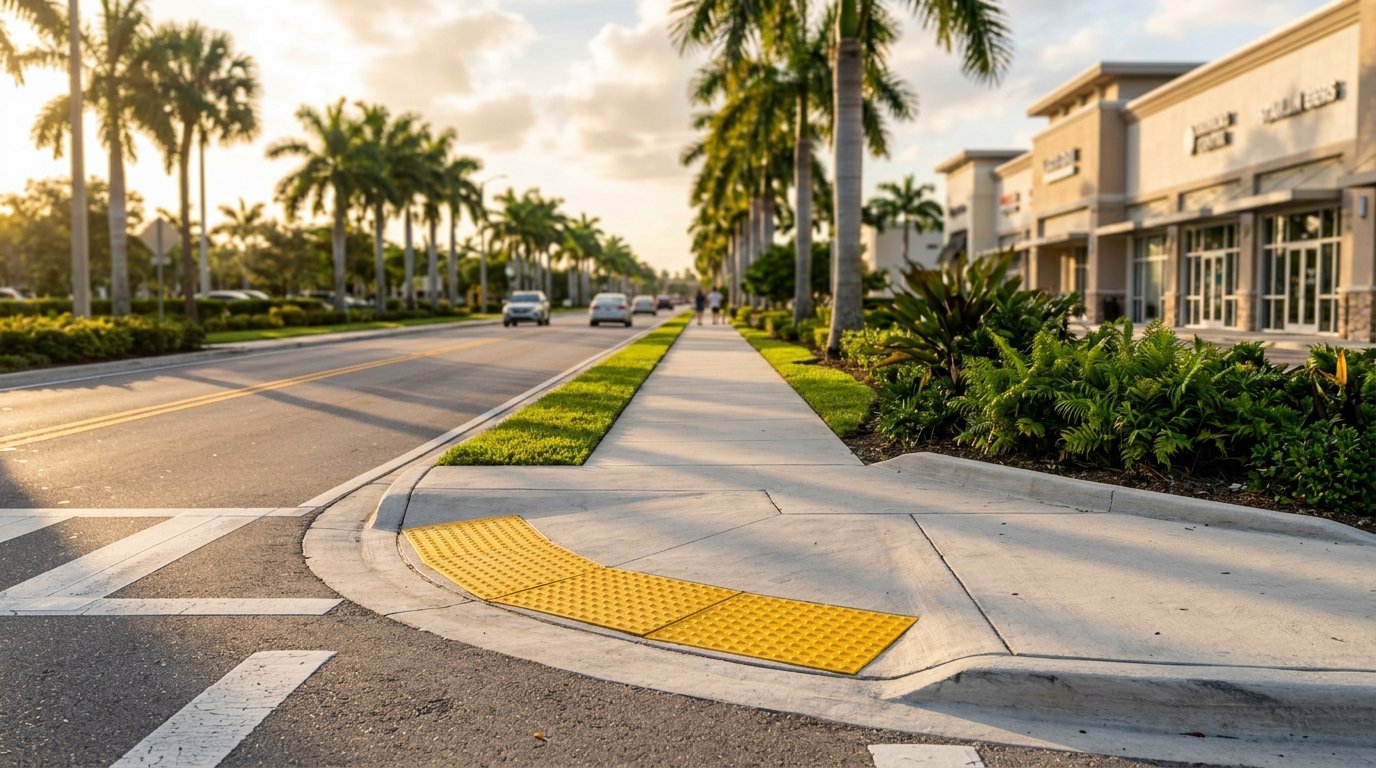
- Detectable warning surfaces (truncated domes) must be present at all curb ramp landings — this is one of the most frequently cited deficiencies in Florida ADA inspections.
- Landing areas at the top and bottom of each ramp must be at least 60 inches in length and level (no more than 2% slope in any direction).
- Flared sides are required where pedestrians may walk across the ramp.
5. Parking Lot Accessible Routes
- Accessible parking spaces must connect to the building entrance via an accessible route that does not require traveling behind parked vehicles.
- Van-accessible spaces require a minimum 98-inch vertical clearance in parking structures.
- Access aisles adjacent to accessible spaces must be level (2% maximum slope in all directions).
- Painted markings must be visible — faded striping does not satisfy ADA requirements.
6. Documentation and Inspection Records
- Maintain written records of all sidewalk and ramp inspections, including dates and findings.
- Document repair orders and completion dates for any identified deficiencies.
- For municipalities and large commercial properties, an ADA Transition Plan is required — update it regularly to reflect completed work and new deficiencies.
Repair Options: Why Cutting Outperforms Grinding and Replacement
When deficiencies are identified, property managers typically face three choices: full panel replacement, surface grinding, or precision concrete cutting. The right choice depends on the nature and severity of the defect, but for the majority of trip hazard and slope issues, precision cutting delivers superior results at a fraction of the cost.
Full replacement costs more — and in Florida, it often means permitting delays, contractor scheduling, and extended disruption to tenants, residents, or the public. Surface grinding removes material aggressively and can leave uneven textures that compromise slope compliance or accelerate future deterioration.
Florida Sidewalk Solutions uses patented precision concrete cutting technology that addresses root uplift, panel displacement, and slope issues with surgical accuracy. The cut is clean, the transition is smooth, and the result meets ADA standards for surface finish and cross-slope. Compared to replacement, our approach typically costs 70 to 90 percent less — with no demolition waste, no concrete debris hauling, and minimal disruption to the surrounding area.
For a comprehensive look at how ADA compliance intersects with repair strategy, visit our ADA sidewalk compliance in South Florida pillar page.
Common ADA Violations Found During Florida Property Inspections
After 20 years serving Palm Beach County and Broward County, our team has identified patterns that consistently show up across property types:
- Missing or damaged detectable warning surfaces at curb ramps — required by the U.S. Access Board’s ADA Accessibility Guidelines and frequently neglected during routine maintenance
- Excessive cross slopes caused by root damage or settling, particularly in older commercial corridors
- Panel edge displacement at expansion joints, creating vertical lips that exceed the ½-inch threshold
- Inadequate ramp landings where space was insufficient at the time of original construction
- No accessible route connecting accessible parking to building entrances — common in properties built before current ADA standards were adopted
Frequently Asked Questions
What are the ADA sidewalk slope requirements in Florida?
ADA sidewalk slope requirements in Florida mirror federal standards: running slope (in the direction of travel) must not exceed 5%, and cross slope (perpendicular to travel) must not exceed 2%. Any surface that exceeds these limits — whether due to original construction or subsequent settling — is considered non-compliant and should be addressed promptly.
What are the handicap ramp requirements in Florida?
Curb ramps must have a maximum slope of 1:12 (8.33%), a minimum clear width of 36 inches, and detectable warning surfaces (truncated domes) at the base. Landings at the top and bottom must be at least 60 inches long and essentially level. These requirements apply to all public accommodations, commercial facilities, and government properties in Florida.
How much does ADA sidewalk repair cost compared to replacement in South Florida?
Precision concrete cutting — the method used by Florida Sidewalk Solutions — typically costs 70 to 90 percent less than full panel replacement. For a property with multiple trip hazards or out-of-compliance ramps, that difference adds up quickly while achieving the same ADA-compliant result.
Is a property owner liable for ADA sidewalk violations if they didn’t cause the damage?
Generally, yes. Florida courts and federal ADA enforcement focus on the condition of the walkway, not its cause. Tree root damage, settling, or contractor error do not relieve property owners of their obligation to maintain accessible routes. Prompt identification and repair is the most effective risk management strategy available. (This is general information, not legal advice — consult your attorney regarding your specific situation.)
How quickly can ADA sidewalk repairs be completed in Palm Beach and Broward Counties?
Most repairs using precision concrete cutting can be completed in a single day with no curing time required. Pedestrian access is typically restored the same day. This makes it an ideal solution for active commercial properties, HOA communities, and municipal rights-of-way where extended closures are not practical.
Take Action Before a Complaint Forces Your Hand
ADA compliance is not a one-time event — it requires ongoing inspection, documentation, and timely repair. For property managers and municipal decision-makers in Palm Beach County and Broward County, the cost of proactive compliance is always lower than the cost of reactive litigation.
Florida Sidewalk Solutions is licensed, insured, and has been delivering ADA-compliant sidewalk repairs across South Florida for 20 years. Our patented precision cutting technology means you get compliant results faster, at lower cost, and with less disruption than any alternative.
Ready to schedule a property assessment or get a repair estimate? Contact Florida Sidewalk Solutions today to speak with an ADA sidewalk compliance specialist serving Palm Beach and Broward Counties.