
A single raised sidewalk slab costs the average Florida property owner between $15,000 and $50,000 in premises liability settlements — and that’s before legal fees. With slip-and-fall lawsuits ranking among the most common property liability claims in Florida, the method you choose to fix a trip hazard isn’t just a maintenance decision. It’s a risk management decision.
Two repair approaches dominate the conversation for property managers, HOA boards, and municipal public works directors in Palm Beach County and Broward County: concrete cutting (also called precision concrete cutting) and concrete grinding. Both address raised edges and uneven surfaces. But they produce very different results in terms of durability, appearance, ADA compliance, and long-term cost.
Here’s a clear comparison of both methods — and why the choice matters more than most property owners realize.
Understanding the Problem: What Creates Trip Hazards
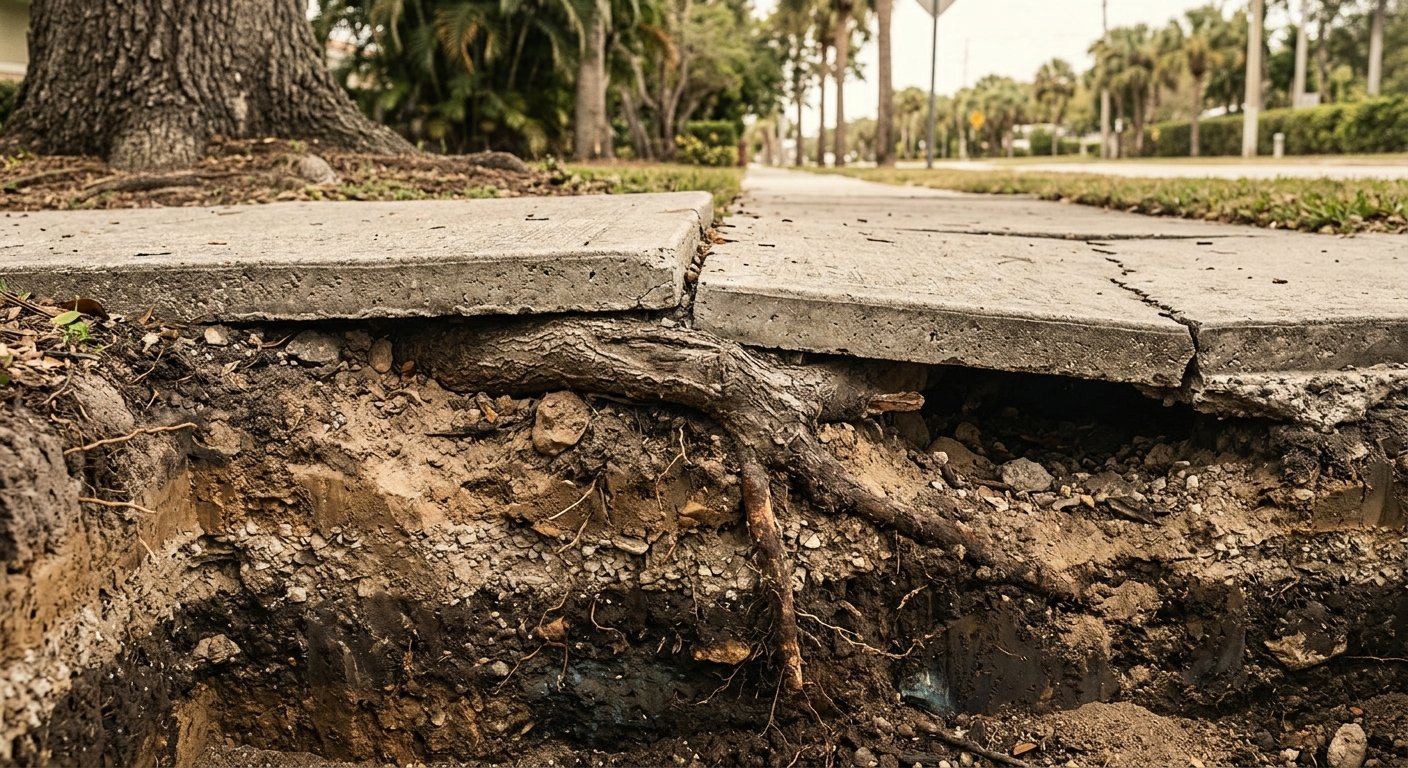
Sidewalk trip hazards in South Florida don’t form overnight. Tree root intrusion, soil settlement, thermal expansion, and shifting substrates gradually push concrete slabs out of alignment. The ADA’s Title II accessibility guidelines define a vertical displacement of ½ inch or greater as a significant barrier — and anything approaching ¼ inch warrants proactive attention.
Once a raised edge exists, property owners face three choices: replace the slab, grind it down, or use precision concrete cutting to create a controlled bevel. Each approach has a different cost profile, aesthetic outcome, and compliance record.
Concrete Grinding: The Traditional Approach
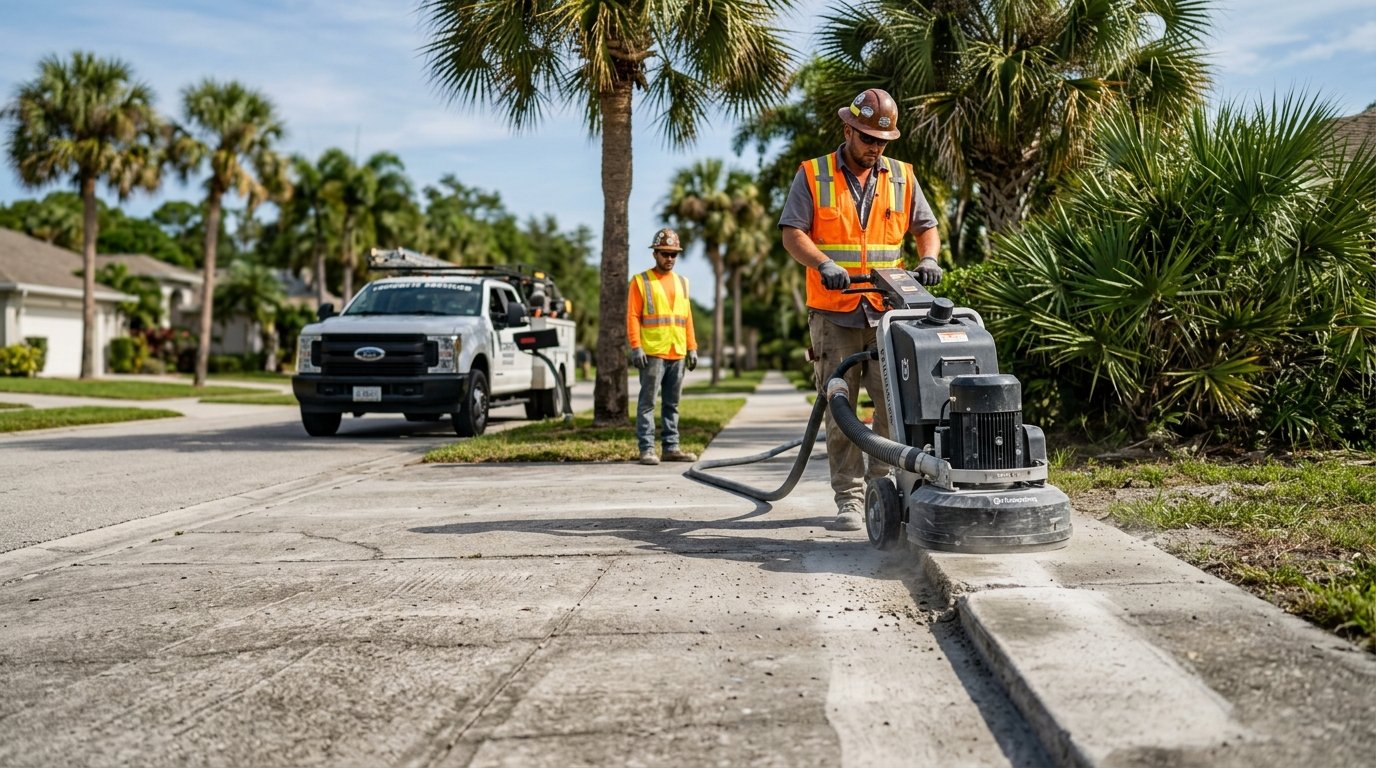
Grinding uses an abrasive wheel to shave down the raised edge of a slab. It’s widely available, relatively quick, and has been the default repair method for decades.
The limitations, however, are significant:
- Rough surface texture: Grinding removes material aggressively, often leaving a coarse, uneven finish that can itself become a friction hazard — particularly for wheelchair users and pedestrians with mobility aids.
- Short-term results: Because grinding removes the symptom rather than addressing the underlying displacement, the hazard frequently returns as the slab continues to shift. Many properties find themselves re-grinding the same locations every two to three years.
- ADA compliance uncertainty: A rough grind may visually reduce the vertical change but still fail to meet the ADA’s requirement for a smooth, stable, slip-resistant surface transition. If the finish doesn’t meet standards, the repair provides limited legal protection.
- Appearance: Grinding scars the concrete surface with visible tooling marks, detracting from the professional appearance of commercial properties, HOA communities, and municipal streetscapes.
Grinding remains a viable option for minor surface corrections, but for actual trip hazard removal on public or commercial sidewalks, it frequently falls short of what regulators and courts consider adequate remediation.
Precision Concrete Cutting: The Modern Standard
Precision concrete cutting uses patented cutting technology to remove material in a controlled, angled cut — creating a smooth, tapered transition between misaligned slabs. Rather than abrading the surface, it shapes the concrete with surgical accuracy.
The difference in outcome is substantial:
- Clean, professional finish: The cut produces a smooth bevel that blends naturally with the surrounding pavement, maintaining the aesthetic integrity of the property.
- ADA-compliant transitions: Properly executed precision cuts create transitions that meet the ADA’s standards for surface cross-slope, vertical change, and surface texture — providing documentable compliance rather than a best-guess approximation.
- Longer-lasting results: The precise removal of the raised edge, combined with a stable cut geometry, holds up significantly longer than a grind under normal conditions.
- No demolition waste: Precision cutting produces minimal debris compared to slab replacement and generates far less particulate than grinding — an important consideration for occupied commercial and residential properties.
- Minimal disruption: Work is completed quickly with no heavy equipment, no lane closures lasting days, and no need to tear out and dispose of concrete slabs.
For a deeper technical overview of the process, visit our concrete cutting sidewalk repair page, which outlines how the patented technology works and what property owners can expect during a repair.
Cost Comparison: Cutting vs. Replacement
Neither cutting nor grinding should be compared to slab replacement in price terms — both are dramatically less expensive. But property managers sometimes bypass cutting in favor of grinding because grinding quotes appear lower at first glance.
The total cost picture tells a different story:
- Precision concrete cutting is typically 70-90% less expensive than full slab replacement, with no excavation, no hauling, and no concrete pouring costs.
- Grinding may require repeat applications every two to three years at the same locations, while a quality precision cut often resolves the hazard once.
- Properties that rely on grinding and experience recurring trip hazards face compounding liability exposure — each incident documented on record weakens their legal position in subsequent claims.
- Municipalities and commercial property owners that invest in ADA-compliant precision cutting reduce their risk of costly ADA Title II enforcement actions and civil litigation.
When evaluating sidewalk repair bids in Palm Beach County or Broward County, property managers should factor in the total cost of ownership — not just the initial invoice.
ADA Compliance: Why the Method Matters Legally
Florida property owners operating under ADA obligations — which includes municipalities, schools, HOAs with common areas, retail centers, and most commercial properties — cannot simply document that a repair was made. They need to document that the repair meets applicable standards.
This is where precision cutting has a measurable legal advantage. A documented, ADA-compliant bevel cut with a smooth surface transition creates a defensible record. A rough grind that still shows an irregular edge provides much weaker protection if a claim is filed.
According to the U.S. Access Board’s ADA Accessibility Guidelines, walking surfaces must be stable, firm, and slip-resistant, with changes in level managed through specific bevel requirements. Precision cutting is engineered specifically to meet those requirements. Grinding is not.
For property owners who want to understand the full scope of their compliance obligations, our ADA sidewalk compliance guide for South Florida covers the specific requirements that apply to different property types.
Real-World Scenarios: Which Method Fits Your Property
HOA Communities
Homeowners associations in Palm Beach County and Broward County manage extensive pedestrian infrastructure and carry significant shared liability. Precision cutting allows HOAs to systematically address all documented trip hazards across common areas efficiently, professionally, and with documented ADA compliance — protecting both residents and the association’s financial reserves.
Municipal Sidewalks
Public works departments managing municipal sidewalk networks face the dual challenge of budget constraints and ADA Title II mandates. Precision concrete cutting for trip hazard removal in Palm Beach County and sidewalk trip hazard repair in Broward County delivers faster turnaround times, lower per-location costs, and stronger compliance documentation than either grinding or replacement programs.
Commercial Properties and Retail Centers
High-traffic commercial environments cannot afford extended sidewalk closures or aesthetics that signal deferred maintenance. Precision cutting completes quickly with minimal disruption to customer traffic and leaves a clean finish that reflects well on the property.
Schools and Universities
Educational campuses carry elevated duty-of-care obligations to students, staff, and visitors. Facilities managers at schools need repairs that are demonstrably compliant and completed during minimal-disruption windows — both of which precision cutting accommodates.
Frequently Asked Questions
How long does precision concrete cutting take compared to grinding?
Both methods are relatively fast compared to full slab replacement. A precision concrete cutting repair on a standard trip hazard is typically completed within minutes per location, allowing multiple repairs across a property in a single visit. Grinding is similarly quick but requires more passes to smooth the surface, and the result often needs reassessment sooner.
Does precision cutting work on all types of trip hazards?
Precision concrete cutting is best suited for vertical displacements at slab joints and edges — the most common type of sidewalk trip hazard in Florida. For more complex structural failures, sunken slabs, or widespread panel deterioration, a full assessment will determine whether cutting, grinding, or targeted replacement is appropriate. Our trip hazard repair resource outlines when each approach applies.
Is precision concrete cutting covered by property insurance?
Coverage varies by policy and insurer. Property owners should consult their insurance provider directly regarding whether sidewalk repairs qualify for coverage under their specific policy terms. What is consistent is that documented, ADA-compliant repairs create a stronger position for both liability defense and claims management.
How do I know if my sidewalk trip hazards meet the ADA threshold requiring repair?
The ADA defines a change in level greater than ½ inch as a barrier requiring remediation. Changes between ¼ and ½ inch must be beveled at a slope no steeper than 1:2. Changes under ¼ inch are typically acceptable. A professional site assessment will identify which hazards require immediate action versus monitoring.
Does precision concrete cutting leave visible marks on the sidewalk?
The process creates a tapered bevel at the transition point, which is visible but neat and professional in appearance. It looks significantly cleaner than a ground surface and integrates naturally with the surrounding pavement over time. Property managers consistently report that it maintains a more polished curb appearance than grinding alternatives.
The Bottom Line for Florida Property Owners in 2026
Concrete grinding has its place — but as a primary method for ADA-compliant trip hazard removal on commercial, municipal, and HOA properties, it consistently underperforms precision concrete cutting on every meaningful metric: durability, appearance, compliance documentation, and long-term cost efficiency.
Florida Sidewalk Solutions has spent over 20 years delivering precision concrete cutting repairs across Palm Beach County and Broward County, using patented technology developed specifically to meet ADA standards and eliminate trip hazard liability. We’re licensed, insured, and have assessed thousands of properties across South Florida.
If your property has documented trip hazards or unresolved ADA compliance concerns, the cost of waiting is measured in liability exposure — not just repair invoices.
Contact Florida Sidewalk Solutions today for a professional site assessment and learn why precision cutting is the right repair method for your property.