For most trip hazards in Palm Beach County and Broward County, targeted repair using precision concrete cutting is the right choice — delivering ADA-compliant results at a fraction of replacement cost. Full sidewalk replacement makes sense only when slabs are structurally compromised beyond surface correction. Understanding which situation you face saves budget, time, and liability exposure.
- The ADA defines a trip hazard as any vertical displacement greater than 1/4 inch — that threshold determines your legal exposure and your repair timeline.
- Patented concrete cutting removes trip hazards permanently without demolition waste, making it 70–90% less expensive than full slab replacement.
- Replacement is rarely necessary for isolated uneven sidewalk sections; most Palm Beach County properties have hazards that respond well to precision cutting.
- Delaying repairs increases both the severity of the hazard and the cost of eventual correction — acting early is always cheaper.
- ADA compliance is not optional; municipalities and property managers face real legal and financial consequences for unaddressed hazards.
Why This Decision Matters for Palm Beach Property Managers
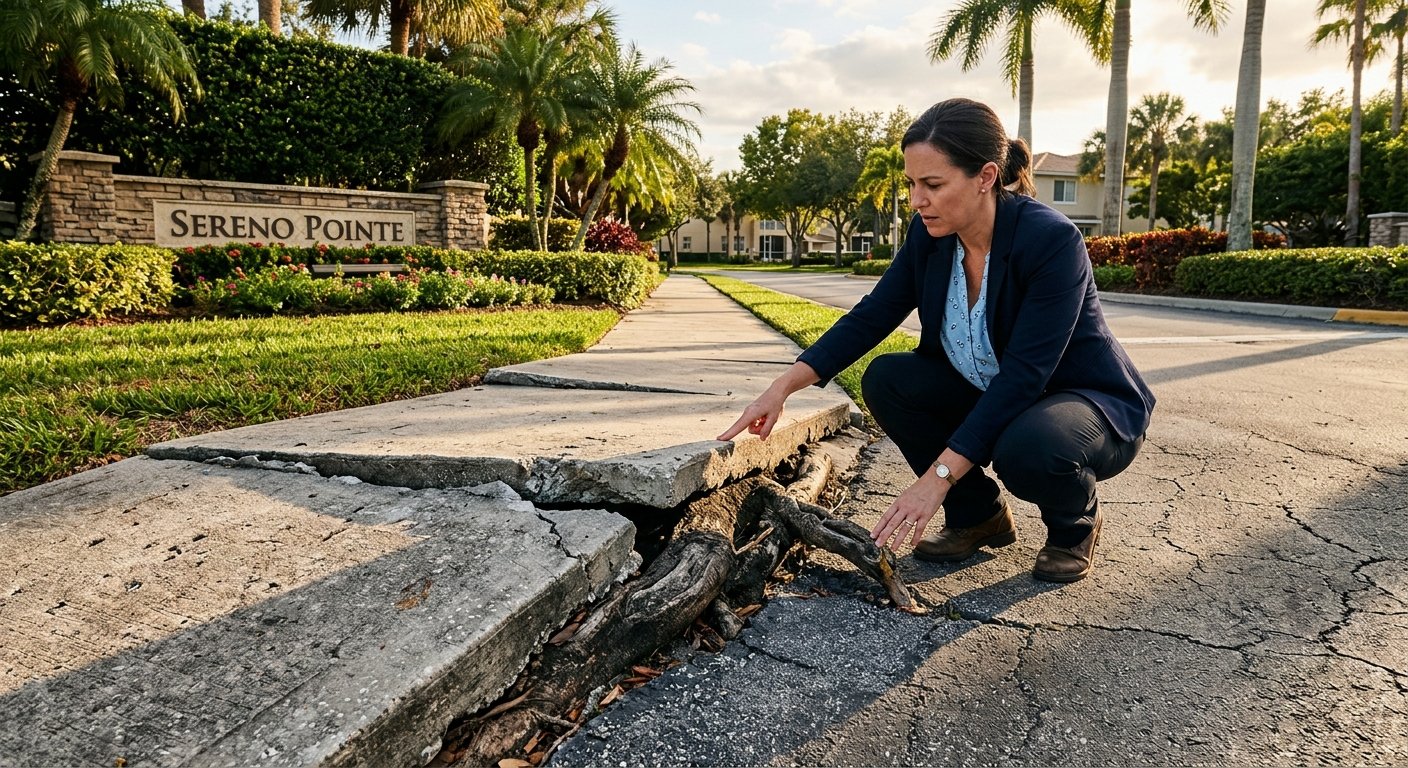
Florida’s combination of mature tree canopies, expansive root systems, and the natural settling of sandy soil creates an outsized sidewalk problem compared to most of the country. For HOA boards, municipal public works directors, and commercial property owners across Palm Beach and Broward counties, uneven sidewalks are not a cosmetic issue — they are an active liability. The Americans with Disabilities Act sets a clear, enforceable standard: any vertical change in level greater than 1/4 inch constitutes a trip hazard, and changes between 1/4 inch and 1/2 inch must be beveled at a slope no steeper than 1:2.
Property managers who understand the repair-versus-replace decision are better positioned to allocate budgets effectively, respond to compliance notices quickly, and defend their properties against premises liability claims. The wrong choice — defaulting to full replacement when targeted repair would suffice — wastes public or association funds and creates unnecessary construction disruption. The right choice, made with accurate information, protects people and budgets simultaneously.
A documented trip hazard that exceeds the ADA’s 1/4-inch threshold creates immediate legal exposure. Florida courts have consistently found property owners negligent when they were aware of a defect and failed to act. Prompt repair is not just good practice — it is your most defensible legal position.
Understanding the Core Difference: Cutting vs. Replacement
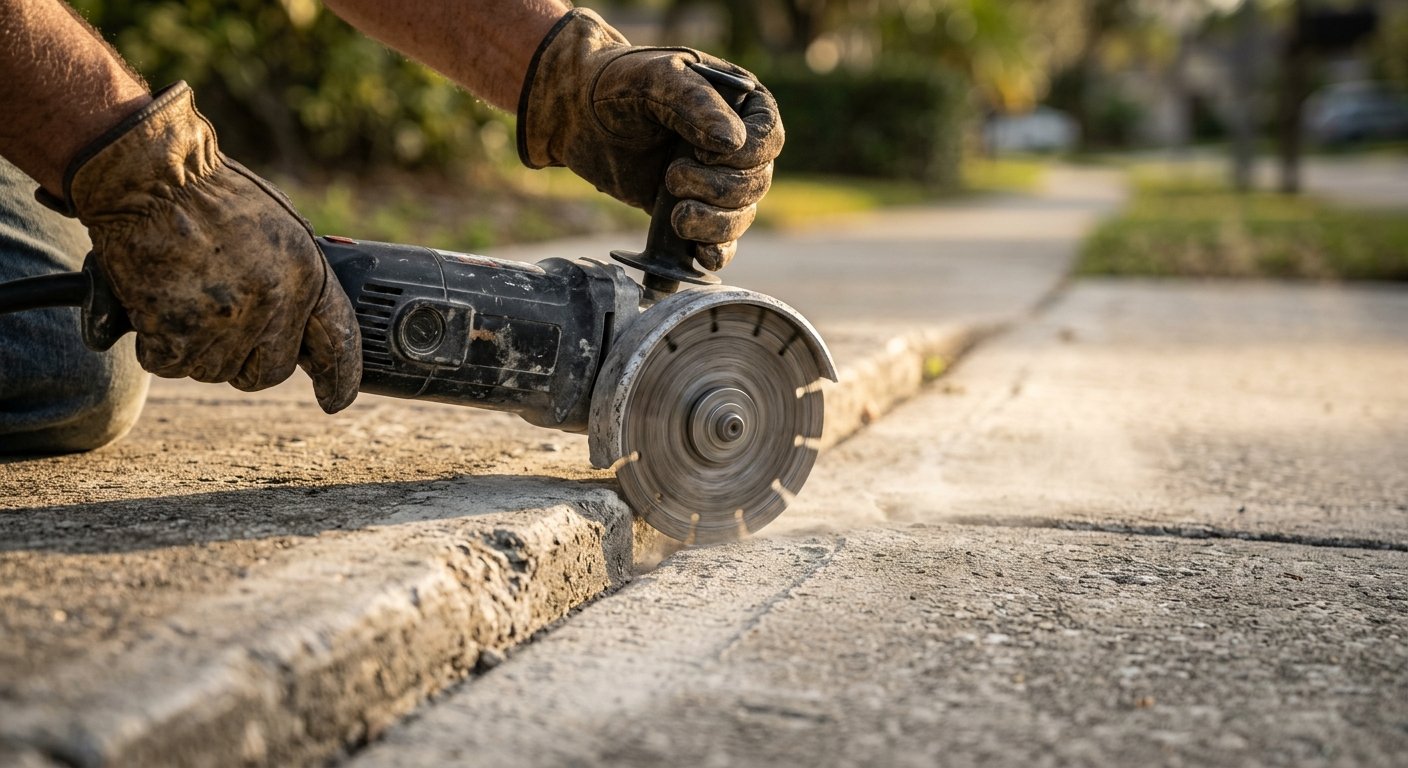
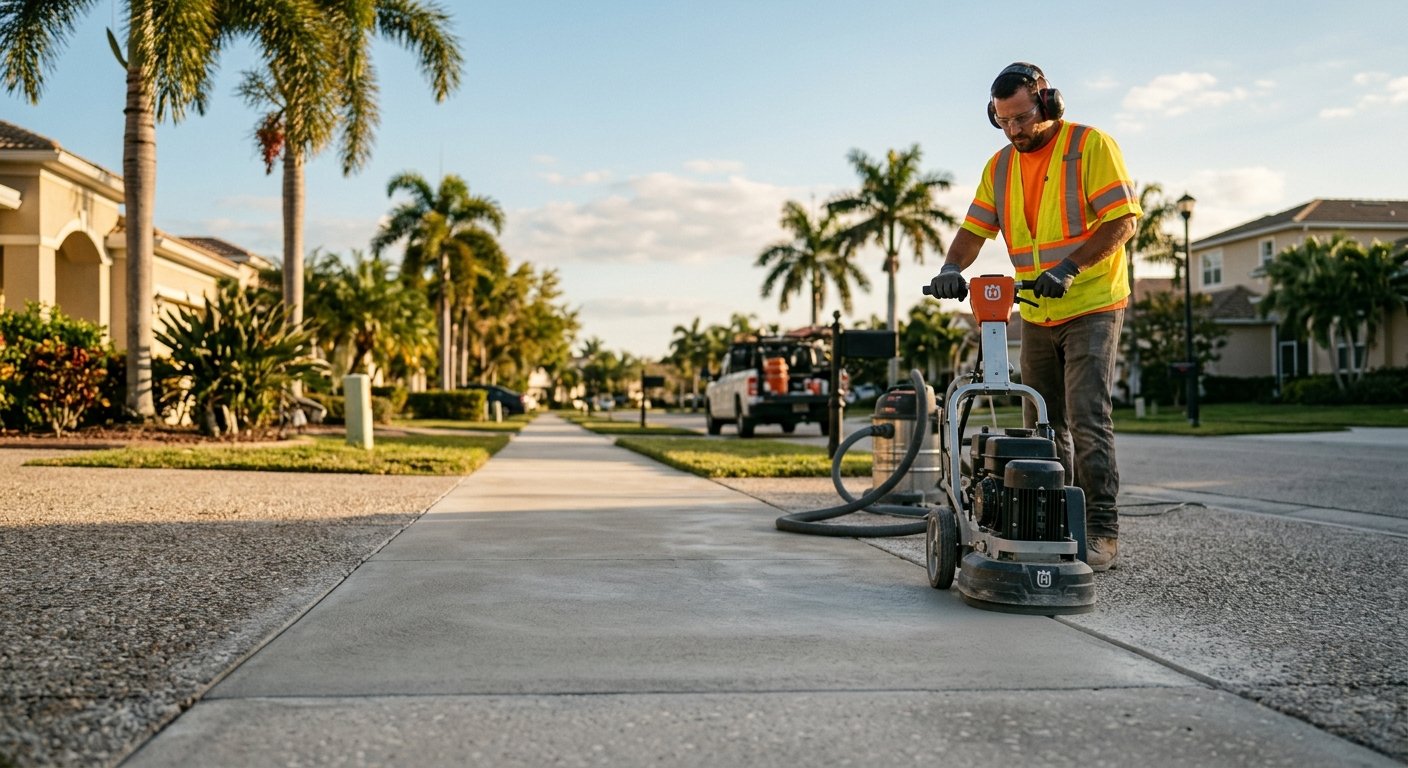
Traditional sidewalk replacement involves breaking out the existing concrete slab, hauling away the debris, forming and pouring new concrete, and waiting for it to cure — a process that can take days and generates significant demolition waste. Precision concrete cutting takes a fundamentally different approach: instead of removing the slab, a patented blade system shaves and levels the raised edge of the higher slab to create a smooth, flush, ADA-compliant transition. No jackhammers, no dumpsters, no extended lane closures.
This distinction matters both financially and practically. Replacement carries the full cost of labor, materials, disposal, and cure time. Precision cutting eliminates most of those cost centers entirely. For properties with multiple scattered hazards — which is typical across aging sidewalk networks in Palm Beach County — the savings compound rapidly. Our overview of how concrete cutting technology saves municipalities money breaks down exactly why this approach has become the preferred method for budget-conscious public works departments.
| Factor | Precision Cutting | Full Replacement |
|---|---|---|
| Cost relative to replacement | 70–90% less expensive | Baseline cost |
| Demolition waste | None | Significant |
| ADA compliance achieved | Yes | Yes |
| Cure/downtime required | Minimal — area usable same day | Days to weeks |
| Best suited for | Raised edges, root-lifted slabs, settled joints | Structurally failed, cracked-through slabs |
| Environmental impact | Low — no demolition debris | High — landfill waste generated |
When Repair Is the Right Answer
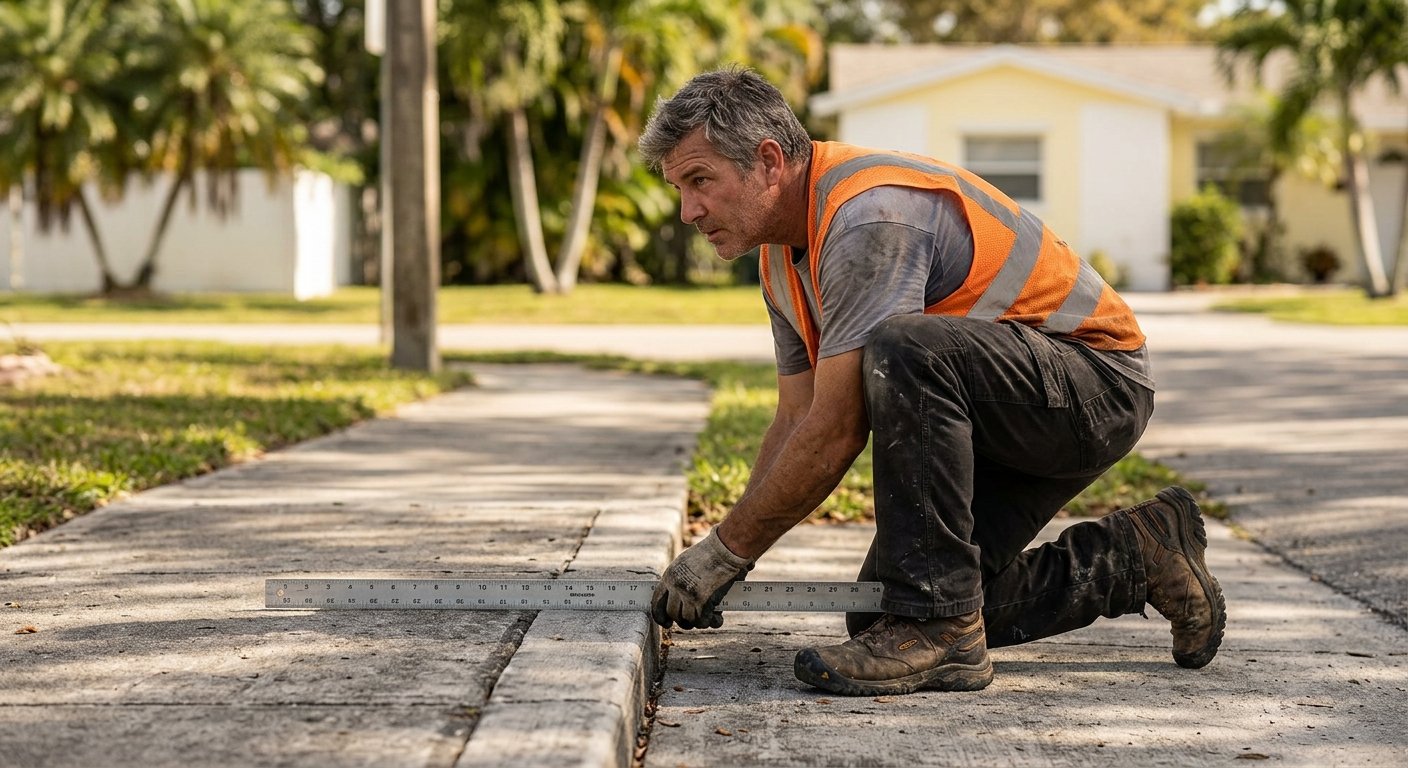
The majority of trip hazard complaints in Palm Beach and Broward counties involve slabs that are structurally sound but have shifted vertically at their joints — lifted by tree roots, settled by soil movement, or heaved by temperature cycling. These are ideal candidates for precision cutting. The slab itself retains its structural integrity; only the raised lip needs correction.
Specific scenarios where targeted trip hazard removal is clearly preferable include:
- A single slab edge that has risen 1/4 inch or more above its neighbor
- Root-lifted sections where the slab is intact but tilted at the joint
- Aging sidewalk networks with multiple isolated hazards spread across a large property
- ADA compliance notices requiring correction within a defined deadline
- HOA communities balancing reserve fund constraints with safety obligations
For a deeper look at the structural reasons sidewalks fail in the first place — and what a permanent correction actually requires — this guide on why uneven sidewalks fail covers the root causes comprehensively.
Before committing to any repair scope, have a qualified technician assess each hazard individually. A slab that looks damaged may only need edge correction, while a visually minor crack could indicate subsurface failure. Accurate assessment prevents both under-correction and unnecessary spending.
When Replacement Is Actually Necessary
Replacement becomes the appropriate choice when the structural integrity of the slab itself is compromised. Precision cutting corrects surface-level displacement — it cannot address a slab that has fractured through its full depth, sunk severely into voids beneath, or spalled to the point where the concrete surface itself is no longer stable. In those cases, the existing material cannot support a safe walking surface regardless of edge correction.
Indicators that replacement may be warranted include:
- Full-depth cracks running across the slab with visible separation
- Severe subsidence where one slab has sunk multiple inches below grade
- Spalling or surface deterioration that has exposed aggregate or rebar
- Sections where the concrete has broken into multiple loose pieces
Even in these cases, replacement should be limited to the affected slabs. Replacing entire sidewalk runs because a few sections have failed is rarely cost-effective. A professional assessment identifies exactly which sections need which treatment, protecting your budget from unnecessary scope creep.
Replacing entire sidewalk runs because a few sections have failed is rarely cost-effective — and rarely necessary.
ADA Compliance and Legal Requirements in Florida
For Palm Beach County property managers and HOA boards, ADA compliance is not abstract — it is enforced. Title II of the ADA applies to state and local governments, while Title III covers places of public accommodation. Both require accessible routes that meet the U.S. Access Board’s published accessibility guidelines, which specify the 1/4-inch vertical displacement threshold as the boundary between compliant and non-compliant surfaces.
Florida adds its own layer of enforcement through the Florida Building Code, which incorporates ADA accessibility requirements for new and altered construction. For property managers receiving compliance notices — whether from a municipal inspector, a resident complaint, or an attorney’s demand letter — understanding the precise standard that applies is essential. If you want a thorough breakdown of what compliance requires and the specific obligations it creates, our ADA compliance guide for Florida property managers is the right starting point.
Speed matters in compliance situations. Precision cutting typically allows corrections to be completed and areas reopened the same day, which means documented hazards can move from identified to corrected without the extended timelines that full replacement requires.
Assess the hazard
Measure vertical displacement at each joint. Any rise greater than 1/4 inch requires correction. Note whether slabs are structurally intact or show signs of deeper failure.
Determine the right method
Structurally sound slabs with raised edges are candidates for precision cutting. Fractured or severely sunken slabs may require targeted replacement of those specific sections.
Prioritize by risk level
High-traffic areas, ADA routes, and locations near building entrances carry the highest liability exposure. Address those first when budgets require phased approaches.
Document the correction
After repair, photograph the corrected area and measure compliance. Maintaining records of inspection and correction dates strengthens your liability defense.
Frequently Asked Questions
How much does trip hazard repair cost compared to replacement in Palm Beach County?
Precision concrete cutting for trip hazard removal is typically 70–90% less expensive than full slab replacement, according to Florida Sidewalk Solutions’ service model. Replacement involves material costs, demolition, disposal, and cure time that cutting eliminates entirely. For properties with multiple hazards, the savings across an entire network are substantial.
What qualifies as a trip hazard under ADA standards?
The ADA defines a trip hazard as any vertical change in level greater than 1/4 inch. Changes between 1/4 inch and 1/2 inch must be beveled at no more than a 1:2 slope. Any vertical displacement greater than 1/2 inch requires full correction to achieve compliance. These thresholds apply to sidewalks, pathways, and all pedestrian routes covered under the ADA.
Can precision cutting achieve ADA compliance on any raised slab?
Precision cutting achieves ADA-compliant results on structurally intact slabs where the problem is vertical displacement at the joint. If a slab has fractured through its full depth or sunk severely due to subsurface voids, cutting the edge alone will not produce a safe surface — targeted replacement of that section is necessary. A site assessment determines which approach applies.
How long does precision cutting take compared to replacement?
Precision cutting is typically completed in a single visit, and the treated area is usable the same day with no curing period required. Full slab replacement involves concrete cure time that can extend lane or path closures for days. For properties with active pedestrian traffic, the difference in downtime is significant.
Does fixing trip hazards eliminate my liability as a property owner?
Prompt, documented repair of known hazards substantially strengthens your legal position, but no repair method provides absolute immunity from claims. What matters legally is that you identified the hazard and corrected it to code within a reasonable timeframe. Maintaining records of inspection dates, repair dates, and post-repair measurements is the best protection available.
Making the Right Call for Your Property
The repair-versus-replace decision comes down to one practical question: is the slab structurally sound? If yes, precision concrete cutting delivers ADA compliance, eliminates the trip hazard, and does it at a fraction of the cost of replacement — with no demolition waste and minimal disruption to your residents, tenants, or the public. If the slab itself has failed structurally, targeted replacement of those specific sections is the correct answer, and cutting is not a substitute.
For Palm Beach County and Broward County properties with aging sidewalk networks, the most common finding is that the vast majority of hazards are candidates for cutting — not replacement. That assessment, done accurately by an experienced specialist, is what separates a well-managed compliance program from one that burns through capital unnecessarily.
With 20 years of Florida sidewalk safety experience and patented precision cutting technology, Florida Sidewalk Solutions has performed this assessment thousands of times across South Florida’s commercial properties, HOA communities, and municipal sidewalk networks. Licensed and insured, and specializing in ADA compliance, the team brings the experience to get it right the first time.
Schedule a Trip Hazard Assessment
Contact Florida Sidewalk Solutions to have your Palm Beach or Broward County property evaluated — and get a clear recommendation on which hazards need cutting, which need replacement, and what compliance will cost.
About Florida Sidewalk Solutions
Florida Sidewalk Solutions specializes in sidewalk safety, ADA compliance, and trip hazard prevention for Florida property managers, municipalities, and commercial property owners. Using patented concrete cutting technology, they deliver cost-effective repairs that are 70-90% less expensive than replacement, with minimal disruption and no demolition waste. With 20 years of Florida-specific experience, they provide the expert solution for eliminating liability risks while meeting ADA standards and legal requirements. Visit floridasidewalksolutions.com →