
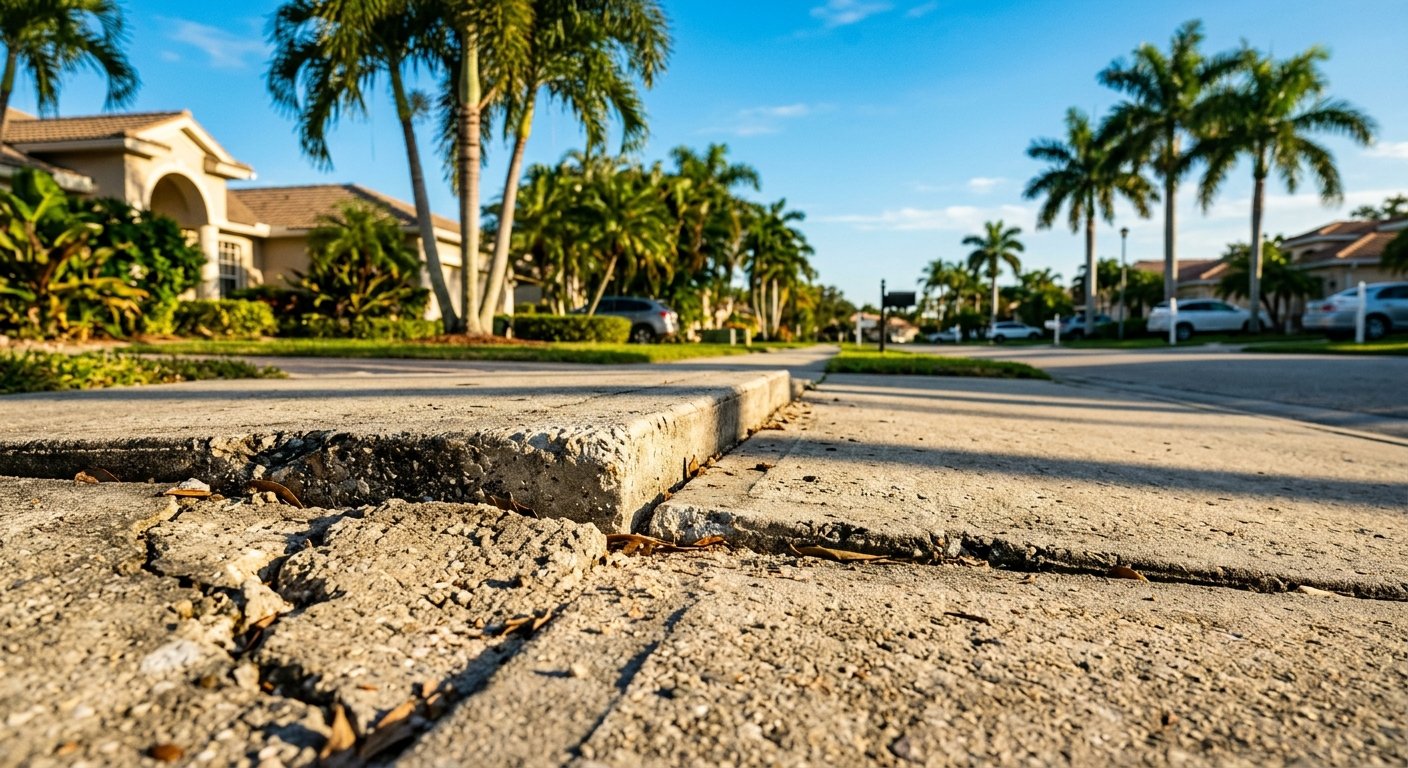
In Florida, when someone trips and falls on a defective sidewalk, the property owner, HOA, municipality, or business controlling that sidewalk is typically responsible for damages — but liability depends on who owns and maintains the walkway, whether they had notice of the hazard, and whether they acted reasonably. Understanding this framework before an accident occurs is the difference between manageable risk and a costly lawsuit.
- Liability follows control: whoever owns or maintains a sidewalk generally bears responsibility for injuries caused by its condition.
- Florida’s premises liability law requires property owners to maintain safe conditions for invited guests and warn of known hazards.
- HOAs, municipalities, and commercial property owners each face distinct — and significant — legal exposure.
- A vertical displacement greater than ¼ inch qualifies as a trip hazard under ADA standards and signals negligence in court.
- Proactive repair is nearly always less expensive than litigation, and concrete cutting repairs cost a fraction of full replacement.
How Florida Premises Liability Law Works for Sidewalks
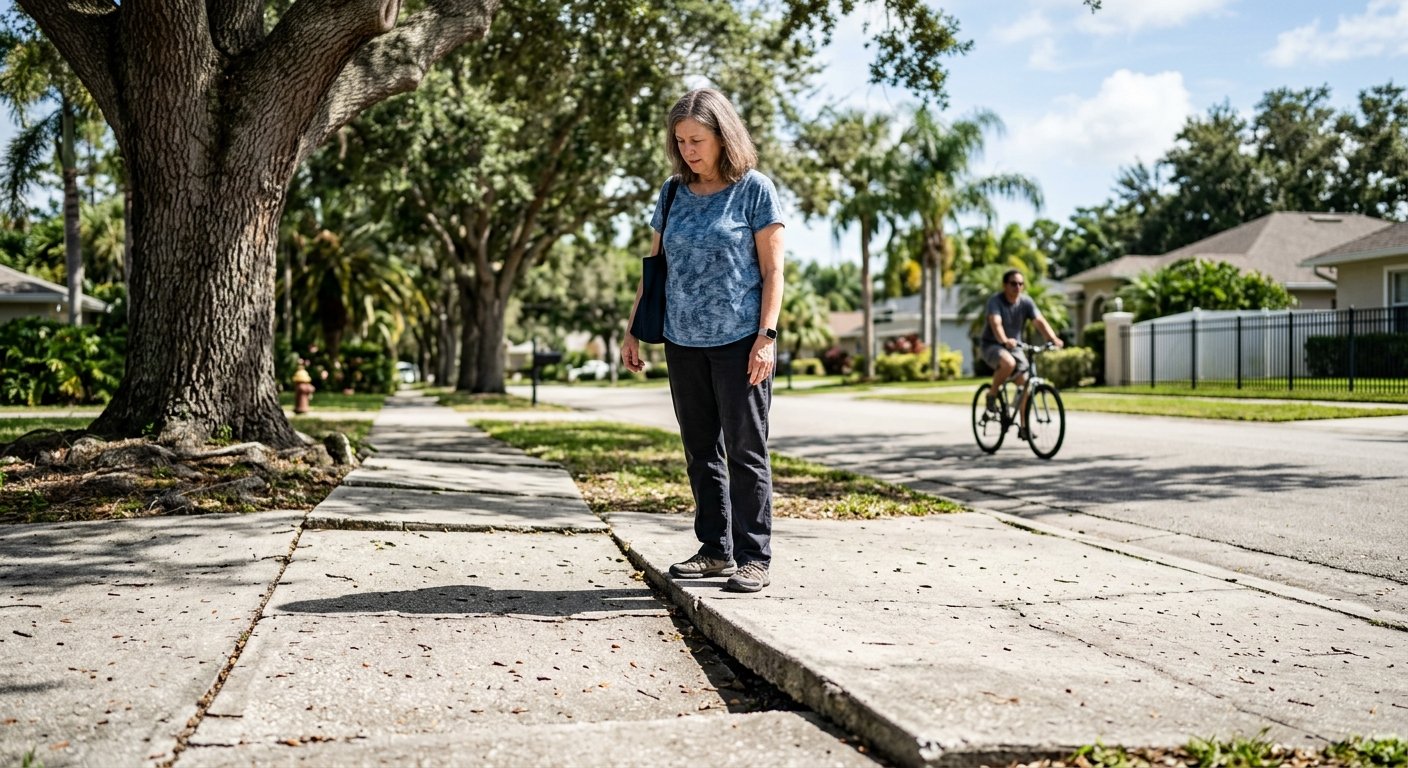
Florida’s premises liability framework, established under Florida Statute § 768.0755, holds property owners accountable when they knew — or should have known — about a dangerous condition and failed to correct it or warn visitors. Sidewalks fall squarely within this standard. A cracked panel, a root-lifted slab, or a raised edge greater than ¼ inch can all form the factual basis of a negligence claim.
For a plaintiff to succeed in a trip and fall lawsuit, they generally must prove four elements: the property owner owed them a duty of care, a hazardous condition existed, the owner had actual or constructive notice of it, and that condition caused the injury. Courts in Palm Beach and Broward County see these cases regularly, and juries are rarely sympathetic to defendants who ignored an obvious defect for months or years.
Florida’s comparative negligence rule (modified in 2023) now bars recovery if a plaintiff is found more than 50% at fault. However, this does not reduce a property owner’s duty to keep walkways in safe, code-compliant condition.
Who Is Actually Liable? Breaking Down the Key Parties
Commercial Property Owners and Landlords
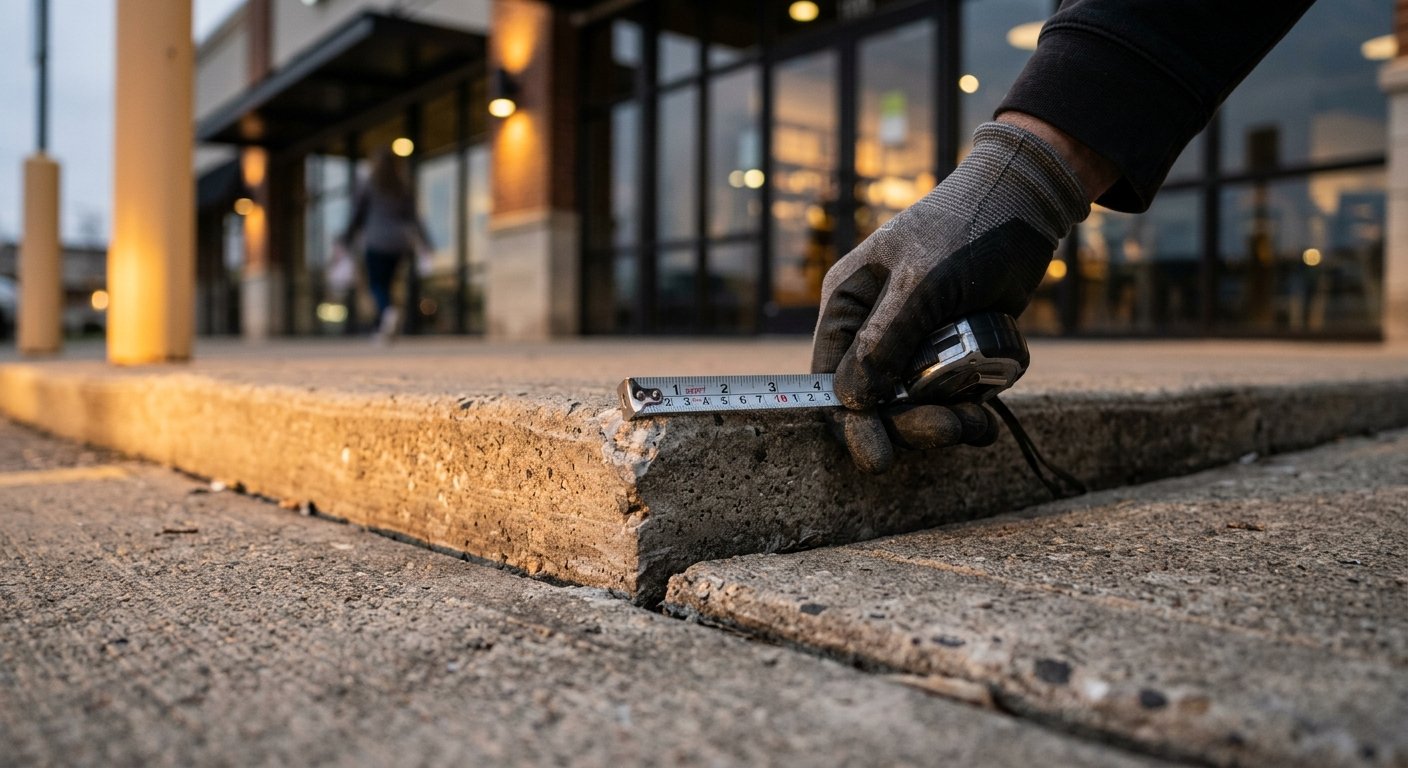
Business owners in Broward and Palm Beach County owe the highest duty of care to customers and clients — known in legal terms as “invitees.” That means actively inspecting the property, identifying hazards, and repairing them within a reasonable time. A raised sidewalk slab at a shopping center entrance or restaurant walkway is exactly the kind of defect that generates trip hazard insurance claims. If an owner knew about the issue and did nothing, courts typically find that knowledge alone sufficient to establish negligence.
HOA Sidewalk Liability in Florida
Homeowners associations that maintain community sidewalks, common areas, or private streets take on legal responsibility for those surfaces. HOA sidewalk liability in Florida is a growing area of litigation, particularly as aging communities see tree root intrusion buckle concrete panels throughout their neighborhoods. The critical question is whether the HOA had notice and a reasonable opportunity to repair. Regular inspection programs — and documented repair records — are the HOA’s best defense and best risk management tool simultaneously.
Municipal Sidewalk Liability
Cities and counties occupy a unique legal position. Under Florida’s sovereign immunity doctrine, municipalities are protected from unlimited lawsuits, but that protection is capped — not absolute. Injured parties can still pursue claims against local governments for sidewalk negligence. Municipal sidewalk liability cases often hinge on whether a formal notice of the defect was submitted through official channels and whether the city responded within a reasonable period. Municipalities that defer maintenance year after year carry real financial exposure when injuries occur.
Homeowners and Residential Owners
Residential homeowners are sometimes surprised to learn they may be responsible for the sidewalk running in front of their home, even if it is technically city property. Municipal ordinances in many South Florida cities require abutting property owners to maintain adjacent sidewalks. When this language is in place, liability can shift to the homeowner even for a publicly owned walkway.
The critical question is never “whose concrete is it?” — it is “who had the duty to maintain it, and did they?”
The Role of ADA Standards in Liability Claims
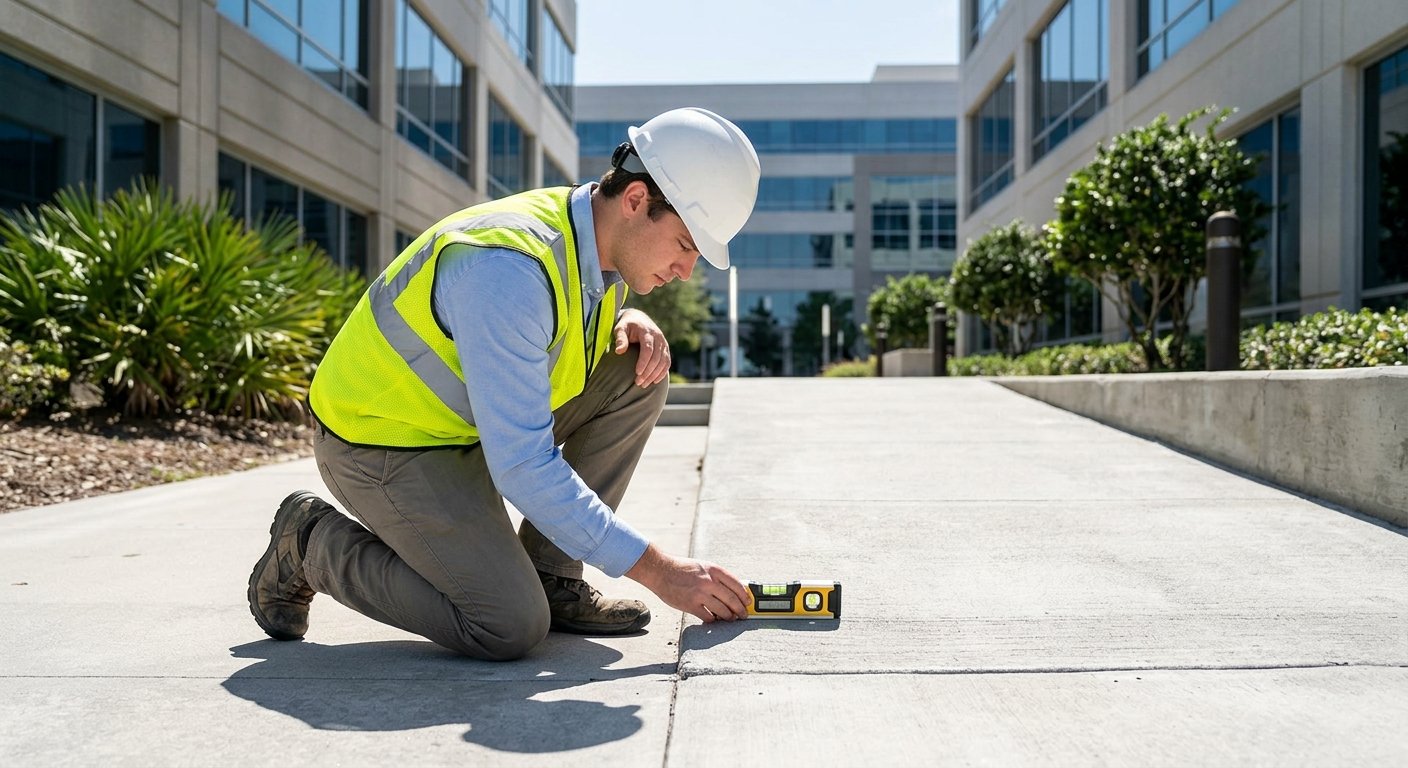
The 2010 ADA Standards for Accessible Design set clear thresholds for walkway surfaces. Any vertical change in elevation greater than ¼ inch without a proper bevel is a code violation and a trip hazard. Changes between ¼ inch and ½ inch must be beveled at no more than a 1:2 slope. Anything beyond ½ inch must be ramped. These measurements are not suggestions — they are compliance benchmarks that plaintiff’s attorneys use directly in sidewalk accident liability cases.
When a property’s sidewalk has documented ADA violations, the owner’s legal position weakens considerably. The defect is not just a maintenance issue; it is a failure to meet a federal accessibility standard. This is why ADA compliance is inseparable from liability protection — fixing one solves both problems at once.
Many property owners assume ADA compliance only applies to accessible parking or ramps. In practice, any public-facing walkway on commercial, institutional, or multi-family property must meet ADA surface requirements — including the ¼ inch vertical displacement threshold.
Notice: The Factor That Often Decides the Case
Courts look carefully at whether a property owner had “notice” of the defect. Actual notice means the owner was specifically told about the problem — a maintenance request, a complaint email, a prior incident report. Constructive notice means the defect was so visible and long-standing that any reasonable owner conducting regular inspections would have discovered it.
An unrepaired raised slab that has been growing for two years while palm tree roots push it higher is constructive notice. Cracked concrete at a main building entrance that appears in inspection photos from 18 months ago is constructive notice. Property managers who implement and document regular sidewalk inspections are in a much stronger position — both legally and practically — than those who react only when someone falls.
Understanding the full scope of Florida sidewalk liability lawsuits helps property managers prioritize which hazards to address first and why documentation matters at every step.
Repair as a Risk Management Strategy
The most reliable way to reduce sidewalk trip and fall liability is to eliminate the hazard before it injures someone. For most property managers in Palm Beach and Broward County, the practical obstacle has been cost — traditional full-slab replacement is expensive, time-consuming, and disruptive to tenants, residents, and visitors.
Florida Sidewalk Solutions addresses this directly with patented precision concrete cutting technology that levels raised slabs and eliminates trip hazards without demolition or replacement. The result is a smooth, safe, code-compliant surface achieved in a fraction of the time and cost of conventional repair methods. Properties that previously deferred maintenance for budget reasons find this approach genuinely accessible, which means hazards get addressed rather than put off until an injury occurs.
Sidewalk Inspection
A licensed technician surveys the property, identifies all vertical displacements greater than ¼ inch, and documents each hazard — creating a record of due diligence.
Hazard Assessment
Hazards are prioritized by severity, traffic volume, and ADA compliance status so the most critical trip hazards are addressed first.
Precision Cutting Repair
Using patented concrete cutting technology, raised slabs are leveled to eliminate vertical displacement and restore ADA-compliant surfaces — no jackhammering, no demolition debris.
Documentation Provided
Completed repairs are documented, giving property managers a defensible record that hazards were identified and corrected promptly.
For a detailed look at repair methods and what to expect during service, the trip hazard repair page covers the process and outcomes in full.
Frequently Asked Questions
Can a property owner be sued even if they didn’t know about the trip hazard?
Yes. Florida law recognizes “constructive notice,” meaning if a hazard was visible and long-standing, a court may find the owner should have known about it through reasonable inspection. Ignorance of an obvious defect is not a legal defense.
Is an HOA responsible for sidewalk injuries in a community?
Generally yes, when the HOA maintains the sidewalk as part of the common area. HOA sidewalk liability in Florida depends on the governing documents, maintenance obligations, and whether the HOA had notice of the hazard. HOAs with documented inspection and repair programs are in a significantly stronger legal position.
What makes a sidewalk defect a legal trip hazard?
Under ADA standards, any vertical displacement greater than ¼ inch qualifies as a trip hazard. This threshold is widely used in Florida premises liability cases as a measurable benchmark for negligence. Even a seemingly small raised edge at this level can cause serious falls.
Can municipalities be sued for sidewalk trip and fall accidents?
Yes, within limits. Florida’s sovereign immunity doctrine caps municipal liability, but cities and counties are not immune from negligence claims related to sidewalk maintenance. Claims against government entities also typically have strict notice requirements and shorter filing windows than standard civil suits.
How does repairing a hazard affect a property owner’s liability?
Prompt, documented repair demonstrates that the owner fulfilled their duty of care. It removes the hazard and creates a record showing the property was actively maintained — both of which are valuable if a prior incident is later raised in litigation. Repair does not erase prior liability but does interrupt ongoing exposure.
The Cost of Inaction
Trip and fall claims are among the most common premises liability cases in South Florida courts. Legal defense costs, settlements, and increased insurance premiums routinely dwarf the cost of the repair that would have prevented the injury. For property managers and HOA boards operating under tight budgets, the math consistently favors proactive maintenance over reactive crisis management.
Florida Sidewalk Solutions has spent more than 20 years helping Palm Beach and Broward County property owners, municipalities, and HOAs address sidewalk hazards efficiently, affordably, and in full compliance with ADA requirements. Licensed, insured, and equipped with patented cutting technology, the team delivers results that protect both pedestrians and the people responsible for their safety.
Get a Professional Sidewalk Safety Assessment
Contact Florida Sidewalk Solutions today to schedule an inspection — before a hazard becomes a claim.

About Florida Sidewalk Solutions
Florida Sidewalk Solutions specializes in sidewalk safety, ADA compliance, and trip hazard prevention for Florida property managers, municipalities, and commercial property owners. Using patented concrete cutting technology, they deliver cost-effective repairs that are 70-90% less expensive than replacement, with minimal disruption and no demolition waste. With 20 years of Florida-specific experience, they provide the expert solution for eliminating liability risks while meeting ADA standards and legal requirements. Visit floridasidewalksolutions.com →