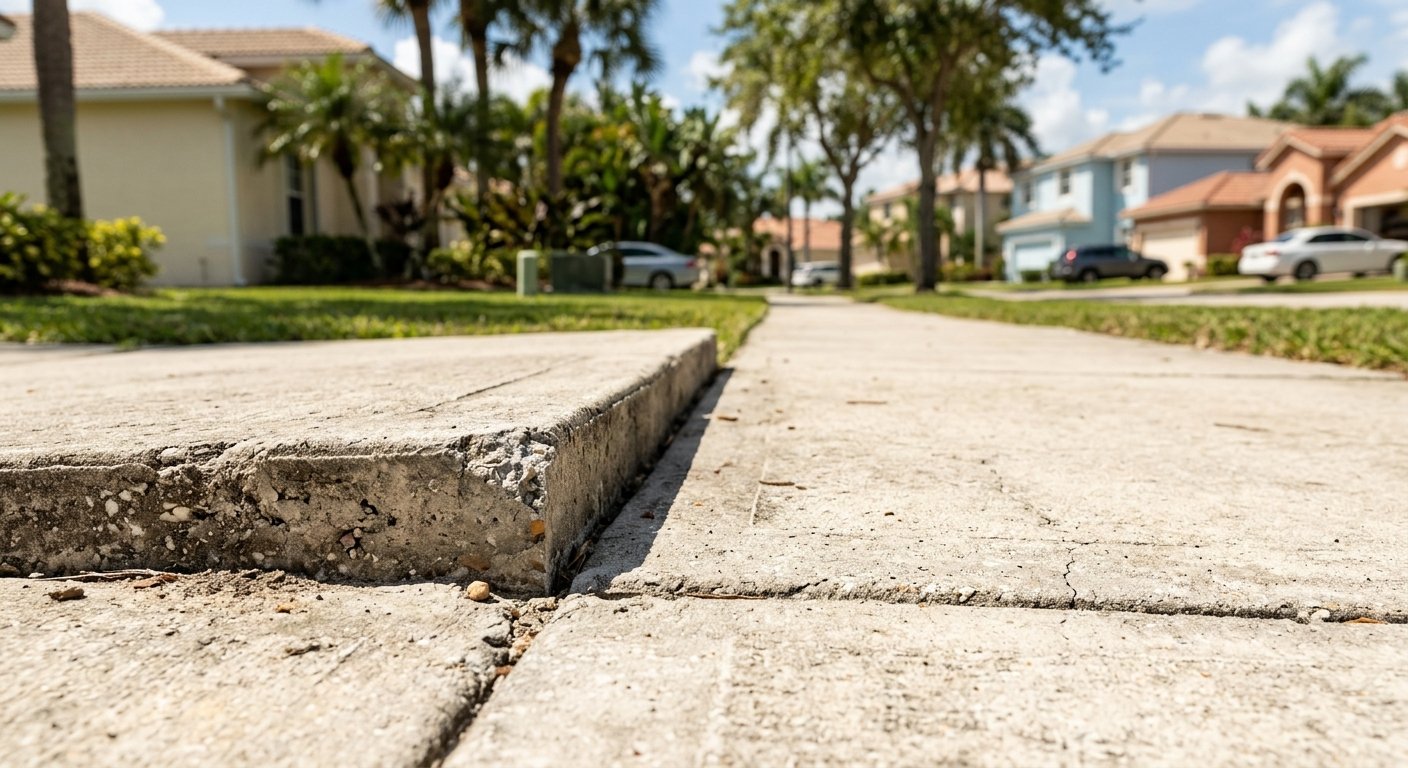
Florida HOAs face direct premises liability exposure when uneven sidewalks on their property cause a trip and fall injury. Under Florida’s premises liability law, an HOA that knows — or should know — about a sidewalk defect and fails to correct it can be held liable for resulting injuries. The legal and financial consequences are serious, and the good news is that cost-effective repair solutions exist.
- Florida HOAs have a legal duty to maintain sidewalks in reasonably safe condition for residents and guests.
- A vertical displacement of more than 1/4 inch meets the ADA’s definition of a trip hazard — and a plaintiff’s attorney’s definition too.
- Documenting hazards without promptly repairing them can actually strengthen a negligence claim against your association.
- Precision concrete cutting repairs trip hazards without demolition, typically completing faster and at a fraction of replacement cost.
- Early intervention is always less expensive than litigation — in time, money, and community disruption.
Why Florida HOAs Are Especially Vulnerable
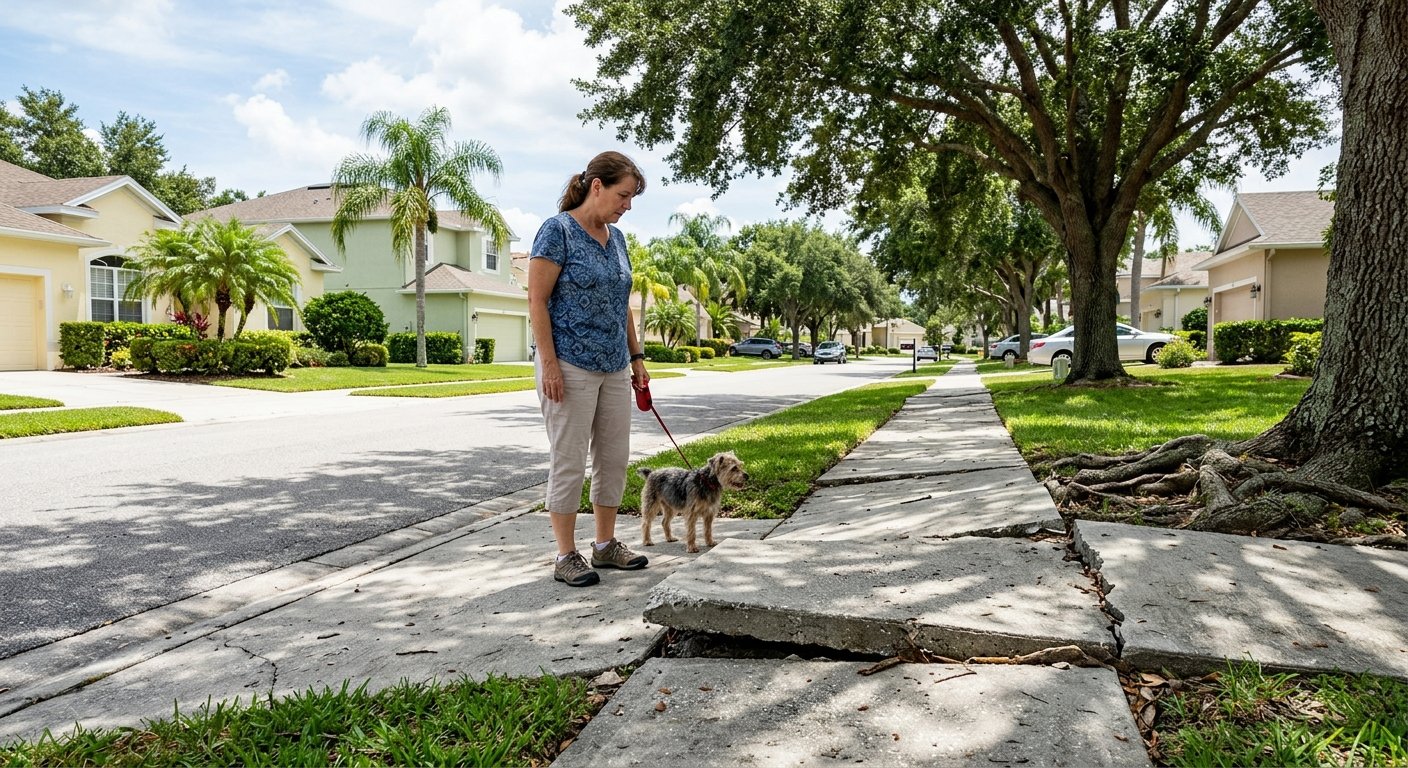
Florida’s aging residential infrastructure, combined with the state’s active root growth and heavy rainfall cycles, creates a particularly aggressive environment for sidewalk deterioration. Concrete panels heave, separate, and settle faster here than in drier climates. For HOA boards in Palm Beach County and Broward County, that means sidewalk defects appear year-round — not just after a single freeze-thaw season like northern communities experience.
What makes the liability picture particularly sharp in Florida is the sheer volume of foot traffic on HOA-controlled walkways. Residents, their guests, service vendors, mail carriers, and emergency responders all use community sidewalks daily. Every one of them is an invitee under Florida premises liability law, meaning the HOA owes them the highest standard of care: regular inspection, prompt hazard identification, and timely repair.
In Florida, a written notice of a trip hazard — a resident complaint email, a board meeting mention, or a maintenance report — can be used in court to establish that the HOA had actual knowledge of the defect. Awareness without action is among the strongest arguments a plaintiff’s attorney can make.
Florida’s premises liability framework is governed by Florida Statute § 768.0755, which addresses slip and fall liability on transitory foreign substances. While trip-and-fall cases involving fixed structural defects like uneven sidewalks operate under the general negligence standard for invitees, the underlying principle is the same: property owners must maintain safe conditions and warn of known hazards. HOA boards that treat sidewalk repair as optional are operating with significant legal exposure.
The ADA Factor: A Second Layer of Risk
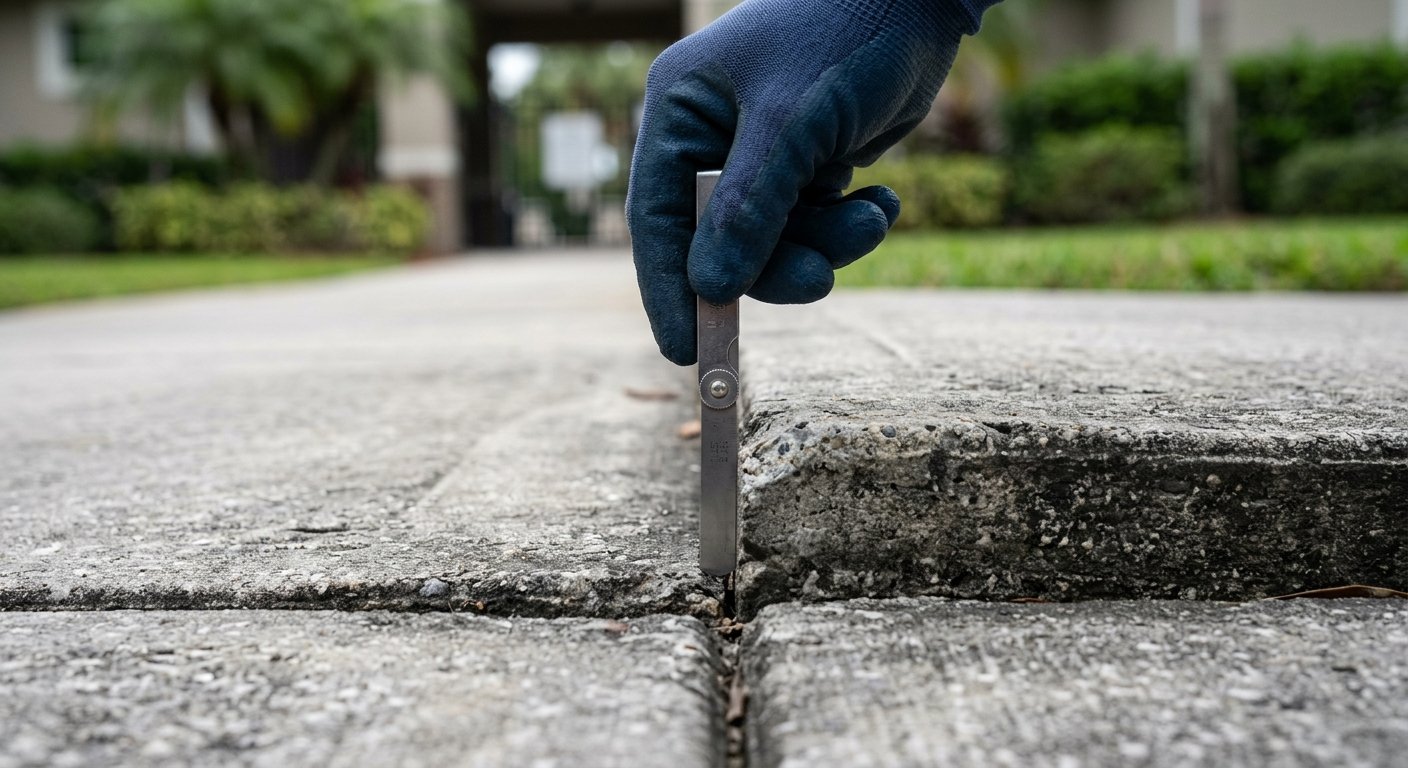
Beyond premises liability, HOAs that serve communities with common areas accessible to the public — or that receive any federal funding — may also face obligations under the Americans with Disabilities Act. The ADA’s Architectural Barriers Act Accessibility Guidelines establish that any vertical change in a walking surface greater than 1/4 inch constitutes a trip hazard and an accessibility barrier. Vertical changes between 1/4 and 1/2 inch must be beveled at no steeper than a 1:2 slope.
For HOAs, this means a cracked or heaved sidewalk panel isn’t just an injury risk — it’s potentially a federal compliance failure. Our team works with property managers across South Florida on ADA compliant sidewalks that meet both federal accessibility standards and Florida code requirements simultaneously, addressing both liability concerns in a single visit.
A sidewalk defect your board documented but didn’t fix is often more damaging in litigation than one you never knew about.
What Trip and Fall Claims Actually Cost HOAs
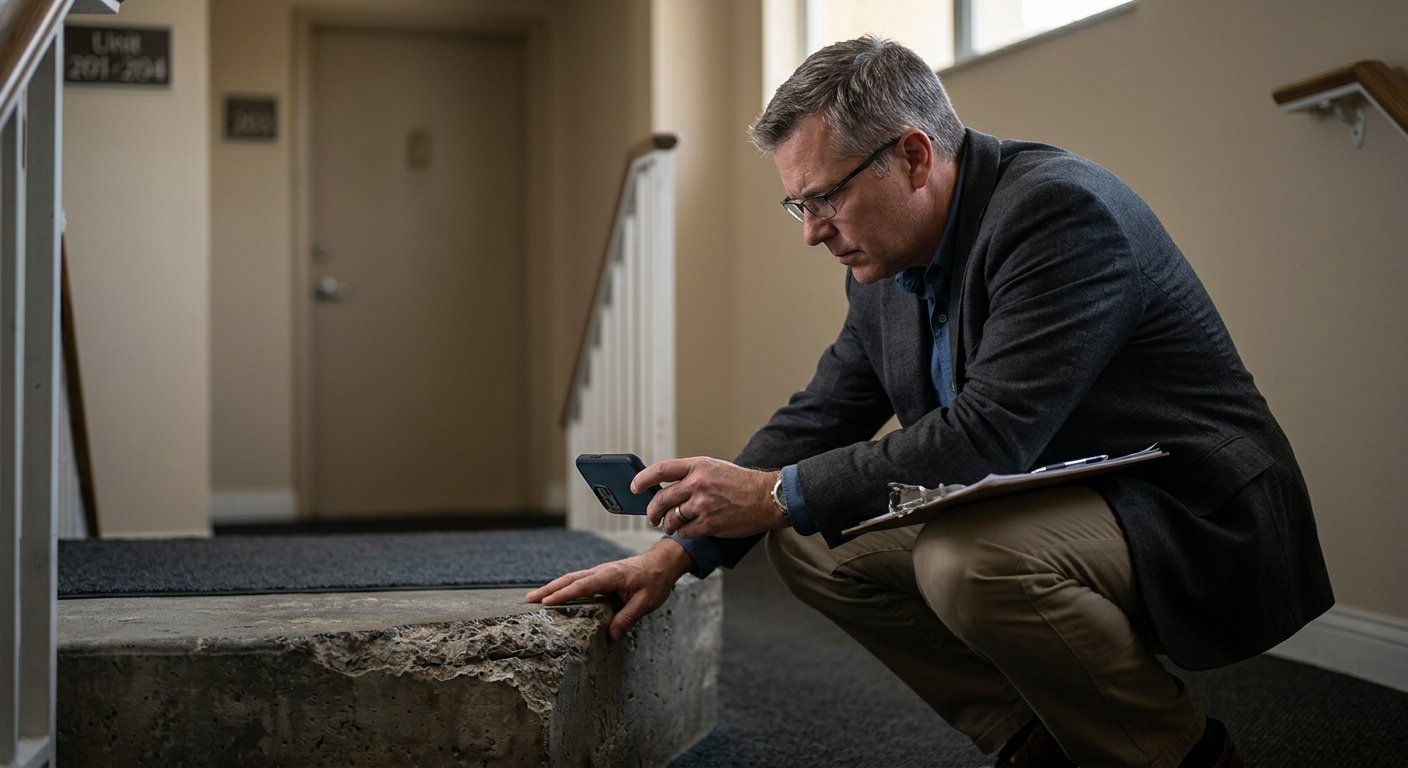
The financial exposure from a single trip-and-fall claim against an HOA extends well beyond a settlement check. When a claim is filed, the HOA’s insurance carrier typically investigates, defends, and potentially settles — but that process drives up premiums for subsequent years. An HOA with multiple claims may find itself placed in a higher-risk tier, paying significantly more annually for general liability coverage, or facing policy non-renewal.
Beyond the insurance impact, there are legal defense costs even in claims that are ultimately dismissed, staff and board time consumed by depositions and documentation requests, and the reputational effect on property values within the community. Homeowners who feel unsafe — or who worry about the association’s financial exposure — may become vocal at board meetings or push for leadership changes.
Many HOA insurance policies include specific sidewalk maintenance requirements. Failing to document and address known defects can give a carrier grounds to contest coverage on a trip-and-fall claim, leaving the association to fund its own defense.
The math is straightforward: proactive trip hazard repair costs a fraction of what even a modest settlement costs — and it eliminates the chain of downstream expenses entirely.
How Precision Concrete Cutting Changes the Repair Equation
For decades, HOAs faced a difficult choice when sidewalks deteriorated: grind down the raised edge (a temporary fix that often fails within a season or two), or replace the entire panel at significant cost and disruption. Neither option was ideal, and many boards deferred action entirely — which is exactly how liability exposure accumulates.
Florida Sidewalk Solutions uses patented precision concrete cutting technology that removes the trip hazard cleanly and permanently by cutting the raised section to create a flush, level transition. Unlike surface grinding, which removes only a thin layer and leaves a rough, rounded edge, precision cutting produces a clean bevel that meets ADA slope specifications and holds up to South Florida’s climate and traffic conditions.
| Repair approach | Concrete grinding | Precision cutting | Full panel replacement |
|---|---|---|---|
| ADA compliance | Often marginal | Yes — meets 1:2 bevel standard | Yes, if installed correctly |
| Disruption to residents | Low, but short-lived result | Minimal — no demolition | High — curing time, access blocked |
| Demolition waste | Minimal | None | Significant concrete disposal |
| Longevity | Months to a year | Long-lasting structural repair | Dependent on subsurface conditions |
| Relative cost | Low upfront, repeating | Cost-effective, lasting | Highest |
With 20 years serving Palm Beach County and Broward County communities, our team has completed assessments and repairs for HOAs of every size — from small gated neighborhoods to large master-planned communities. Licensed and insured, we provide written documentation of each repair for the HOA’s records, which is important for demonstrating due diligence if a claim is ever filed.
What a Proactive Sidewalk Safety Program Looks Like
The HOAs that manage their sidewalk liability most effectively don’t wait for a fall to prompt action. They build sidewalk safety into their regular property management cycle. Here’s what that typically looks like in practice:
Annual professional assessment
A qualified contractor walks the entire sidewalk network and documents every displacement greater than 1/4 inch, producing a written hazard log with measurements and photographs.
Prioritize by risk level
High-traffic areas near mailboxes, entrances, pools, and parking lots get addressed first. Lower-traffic paths can be scheduled for the next service cycle.
Repair and document
Precision cutting repairs are completed with minimal disruption. Each repaired location is documented with before-and-after measurements and photos for the association’s records.
Communicate to residents
Notify homeowners of completed repairs. This reinforces board diligence and discourages frivolous claims by demonstrating the association’s proactive maintenance posture.
Repeat on a regular cycle
Florida’s root activity and soil movement mean new displacements will appear. A consistent inspection schedule keeps hazards from accumulating undetected.
This kind of systematic approach also supports the HOA’s position if a claim is ever filed. An association with documented inspection records and a consistent repair history is in a meaningfully stronger legal position than one that reacted only after someone was hurt. Learn more about how Florida sidewalk liability lawsuits unfold and what documentation matters most.
Frequently Asked Questions
How does an HOA establish it wasn’t negligent in a trip and fall case?
The strongest defense is documented evidence of regular inspection and prompt repair. If your association can show a written inspection log, photographs, and repair records demonstrating that hazards were identified and addressed in a timely manner, it supports the argument that the association exercised reasonable care. Boards that only respond after an incident have a much harder time making that case.
Does a small sidewalk crack — less than 1/4 inch — create liability?
Under ADA standards, vertical displacements up to 1/4 inch are within tolerance. However, Florida premises liability law asks whether a condition was “unreasonably dangerous” — a question that depends on the totality of circumstances, not a single measurement. A crack that is expanding, that has sharp edges, or that occurs in a high-traffic area may still warrant attention even if it doesn’t yet meet the 1/4-inch threshold.
Is full sidewalk panel replacement ever necessary?
Full replacement is warranted when the structural integrity of the panel is compromised — severe cracking throughout, significant subsidence, or damage caused by an underlying drainage failure. In many cases, however, the defect is at the joint between panels, and precision cutting addresses the hazard without replacing the panels themselves. A professional assessment will identify which approach fits each specific condition.
How quickly can trip hazard repairs be scheduled in Palm Beach or Broward County?
Because precision concrete cutting requires no demolition or curing time, repairs can typically be completed in a single visit with minimal advance setup. Most HOA projects in our service area are scheduled and completed within a short turnaround, with sidewalks returning to full use immediately after the work is done — no waiting for concrete to cure.
Will our HOA’s insurance carrier want documentation of repairs?
Many carriers look favorably on documented repair activity when evaluating a claim — it supports the argument that the association was exercising reasonable care. It is always worth reviewing your specific policy language and speaking with your insurance representative about what maintenance documentation they recommend. Florida Sidewalk Solutions provides written before-and-after documentation for every repair, which HOA boards can retain in their records.
Protect Your HOA Before the Next Claim
A professional sidewalk assessment from Florida Sidewalk Solutions gives your board the documentation and repairs needed to address hazards proactively — before they become a lawsuit.
About Florida Sidewalk Solutions
Florida Sidewalk Solutions specializes in sidewalk safety, ADA compliance, and trip hazard prevention for Florida property managers, municipalities, and commercial property owners. Using patented concrete cutting technology, they deliver cost-effective repairs that are 70-90% less expensive than replacement, with minimal disruption and no demolition waste. With 20 years of Florida-specific experience, they provide the expert solution for eliminating liability risks while meeting ADA standards and legal requirements. Visit floridasidewalksolutions.com →