
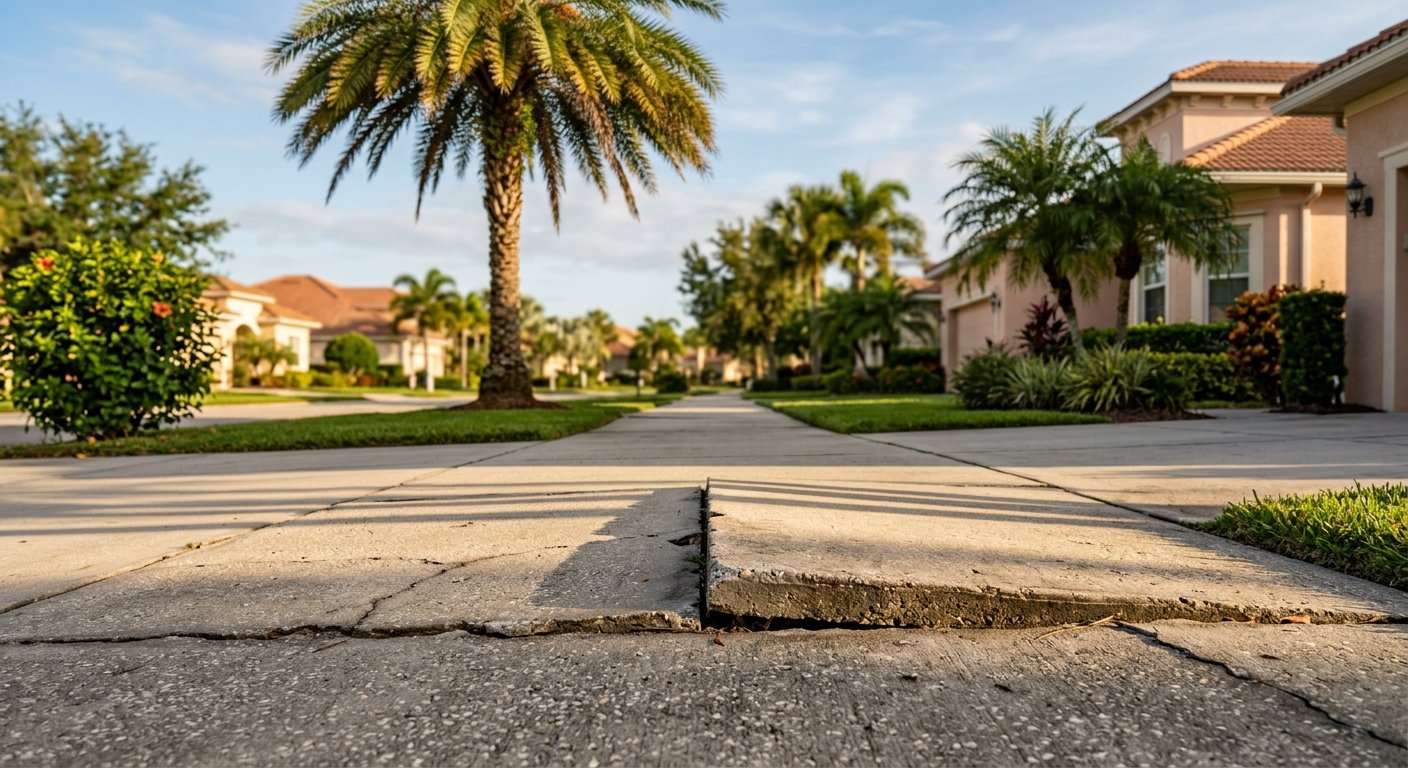
A single trip-and-fall accident on a cracked sidewalk can cost a Florida HOA tens of thousands of dollars — and that’s before attorneys’ fees, settlements, or increased insurance premiums. Yet board members across Palm Beach County and Broward County continue to defer sidewalk repairs, unaware of the legal exposure accumulating with every ignored crack and raised panel.
Florida premises liability law places a clear duty of care on property owners and associations. When a guest, resident, or visitor is injured on a defective sidewalk that the HOA knew about — or should have known about — the association can be held legally responsible. Understanding that exposure, and knowing how to address it cost-effectively, is one of the most important things any HOA board can do in 2026.
Florida Premises Liability and Your HOA’s Legal Duty
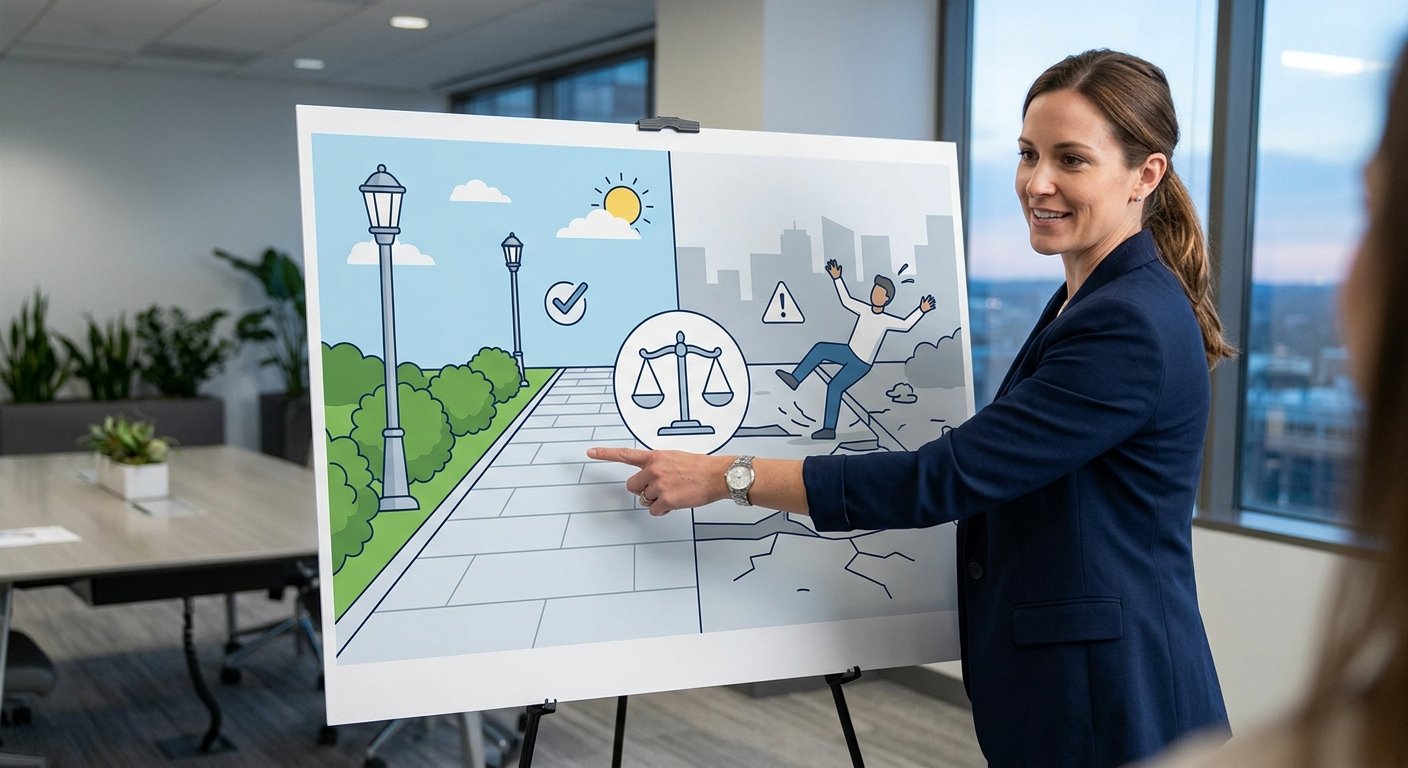
Under Florida law, property owners owe a duty of reasonable care to those who are lawfully on their property. For HOAs, this means maintaining common areas — including sidewalks and walkways — in a reasonably safe condition. When that duty is breached and someone is injured, the association can face a premises liability lawsuit.
Florida Statute §768.0755 governs slip and fall cases on business premises, but broader negligence principles apply to HOA common areas. Courts have consistently held that when an association has actual or constructive knowledge of a hazard — meaning they knew or should have known through reasonable inspection — they are liable for resulting injuries.
The critical phrase is constructive knowledge. You don’t have to have received a written complaint about a cracked sidewalk to be liable. If a reasonable inspection would have revealed the hazard, courts may find the HOA responsible. This is why proactive sidewalk inspection and repair are not optional — they are a core part of responsible association management.
For more detailed context on how these cases play out in Florida, the sidewalk liability pillar resource covers the legal landscape in depth.
What Makes a Sidewalk a Legal Liability?
Not every crack creates legal exposure, but Florida courts and ADA guidelines both recognize specific thresholds. The most commonly cited standard for a trip hazard is a vertical displacement of ½ inch or more between adjoining concrete panels. Once a surface irregularity meets or exceeds that measurement, it is considered an actionable hazard under ADA accessibility guidelines and is routinely cited in personal injury lawsuits.
Common sidewalk conditions that create HOA liability include:
- Raised or sunken concrete panels caused by tree root intrusion
- Cracked or spalled concrete with surface irregularities
- Gaps or lips at panel joints
- Sloped or cross-sloped surfaces that exceed ADA grade limits
- Missing or damaged curb ramps that fail ADA accessibility requirements
In Florida communities with mature tree canopies — extremely common in Palm Beach County and Broward County neighborhoods — tree root uplift is the single most frequent cause of trip hazards. Roots growing beneath concrete panels push them upward unevenly, creating exactly the kind of raised lip that catches feet and causes falls.
ADA Compliance: More Than a Federal Requirement
The Americans with Disabilities Act requires accessible routes through common areas in housing communities that fall under its coverage. For HOAs with common-area sidewalks, pathways to amenities, or public-facing walkways, ADA compliance is a legal obligation — not a voluntary upgrade.
The U.S. Access Board’s ADA Accessibility Guidelines specify requirements for sidewalk width, slope, cross-slope, surface continuity, and curb ramp design. Non-compliant surfaces expose HOAs not only to personal injury lawsuits but also to federal ADA complaints and the legal fees that come with defending them.
In practical terms, an HOA that has uneven sidewalks may simultaneously be violating ADA standards and Florida premises liability law — doubling its legal exposure from a single deferred maintenance issue. For a comprehensive look at what ADA compliance requires in South Florida communities, visit the ADA compliance resource.
The Cost of Doing Nothing vs. The Cost of Repair
HOA boards often defer sidewalk repairs because of budget constraints. It’s understandable — reserve funds are finite and competing priorities are real. But the math of deferred repairs rarely works in the association’s favor.
A single trip-and-fall settlement in Florida can range from $50,000 to well over $200,000 depending on the severity of injury, the clarity of the hazard, and the HOA’s history of inspections and maintenance. Legal defense costs alone — even in cases the association ultimately wins — routinely reach $20,000 to $40,000. And that says nothing about increased insurance premiums following a claim.
Compare that to the cost of professional trip hazard repair using precision concrete cutting technology. Florida Sidewalk Solutions’ patented cutting method costs 70 to 90 percent less than full sidewalk replacement, addresses the hazard permanently without demolition, and can be completed with minimal disruption to residents and traffic. There is no concrete debris, no extended curing time waiting for new slabs, and no landscaping damage from heavy equipment.
For a full breakdown of repair options and their costs, the trip hazard repair overview explains the process in detail.
Why Cutting Outperforms Grinding and Replacement
When a trip hazard is identified, HOAs typically have three repair options: grinding, cutting, or full panel replacement. Understanding the difference is important for boards making long-term maintenance decisions.
Concrete Grinding
Grinding removes material from the higher panel to reduce the lip. It’s fast and inexpensive, but the result is a beveled surface that may not meet ADA slope requirements and can leave a rough, visually inconsistent finish. Grinding also removes the concrete’s hardened surface layer, which can accelerate weathering and future deterioration.
Full Panel Replacement
Replacement removes and repours the affected concrete panels. It eliminates the existing hazard but is expensive, time-consuming, generates demolition waste, and requires days of curing time before the area can be reopened. In root-uplift situations, replacement without addressing the root cause often means the new panel is displaced again within a few years.
Precision Concrete Cutting
Florida Sidewalk Solutions uses patented precision concrete cutting technology to create a smooth, ADA-compliant transition between uneven panels. The process removes a precise wedge of concrete from the raised panel, creating a tapered surface that meets ADA slope standards and virtually disappears visually. No heavy equipment, no debris removal, no demolition. The result is a durable, professionally finished surface that meets compliance requirements and dramatically reduces future liability exposure.
For HOAs managing dozens or hundreds of linear feet of sidewalk, the difference in cost between grinding and precision cutting — and the difference in compliance outcome — can be significant over a maintenance cycle.
Building a Defensible Maintenance Program
Beyond making repairs, HOA boards can significantly reduce their legal exposure by establishing a documented sidewalk maintenance program. Courts look favorably on associations that can demonstrate consistent inspection, documentation, and timely response to hazards. A defensible maintenance program includes:
- Annual or biannual sidewalk inspections with written documentation and photographs
- A written hazard response policy that defines acceptable response times once a hazard is identified
- Repair records showing dates, locations, and methods used for all corrections
- Resident reporting channels so residents can flag hazards and the association has a documented intake process
- ADA compliance reviews whenever new construction, landscaping, or utility work affects sidewalk surfaces
According to the Community Associations Institute, proactive maintenance documentation is one of the most effective tools associations have for managing liability and demonstrating reasonable care in the event of litigation.
Frequently Asked Questions
How much does it cost to repair HOA sidewalk trip hazards in Florida?
Costs vary based on the number and severity of hazards, but precision concrete cutting typically runs 70 to 90 percent less than full sidewalk replacement. For most HOAs in Palm Beach County and Broward County, addressing multiple trip hazards through cutting is far more budget-friendly than a single panel replacement project.
What is the ADA standard for a sidewalk trip hazard?
The ADA defines a surface discontinuity of more than ½ inch in vertical change as a hazard on accessible routes. Florida courts also commonly reference this threshold in premises liability cases. Surfaces must also meet limits on running slope and cross-slope to be considered ADA compliant.
Is the HOA responsible for sidewalks in front of homes, or is that the homeowner’s responsibility?
This depends on the HOA’s governing documents. In many Florida communities, sidewalks within common areas or adjacent to common property are maintained by the association. In others, the CC&Rs assign maintenance to individual homeowners. Boards should review their documents carefully and consult with association counsel to confirm responsibility.
How quickly can trip hazards be repaired without disrupting residents?
Using precision concrete cutting, most trip hazards can be corrected within minutes per location. There is no demolition, no heavy machinery, and no extended closure of the sidewalk area. Most HOA repair projects are completed in a single day with minimal impact on residents or foot traffic.
Does repairing trip hazards protect the HOA from all future lawsuits?
No repair can guarantee immunity from litigation. However, a documented history of proactive inspections, timely repairs, and ADA-compliant surfaces significantly strengthens the association’s legal position and demonstrates the reasonable care required under Florida law.
Take Action Before a Claim Is Filed
The most expensive sidewalk repair an HOA will ever make is the one that happens after a lawsuit is filed. Florida Sidewalk Solutions has spent over 20 years helping HOAs, property managers, and municipalities across Palm Beach County and Broward County identify hazards, meet ADA requirements, and protect their communities — at a fraction of the cost of replacement.
If your community has sidewalks showing signs of displacement, cracking, or uneven surfaces, now is the time to act. Our licensed and insured team uses patented precision cutting technology to deliver compliant, lasting repairs with the speed and minimal disruption your community deserves.
Contact Florida Sidewalk Solutions today to schedule a sidewalk safety assessment and get a clear picture of your association’s current liability exposure and the most cost-effective path to compliance.