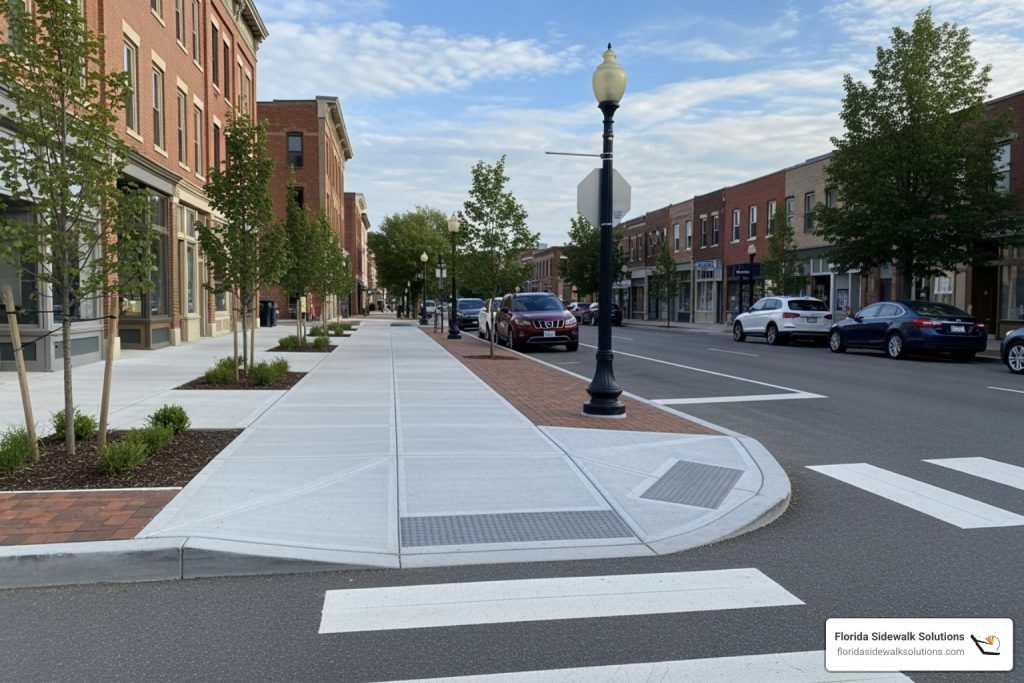
Why ADA Approved Sidewalk Standards Matter for Public Safety and Compliance
ADA approved sidewalk standards ensure public walkways are safe and accessible for everyone, including those with disabilities. While there’s no official “approval” process, sidewalks must meet specific technical requirements from the 2010 ADA Standards for Accessible Design to be compliant.
Quick Answer: Key ADA Sidewalk Requirements
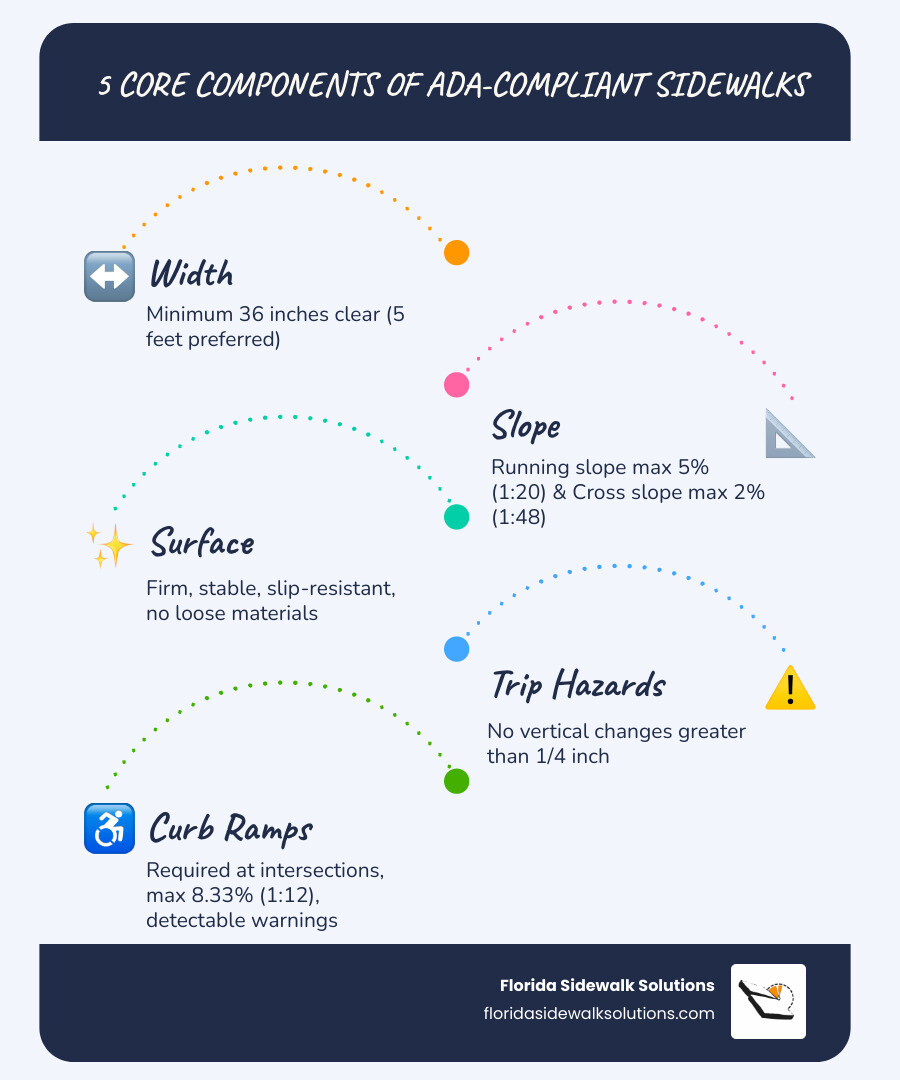
- Width: Minimum 36 inches clear (5 feet preferred)
- Running Slope: Maximum 5% (1:20 ratio)
- Cross Slope: Maximum 2% (1:48 ratio)
- Trip Hazards: No vertical changes greater than 1/4 inch
- Surface: Firm, stable, and slip-resistant
- Curb Ramps: Required at intersections with max 8.33% slope (1:12 ratio)
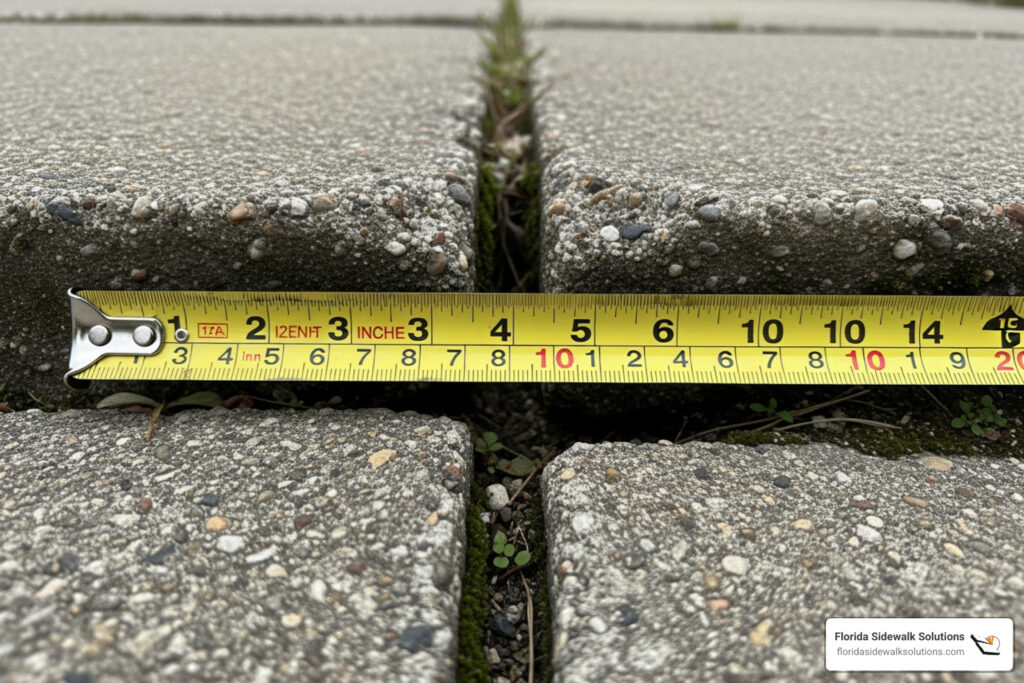
- Gaps/Openings: Maximum 1/2 inch wide
For Municipal Maintenance Managers, the challenge is familiar: miles of aging sidewalks with trip hazards, uneven panels, and non-compliant curb ramps. Budget constraints make full replacement impossible, yet federal law requires accessibility. Every raised slab is a potential liability and a barrier to safe pedestrian access.
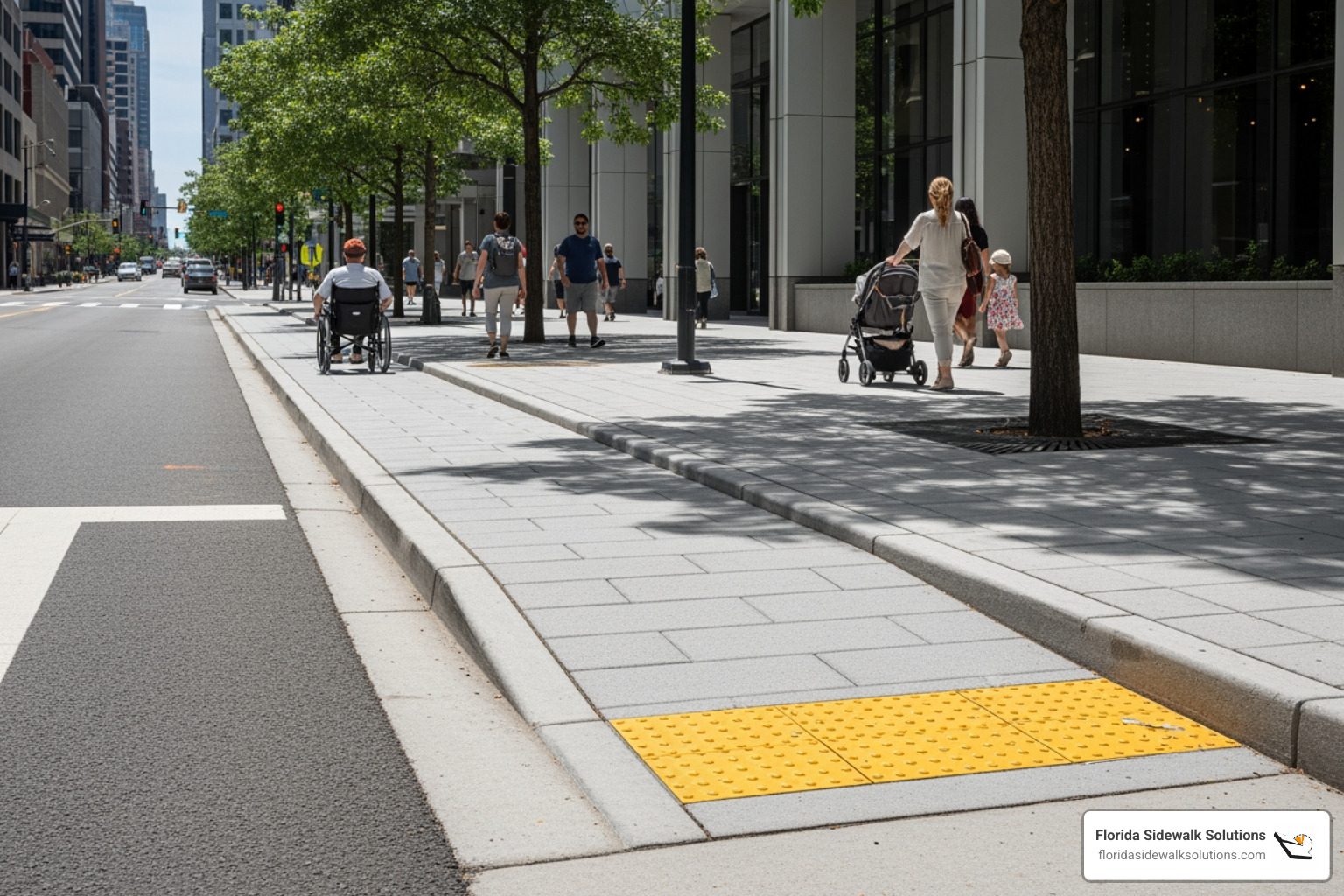
The Americans with Disabilities Act impacts more than just wheelchair users; it affects parents with strollers, delivery workers, older adults with walkers, and anyone needing a smooth, level path. Non-compliant sidewalks create hazardous conditions and expose municipalities to significant legal and financial risk.
The good news is that achieving compliance doesn’t always require expensive removal and replacement. Modern precision cutting methods can eliminate trip hazards and create compliant surfaces at a fraction of the cost, with minimal disruption to pedestrian traffic.
The Core Requirements for an ADA-Compliant Sidewalk
Creating an ADA approved sidewalk means understanding the design principles that ensure true accessibility. The 2010 ADA Standards for Accessible Design provide specific technical requirements that are not suggestions, but law. They are based on the real-world needs of people with disabilities, from the width a wheelchair needs to the slope a person can safely steer.
Let’s break down the essential requirements for a compliant sidewalk, drawing from the official A guide to the ADA Standards.
Sidewalk Width and Passing Spaces
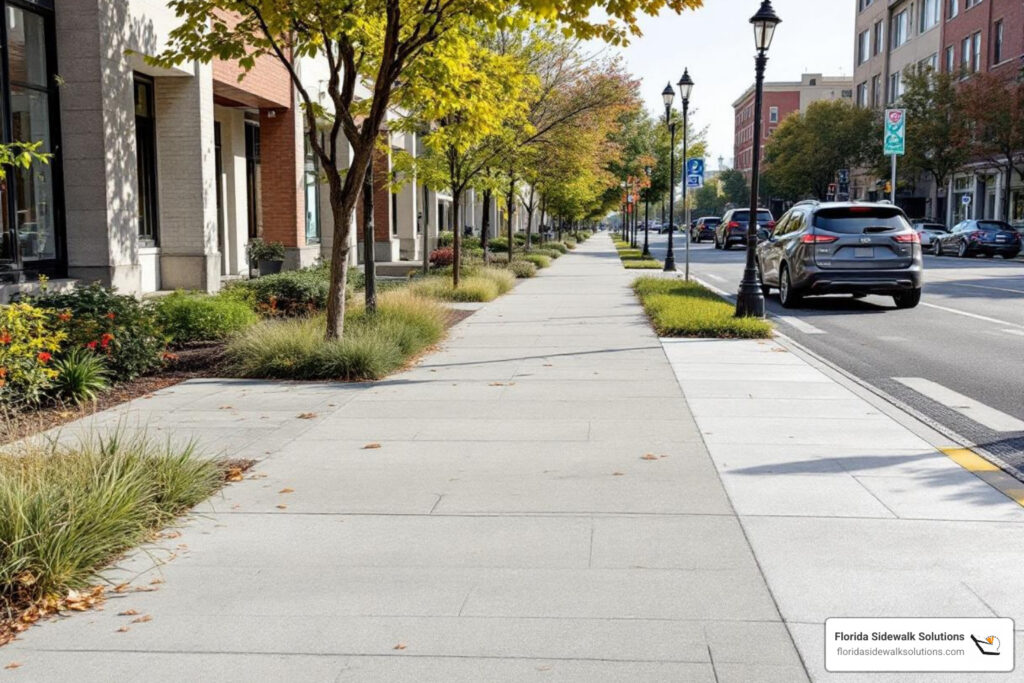
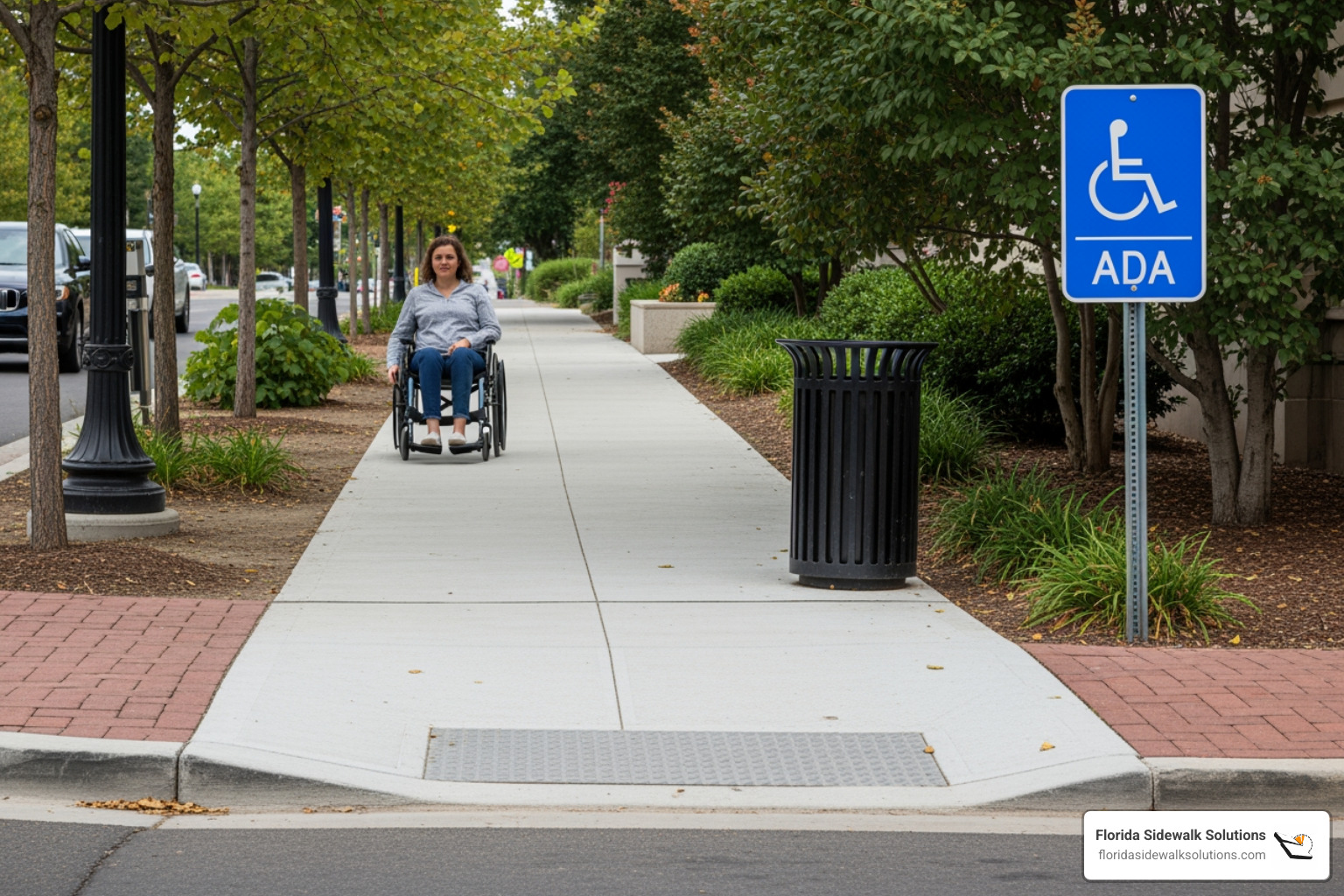
Sidewalk width is a core pillar of ADA compliance. The minimum continuous clear width for an accessible walkway is 36 inches (3 feet), which must be completely free of obstructions like signs, poles, or landscaping.
However, 36 inches is tight for two-way traffic. For this reason, a 60-inch (5-foot) minimum width is preferred, especially in busy Florida communities like Fort Lauderdale or Miami. This width allows two wheelchair users to pass comfortably.
If a sidewalk is narrower than 60 inches, the ADA requires passing spaces of at least 60 by 60 inches at intervals of 200 feet.
A few exceptions exist:
- The path can narrow to 32 inches for up to 24 inches in length, provided these points are separated by at least 48-inch sections.
- Turns require a minimum width of 42 inches, expanding to 48 inches at the turn point, unless the entire turn area is 60 inches wide.
Running Slope and Cross Slope
Even small grades can be major obstacles for people using mobility devices.
The running slope, or the slope in the direction of travel, cannot exceed 1:20 (5%). Anything steeper is considered a ramp and is subject to stricter requirements.
The cross slope, which runs perpendicular to the direction of travel, is crucial for drainage, especially in Florida’s rainy climate. It must not exceed 1:48 (about 2%). This gentle grade prevents water from pooling without creating a tilt that makes it difficult for wheelchair users to steer straight or causes balance issues for others. Even minor deviations can create significant barriers.
Surface Texture and Materials
A compliant sidewalk surface must be firm, stable, and slip-resistant. Materials that shift, become uneven, or get slippery when wet are not acceptable.
- Compliant Materials: Concrete and asphalt are the standard choices because they provide smooth, durable, and consistent surfaces.
- Materials to Avoid: Cobblestones, pavers, and loose materials like gravel or sand are unsuitable. They create vibrations, are unstable, and can make it nearly impossible for wheeled devices to move.
- Gaps and Openings: Any openings, such as those at expansion joints or around utility grates, must be no wider than 1/2 inch. Larger gaps can catch wheelchair wheels or cane tips, creating serious hazards. The U.S. Access Board offers more guidance on floor and ground surfaces and slip-resistance.
Identifying and Eliminating Common ADA Violations
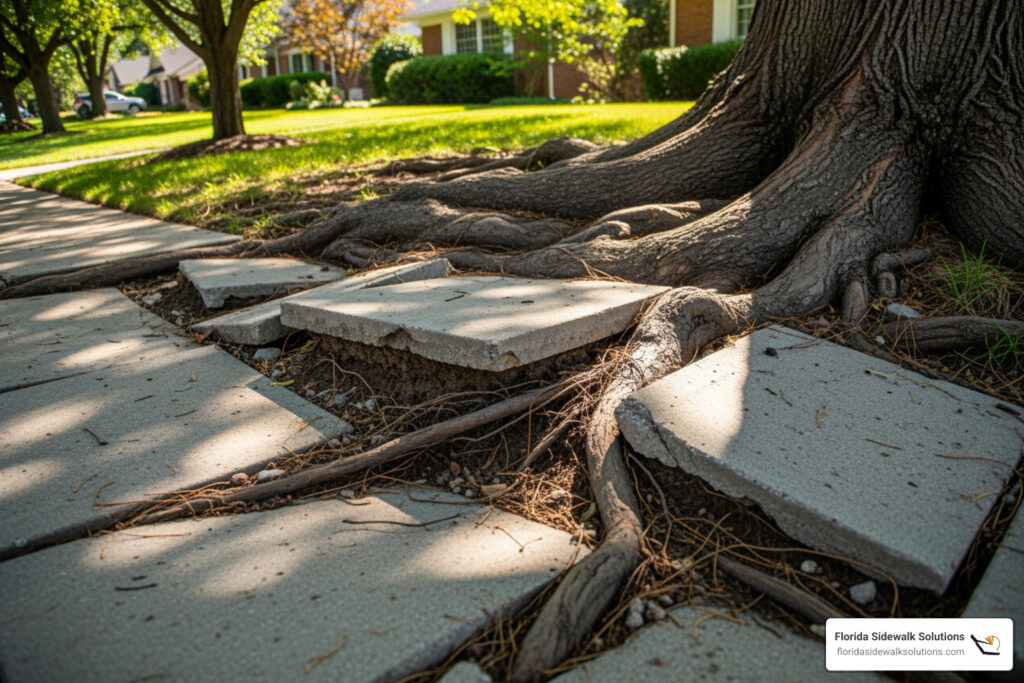
Even well-maintained sidewalks develop problems. Tree roots, soil settlement, and weather can create uneven surfaces, dangerous lips, and non-compliant curb ramps. These are not just cosmetic issues; they are safety risks that expose your municipality or business to legal liability. Let’s review the most common ADA violations so you can spot them early.

What is an ADA Trip Hazard?
An ADA trip hazard is any vertical change greater than 1/4 inch at a joint or crack. This strict standard exists because even small bumps can catch wheelchair wheels or cause falls. A vertical change up to 1/2 inch is permissible only if it is beveled with a slope no steeper than 1:2.
In Florida, the most common causes are tree roots, soil settlement, and concrete lifting in our sandy ground. Regular inspections are crucial to catch these issues before they cause an injury. The Access Board’s guide on floor and ground surfaces provides more detail on these critical safety factors.
Curb Ramp Specifications
Curb ramps are one of the most frequently violated elements of an ADA approved sidewalk. A compliant ramp is required wherever an accessible route crosses a curb. Key specifications include:
- Running Slope: Cannot exceed 1:12 (8.33%).
- Cross Slope: Must be no steeper than 1:48 (2%).
- Width: A minimum of 36 inches clear.
- Landings: A level landing at least 48 inches deep is required at the top of the ramp.
- Flared Sides: The angled sides of the ramp cannot be steeper than 1:10 to prevent tripping.
Getting these details right is essential for accessibility. The Access Board guide on ramps and curb ramps offers comprehensive specifications.
Detectable Warning Surfaces
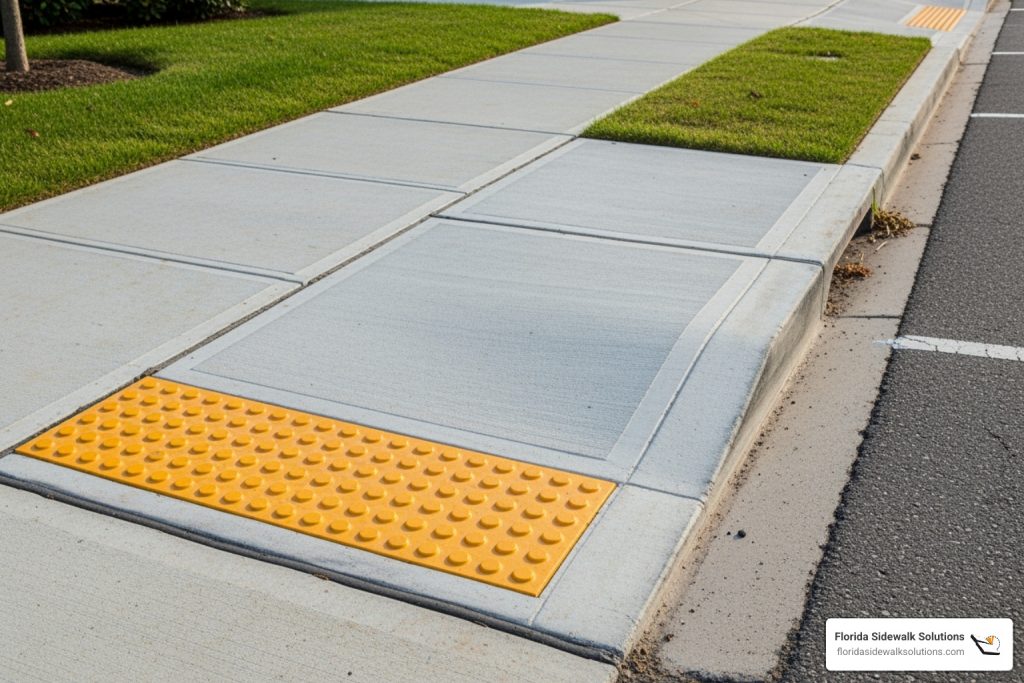
Those textured, bumpy surfaces at crosswalks are called detectable warning surfaces. They are a required element of an ADA approved sidewalk, serving as a tactile alert for people with visual impairments that they are approaching a street or other hazard.
The pattern of truncated domes (flat-topped bumps) is precisely specified to be detectable by foot or with a cane. Just as important is visual contrast—the surface must stand out from the surrounding walkway, which is why they are often bright yellow.
These surfaces are required at curb ramps and along the edges of transit platforms. The Department of Transportation also mandates them for any project receiving Federal Highway Administration funding. They are a critical safety feature for pedestrians with visual impairments.
How to Achieve an ADA Approved Sidewalk: Trip Hazard Repairs and Alterations
Achieving an ADA approved sidewalk requires careful planning and the right repair methods, especially when dealing with existing infrastructure.
New Construction vs. Altering Existing Sidewalks
The ADA’s requirements differ for new and existing sidewalks.
- New Construction: Any sidewalk built after March 15, 2012, must fully comply with the 2010 ADA Standards. This means getting the width, slope, surface, and curb ramps right from the start.
- Alterations: When altering an existing sidewalk, accessibility requirements are triggered. For public entities (Title II), alterations must ensure “program access,” meaning services as a whole are accessible. For private businesses (Title III), altering a “primary function” area requires making the “path of travel” to it accessible. This cost is limited to 20% of the total alteration cost.
Additionally, private businesses have an ongoing duty to remove barriers when it is “readily achievable” (easily done without much difficulty or expense), which often includes fixing sidewalk trip hazards in places like Boca Raton or Davie.
The Florida Sidewalk Solutions Method for ADA Trip Hazard Compliance
Traditional trip hazard repairs fall short. Removal and replacement is expensive and disruptive, while grinding leaves rough, uneven surfaces. Florida Sidewalk Solutions offers a smarter approach.

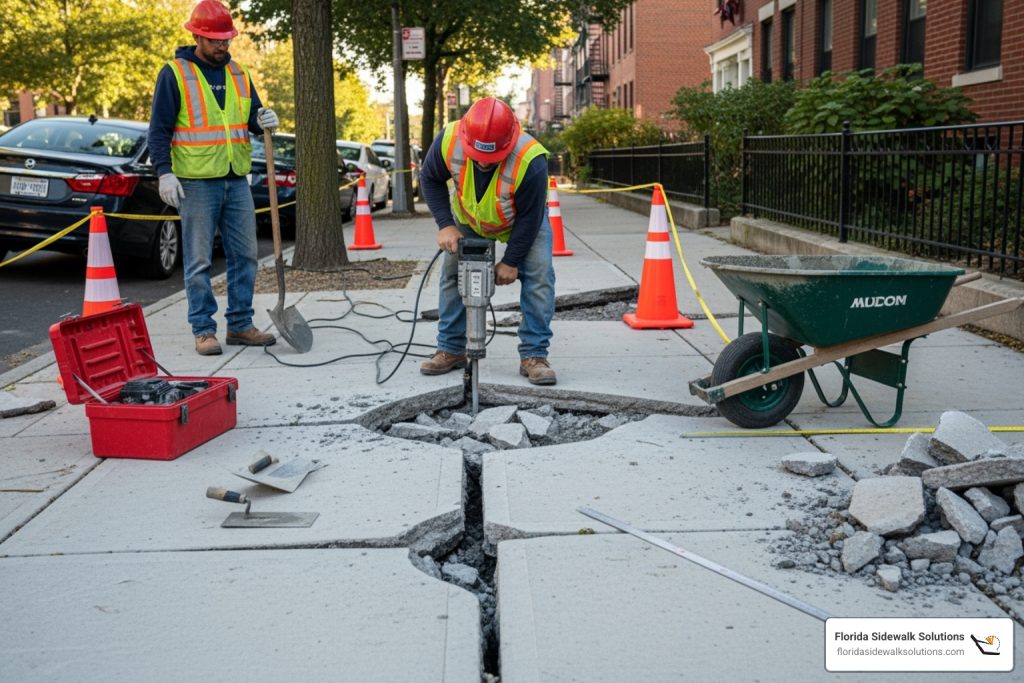
We specialize in precision sidewalk cutting to achieve ADA approved sidewalk compliance. Our patented technology precisely cuts and levels uneven concrete, eliminating trip hazards and creating smooth, flush transitions without unnecessary demolition.
For Florida property owners and municipalities, this means targeting the specific problem instead of tearing out entire concrete sections. You get full ADA compliance without the high cost or long construction times. Our method minimizes disruption, with most repairs completed the same day, and costs a fraction of full replacement.

Why Precision Trip Hazard Cutting is Key for an ADA Approved Sidewalk
Our precision cutting method is a strategic approach to creating a lasting ADA approved sidewalk.
The primary benefit is a flush, smooth transition between panels, eliminating the vertical changes that catch wheels and cause trips. Unlike grinding, our cuts create a consistent, level surface that prevents water from pooling, which is crucial in Florida’s rainy climate.
Our repairs are designed for long-term durability, reducing future maintenance for municipal managers in cities like Coral Springs or Fort Myers. Most importantly, eliminating trip hazards is a direct step toward reducing your liability exposure from costly trip-and-fall lawsuits. Our targeted method is superior to temporary patching or expensive full replacement, making it the smart choice for achieving compliance without breaking the budget.
The Legal Landscape of Sidewalk Accessibility
Understanding the legal landscape of an ADA approved sidewalk is crucial for protecting your organization from serious financial and legal consequences. The framework includes Title II of the ADA (state/local governments), Title III (private businesses), and the Public Right-of-Way Accessibility Guidelines (PROWAG). For property managers in Florida cities like Fort Lauderdale or Miami, these are daily realities that impact budgets and liability.
Financial and Legal Risks of Non-Compliance
Ignoring ADA sidewalk requirements carries staggering financial risks. The Department of Justice can impose civil penalties of up to $75,000 for a first violation and $150,000 for subsequent ones, as detailed in the Details on civil penalties under the ADA.
Beyond fines, private lawsuits are common and can result in substantial damages and legal fees. A history of non-compliance can also lead to higher insurance premiums and significant damage to your public reputation. Proactively investing in an ADA approved sidewalk costs far less than the consequences of inaction.
Are There Exemptions to ADA Sidewalk Rules?
While the ADA is broad, a few specific exemptions exist:
- Religious organizations and private clubs are generally exempt from federal ADA rules.
- Single-family homes and private residences not used as public accommodations are not covered.
- Federal government agencies fall under the Architectural Barriers Act (ABA), not the ADA.
However, state and local laws in Florida may still require accessibility. Always check with local authorities in your area, from West Palm Beach to Davie. For more details, consult the Access Board guide on exemptions.
Understanding PROWAG and the Evolution of Standards
Accessibility standards evolve. The original 1991 ADA standards were updated by the 2010 ADA Standards for Accessible Design, which are now the enforceable rules for new construction and alterations. Sidewalks built before 2012 may no longer meet the current requirements for an ADA approved sidewalk.
Another key development is PROWAG (Public Right-of-Way Accessibility Guidelines). Developed by the U.S. Access Board, PROWAG provides specific guidance for sidewalks, curb ramps, and crosswalks. While not yet a formal federal standard, it is considered the best practice and is already being adopted by many Florida jurisdictions. Building to PROWAG standards now is a smart investment to avoid future retrofitting costs.
Frequently Asked Questions about ADA Sidewalks
Here are answers to common questions about ADA approved sidewalk standards.
Who is responsible for sidewalk ADA compliance?
Responsibility for ADA compliance varies:
- Public Sidewalks: The municipality (city, county, or state DOT) is typically responsible for sidewalks in the public right-of-way.
- Private Property: If a sidewalk is on your property (e.g., leading to a business entrance or through a shopping center), you are responsible for its compliance.
- Shared Responsibility: Commercial property owners often share responsibility for the public sidewalk adjacent to their business, as they have a duty to remove barriers to access.
The best practice is to check with your local government in your Florida community to clarify specific ordinances.
How do I know if my sidewalk has a trip hazard?
The rule is simple: any vertical change of more than 1/4 inch is an ADA trip hazard. You can use a quarter for a quick check; if the height difference is more than the coin’s thickness, it’s a violation. For a precise measurement, use a ruler.
In Florida, trip hazards are commonly caused by tree roots and soil settlement. While a DIY check is a good start, a professional assessment is recommended to identify all potential compliance issues.
Can I just grind down a trip hazard to be compliant?
While grinding seems like a quick fix, it often creates new problems. Grinding can leave a rough, uneven surface that is difficult for wheelchairs to steer and can collect water, leading to slippery conditions. Patching is also a poor solution, as patches often crack and fail quickly, creating a new hazard.
This is why Florida Sidewalk Solutions’ cutting method is superior. We don’t grind or patch; we use precision cutting to create a perfectly smooth, flush, and permanent transition between concrete panels. Our method results in a truly stable and uniform surface, creating a genuinely ADA approved sidewalk that is safe, durable, and professional-looking. It’s a permanent solution, not a temporary band-aid.
Conclusion: Ensuring Safe and Accessible Pathways for Everyone
Creating an ADA approved sidewalk is about more than just avoiding fines; it’s about ensuring safe, independent movement for everyone in your community. From parents with strollers to individuals using wheelchairs, accessible pathways show that your municipality or business cares. In diverse Florida communities like Davie, Fort Lauderdale, and Miami, this is a necessity.
The challenge is clear: aging infrastructure, tight budgets, and the urgent need for compliance. Traditional sidewalk replacement is expensive and disruptive, while grinding and patching are ineffective, temporary fixes.
This is where Florida Sidewalk Solutions provides a better way. Our patented sidewalk cutting technology eliminates trip hazards permanently and cost-effectively, with minimal disruption. We transform hazardous sidewalks into genuinely safe, smooth, and compliant pathways that serve your community for years. Every repair reduces your liability and contributes to a more accessible community.
Ready to transform your hazardous sidewalks into safe, accessible pathways? Find out more about our sidewalk repair services near you and find how our precision cutting method can solve your ADA compliance challenges efficiently and affordably.