Florida property managers face direct legal exposure when uneven sidewalks cause injuries on their property. Under Florida premises liability law, property owners and managers have a duty to maintain walkways in a reasonably safe condition. A vertical displacement of more than 1/4 inch in a sidewalk panel meets the legal definition of a trip hazard — and failing to correct it creates measurable liability risk for HOAs, commercial owners, and municipalities alike.
- Florida premises liability law requires property managers to address known sidewalk hazards promptly.
- A vertical displacement greater than 1/4 inch is a trip hazard under ADA standards — and a liability trigger.
- Patented concrete cutting technology resolves most hazards faster and far less expensively than full replacement.
- HOA boards in Palm Beach and Broward counties carry shared liability for common-area walkways.
- Proactive inspection and documented repair records are your strongest defense against premises liability claims.
What Does Florida Law Say About Sidewalk Liability?
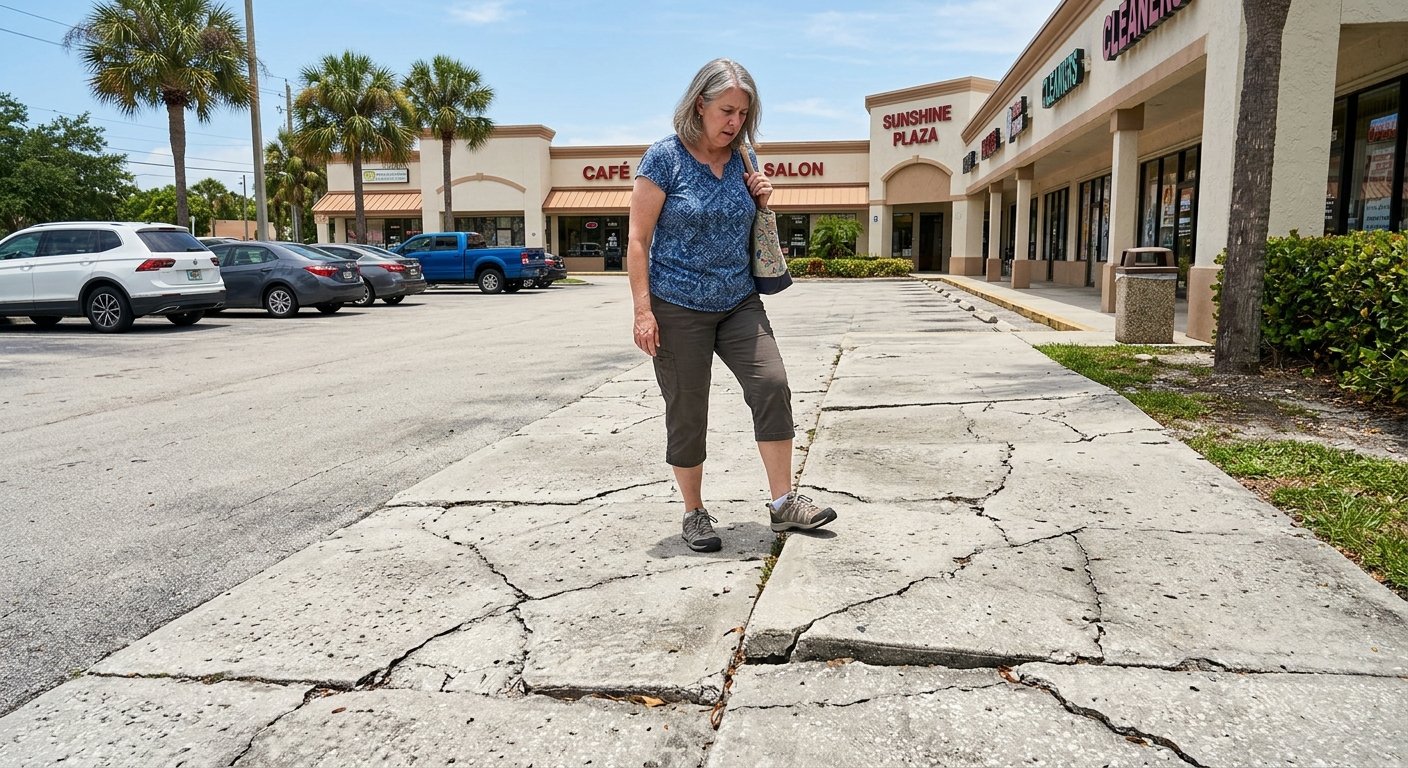
Florida’s premises liability framework is established under Florida Statute § 768.0755, which governs slip-and-fall claims on business premises. While the statute specifically addresses transitory foreign substances, Florida courts have consistently applied premises liability principles more broadly — including to permanent structural hazards like uneven sidewalks and raised concrete edges. Property owners and managers who have actual or constructive knowledge of a hazard and fail to correct it in a reasonable time are exposed to negligence claims.
What matters in practice: if your sidewalk has a known raised panel and someone trips, the question is not just whether the hazard existed — it’s whether you knew or should have known, and whether you acted. Documented inspection schedules and prompt repairs are your best protection.
This article provides general educational information, not legal advice. Consult a licensed Florida attorney for guidance on specific liability situations at your property.
What Is the ADA Threshold for a Sidewalk Trip Hazard?
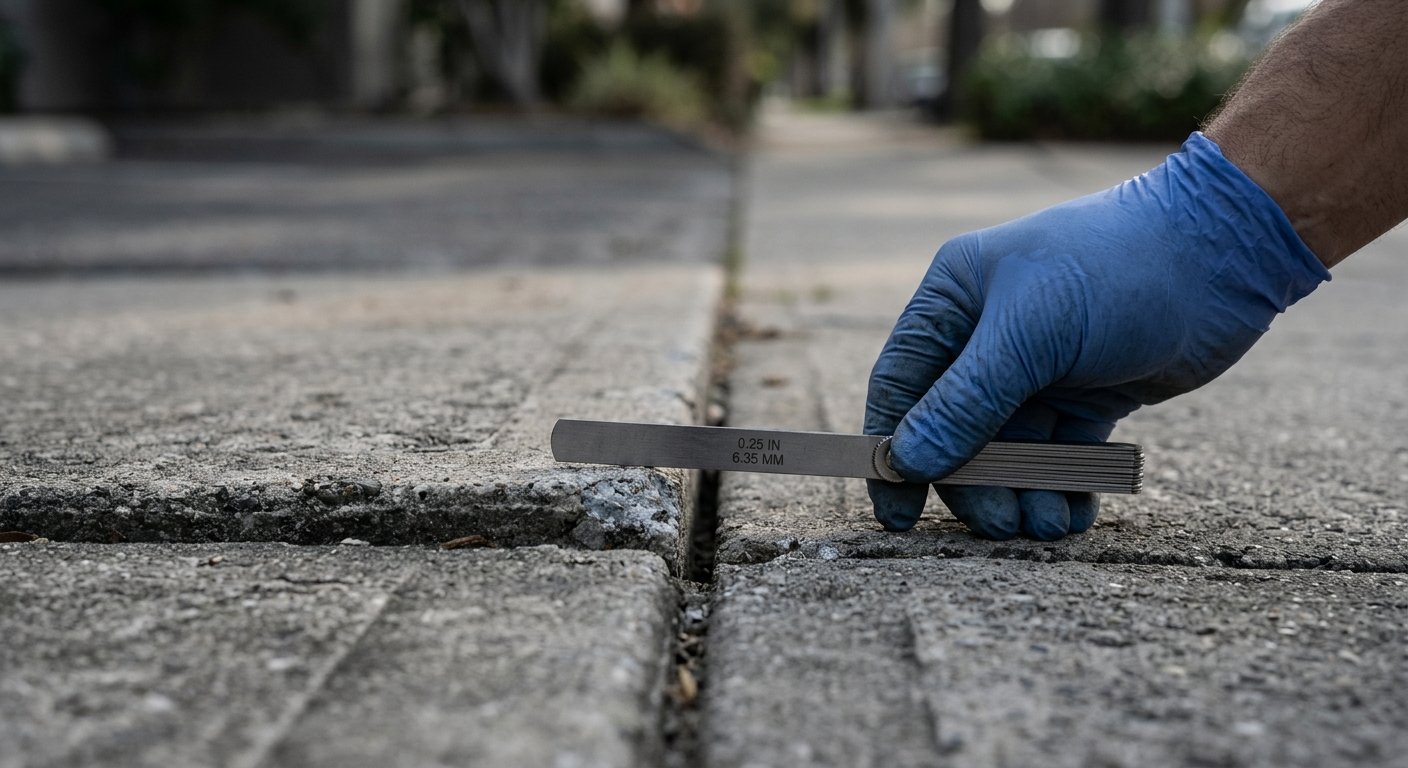
The Americans with Disabilities Act Accessibility Guidelines set the standard: any vertical change in a walking surface greater than 1/4 inch constitutes a trip hazard. Changes between 1/4 inch and 1/2 inch must be beveled at no more than a 1:2 slope. Any abrupt vertical edge exceeding 1/2 inch is a non-compliant surface that must be corrected — no beveling option applies.
This threshold matters for every property manager in Palm Beach County and Broward County because ADA compliance is not optional. Title II of the ADA applies to municipalities and public entities. Title III applies to places of public accommodation. And even private HOA-managed sidewalks can carry ADA obligations depending on how they’re classified and used.
For a thorough breakdown of what these requirements mean for Florida properties specifically, the ADA sidewalk compliance guide for Florida property managers covers the key obligations in plain language.
Are HOA Boards Liable for Common-Area Sidewalks?
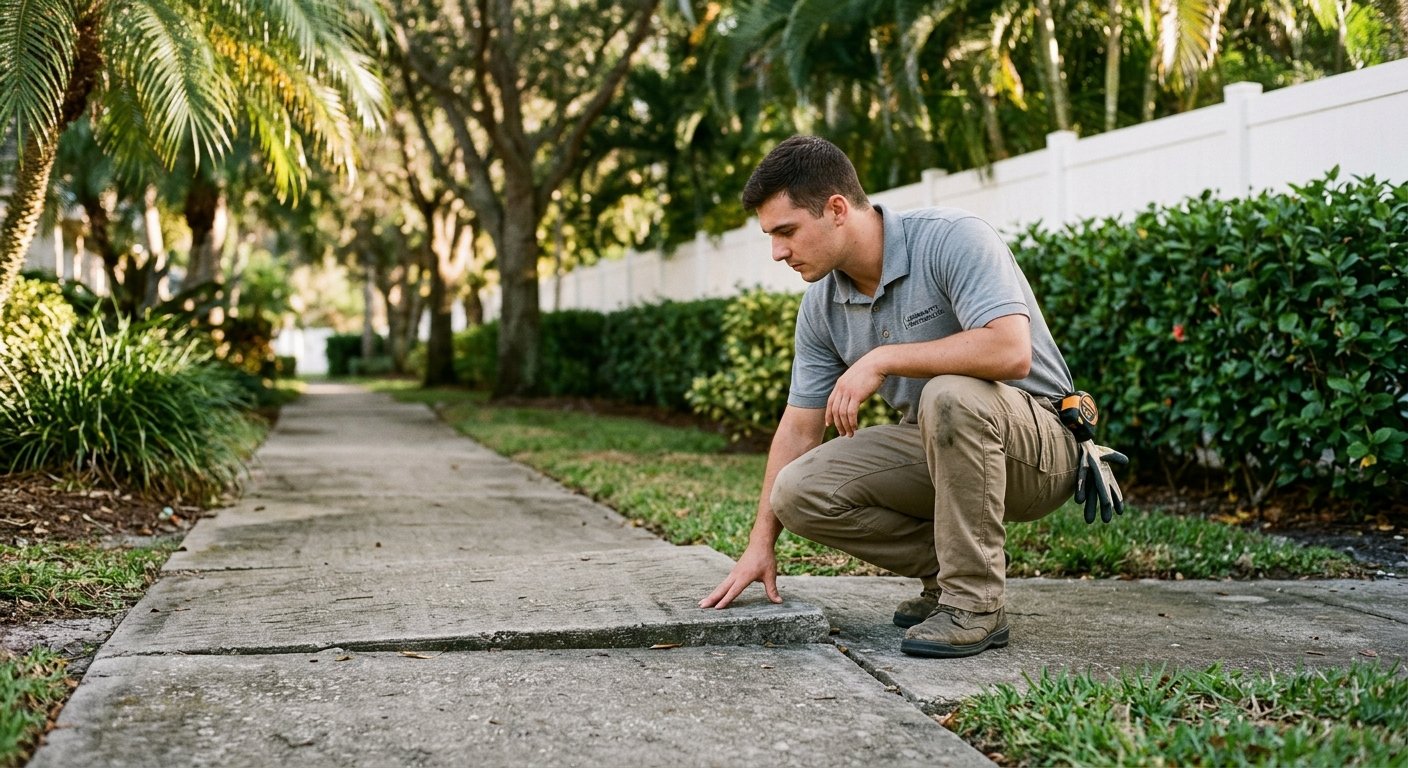
Yes — and this is a question Florida HOA boards frequently underestimate. When a homeowners association maintains ownership or management responsibility over common-area sidewalks, it steps into the role of property owner under premises liability law. If a resident, guest, or service worker trips on an uneven sidewalk panel in a common area and sustains an injury, the association can face a negligence claim.
Florida HOA law, governed by Chapter 720 of the Florida Statutes, requires associations to maintain common areas in good condition. That obligation directly includes walkways. Board members who delay repairs after hazards are reported — or who have no inspection process in place — increase both the association’s legal exposure and their own potential personal liability in certain circumstances.
Documentation of inspections and prompt response to known hazards is as important as the repair itself.
What Are My Repair Options — and How Do They Compare?
When a trip hazard is identified, property managers typically consider three approaches: concrete grinding, full panel replacement, or precision concrete cutting. Each has different cost profiles, timelines, and results.
Grinding removes material from the raised edge of a panel using abrasive equipment. It’s widely used but has a significant drawback: grinding leaves a rough, porous surface that is more susceptible to future erosion, can create an uneven texture that itself presents ADA concerns, and does not fully restore the structural integrity of the transition. For a detailed look at why grinding often falls short, see this comparison of sidewalk grinding versus replacement and cutting alternatives.
Full panel replacement is the most disruptive and expensive option. It requires demolition, debris removal, forming, pouring, curing time, and significant labor costs. For many situations — particularly isolated panel lifts caused by tree roots or soil movement — replacement is simply more than the problem requires.
Patented precision concrete cutting creates a clean, smooth, beveled transition that meets ADA slope requirements. The process removes no more material than necessary, generates no demolition waste, and typically allows the walkway to reopen the same day. Because it eliminates the hazard at the source rather than masking it, the result is a finished surface that looks professional and holds up over time.
| Criterion | Grinding | Full Replacement | Precision Cutting |
|---|---|---|---|
| ADA compliant finish | Often marginal | Yes | Yes |
| Surface quality | Rough, porous | New concrete | Smooth, clean bevel |
| Demolition waste | Minimal | Significant | None |
| Walkway downtime | Hours | Days to weeks | Same day |
| Relative cost | Low–moderate | High | Low–moderate |
| Disruption level | Low | High | Minimal |
How Should I Document Sidewalk Hazards to Protect My Property?
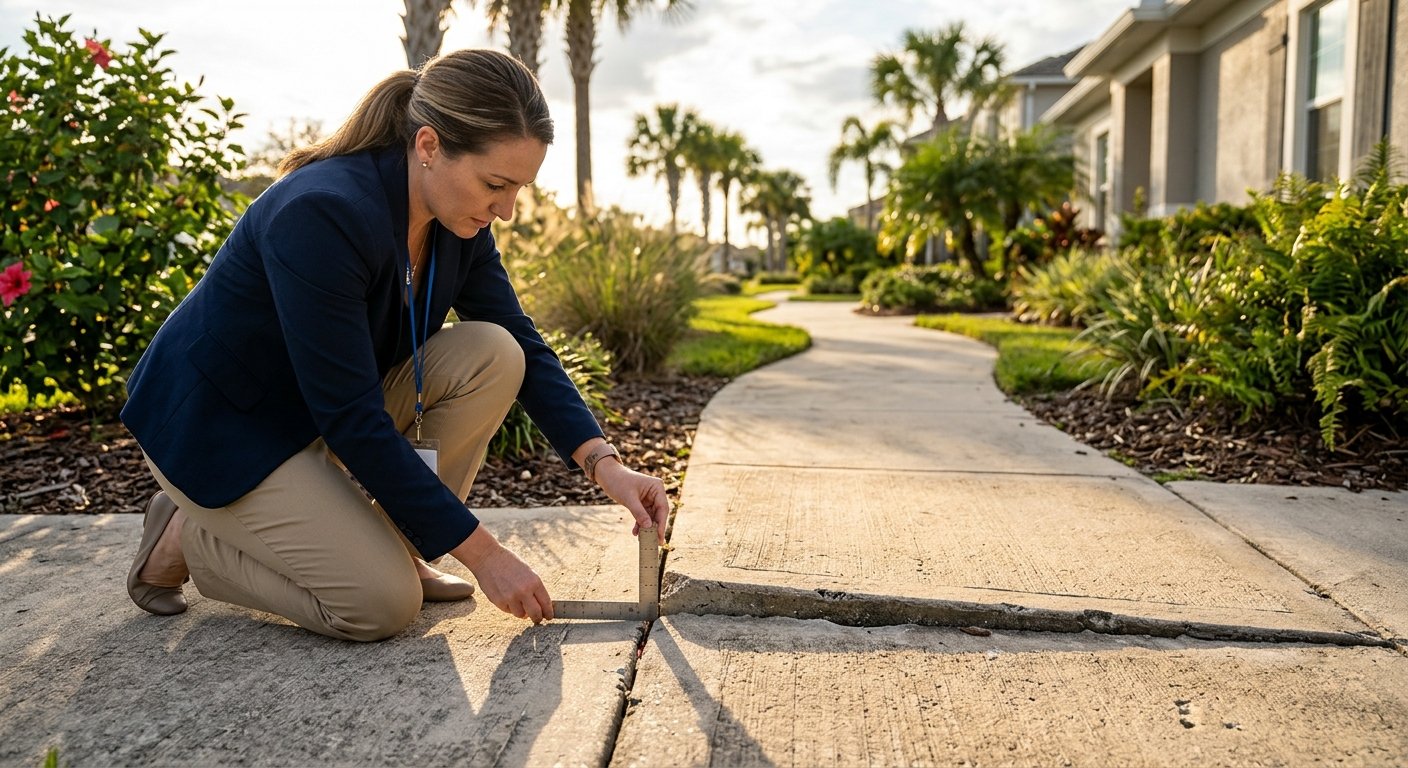
Documentation is a critical but often overlooked part of liability management. A strong documentation practice includes three elements: regular scheduled inspections, written records of findings, and prompt action on identified hazards.
When a hazard is discovered, photograph it with a date stamp and measure the vertical displacement. Log it in a written maintenance record with the date of discovery and the action taken. If repair is scheduled rather than immediate, note the reason for the delay and the planned timeline. This paper trail demonstrates you were acting in good faith — which matters significantly in a premises liability dispute.
For facilities managers overseeing large portfolios in Broward County or Palm Beach County, a formal sidewalk inspection checklist updated at regular intervals (for example, quarterly or after major storm events) provides consistent coverage. Florida Sidewalk Solutions has 20 years of experience helping property managers across South Florida identify and prioritize hazards — and can walk you through what a systematic inspection approach looks like.
When you receive a repair from Florida Sidewalk Solutions, ask for a written completion record noting the specific location, the displacement measurement before repair, and the corrective method used. Add this to your maintenance file. That single document can be invaluable if a claim arises later.
Why Do Sidewalk Panels Become Uneven in the First Place?
In South Florida, the most common culprit is tree root intrusion. Roots grow beneath concrete slabs, exerting upward pressure that lifts one panel edge above another. Soil movement, erosion, and the natural settling of fill material also contribute — particularly in areas that experienced heavy rainfall. For a deeper look at why these failures occur and what long-term repair looks like, the article on why uneven sidewalks fail and how to fix them permanently provides useful context.
Understanding the cause matters because it informs the repair approach. If a root is still actively growing, addressing only the surface without also addressing the root is a temporary fix. Florida Sidewalk Solutions evaluates the underlying condition as part of every assessment.
Frequently Asked Questions
How quickly do I need to repair a known trip hazard to limit liability?
Florida law does not specify a fixed number of days, but courts examine whether a property manager acted within a “reasonable time” after gaining knowledge of the hazard. The more serious the hazard — particularly displacements well above the 1/4-inch ADA threshold — the shorter that reasonable window becomes. Prompt action combined with documented communication is your strongest position.
Does ADA compliance apply to private HOA sidewalks?
ADA applicability to private HOA sidewalks depends on how the association is classified and how the walkways are used. When common-area sidewalks connect to public rights-of-way or serve residents with disabilities, ADA standards are often the practical benchmark courts and regulators apply. Florida Sidewalk Solutions designs all repairs to meet ADA standards regardless of classification — it’s the right outcome either way.
Is concrete cutting more expensive than grinding?
Precision cutting and grinding are often comparable in cost for individual hazards, but cutting consistently produces a superior, ADA-compliant finish that lasts longer without re-treatment. The real cost comparison is against full panel replacement — patented cutting technology typically costs significantly less than replacement while delivering a clean, professional result that meets compliance requirements.
Can a single raised sidewalk panel really result in a lawsuit?
Yes. Florida personal injury attorneys regularly pursue trip-and-fall claims arising from sidewalk displacements at or above the 1/4-inch threshold. The displacement itself is documented, the measurement is straightforward, and notice is often established by prior complaints or the duration the hazard was visible. A single unrepaired panel is a viable claim — and the cost of defending even a meritless lawsuit far exceeds the cost of repair.
How do I know if my sidewalks need professional assessment?
If you can visibly see or feel a raised edge between panels, or if any displacement is at or near 1/4 inch, a professional assessment is warranted. Florida Sidewalk Solutions offers assessments for properties throughout Palm Beach County and Broward County, identifying and prioritizing hazards so you can address the highest-risk locations first.
Taking Action Before a Claim Happens
The most cost-effective approach to sidewalk trip hazard liability is prevention. Reacting after an injury is always more expensive — in legal fees, insurance impact, and reputational cost — than repairing the hazard proactively. Property managers, HOA boards, and facilities directors in Palm Beach County and Broward County who build regular sidewalk inspection and repair into their maintenance programs are simply better positioned on every dimension: compliance, safety, and budget.
Florida Sidewalk Solutions brings 20 years of South Florida experience and patented concrete cutting technology to every job. As licensed and insured ADA compliance specialists, the team has resolved trip hazards at properties across the region — from condominium common areas to municipal walkways — with minimal disruption and no demolition waste. If you manage multiple properties or need to assess a large area, the approach to how precision cutting technology saves budget-constrained property portfolios is worth reviewing before your next planning cycle.
Get a Professional Hazard Assessment
Contact Florida Sidewalk Solutions to schedule an on-site evaluation for your Palm Beach County or Broward County property — and get a clear repair plan before a claim forces your hand.
About Florida Sidewalk Solutions
Florida Sidewalk Solutions specializes in sidewalk safety, ADA compliance, and trip hazard prevention for Florida property managers, municipalities, and commercial property owners. Using patented concrete cutting technology, they deliver cost-effective repairs that are 70-90% less expensive than replacement, with minimal disruption and no demolition waste. With 20 years of Florida-specific experience, they provide the expert solution for eliminating liability risks while meeting ADA standards and legal requirements. Visit floridasidewalksolutions.com →