
Municipal budgets across Florida face unprecedented pressure in 2026. With infrastructure maintenance costs rising and liability claims increasing, public works directors must find cost-effective solutions that don’t compromise safety or ADA compliance. Sidewalk maintenance represents a significant line item, yet many municipalities still allocate funds based on outdated repair methods that drain budgets unnecessarily.
The average Florida municipality spends between $150,000 and $2 million annually on sidewalk repairs, with replacement costs reaching $75-100 per linear foot. Meanwhile, trip and fall claims against municipalities have increased 34% since 2023, with average settlements exceeding $85,000. These dual pressures—rising costs and escalating liability—demand a strategic reassessment of municipal sidewalk solutions.
Understanding the True Cost of Sidewalk Neglect
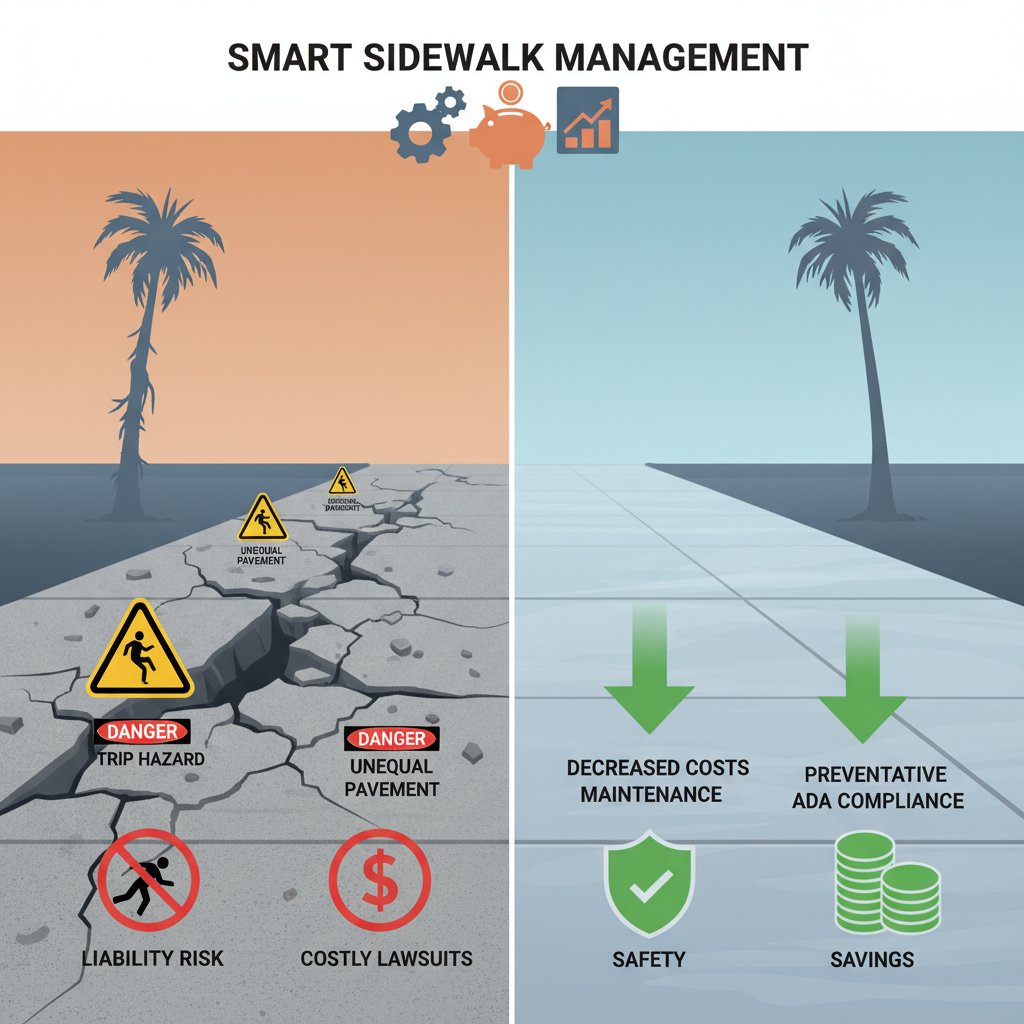
When municipal budgets get tight, sidewalk maintenance often moves down the priority list. This deferral creates a dangerous cycle that ultimately costs more than proactive maintenance.
Liability Exposure in Florida Municipalities
Florida municipalities operate under specific legal obligations regarding sidewalk safety. When a trip hazard exists—typically defined as a vertical displacement of ½ inch or greater—the municipality can be held liable for injuries. Recent Florida court decisions have reinforced that documented knowledge of hazards without timely remediation significantly strengthens plaintiff claims.
A single trip and fall lawsuit can cost more than an entire year’s preventive sidewalk maintenance budget. Beyond direct settlement costs, municipalities face:
- Legal defense fees averaging $25,000-50,000 per case
- Increased insurance premiums following claims
- Staff time dedicated to litigation support
- Negative publicity affecting community trust
- Potential federal ADA violation penalties up to $75,000 for first offense
ADA Compliance Requirements for Public Walkways
The Americans with Disabilities Act establishes clear standards for public sidewalks. Vertical displacements exceeding ½ inch constitute ADA violations, creating accessibility barriers for wheelchair users, individuals with mobility devices, and those with visual impairments.
ADA compliant sidewalks must maintain running slopes no greater than 1:20 (5%) and cross slopes no greater than 1:48 (2%). Trip hazards disrupt these specifications, and municipalities receiving federal funding face particularly stringent enforcement. The Department of Justice has increased ADA compliance investigations by 40% since 2024, with sidewalk accessibility representing a primary focus area.
Budget-Friendly Alternatives to Complete Replacement
Traditional sidewalk replacement has dominated municipal budgets for decades, but this approach wastes taxpayer dollars while creating unnecessary disruption. Modern trip hazard repair technologies offer dramatic cost savings without compromising quality or longevity.
Precision Concrete Cutting Technology
Precision concrete cutting represents the most significant advancement in sidewalk trip hazard removal Florida has seen in decades. This patented technology removes the raised edge of concrete slabs—the actual tripping surface—rather than grinding down the lower slab or replacing entire sections.
The process involves diamond-blade cutting equipment that removes material with surgical precision, creating a smooth beveled transition between slabs. Unlike grinding methods that create rough surfaces collecting debris and water, cutting produces a clean, professional finish that blends seamlessly with existing concrete.
For municipal applications, the advantages are substantial:
- Cost savings of 70-90% compared to replacement
- Completion rates of 100-200 linear feet per day per crew
- No heavy equipment tearing up surrounding landscaping
- Minimal disruption to pedestrian traffic
- Same-day reopening of treated walkways
- Zero concrete waste requiring disposal
Why Cutting Outperforms Grinding
Many municipalities have experimented with grinding approaches for sidewalk leveling Florida projects. While grinding costs less than replacement, it creates long-term problems that increase maintenance expenses.
Grinding removes material from the lower slab, creating depressions that collect water, accelerating deterioration through freeze-thaw cycles and creating standing water hazards. The rough surface texture from grinding also accumulates dirt and organic material, creating slip hazards when wet and requiring more frequent cleaning.
Precision concrete cutting addresses the raised portion directly, maintaining proper drainage patterns and creating smooth surfaces that resist debris accumulation. The beveled edge produced by cutting is also more forgiving for wheels and mobility devices than the abrupt edges sometimes left by grinding.
2026 Budget Planning Strategies
Smart municipal leaders are restructuring their sidewalk maintenance budgets to emphasize prevention over reaction. This strategic shift reduces overall costs while improving safety outcomes.
Conducting a Comprehensive Sidewalk Assessment
Before allocating budget dollars, municipalities need accurate data on existing conditions. A systematic assessment identifies all trip hazards, prioritizes repairs based on traffic and risk, and provides cost projections for different repair methods.
Modern assessments use GPS mapping to document each hazard location, severity, and surrounding conditions. This data supports both immediate repair planning and long-term capital improvement budgeting. Many Florida municipalities discover that switching from replacement to precision cutting allows them to address 3-5 times more linear feet of hazards within the same budget allocation.
Prioritizing High-Risk Locations
Not all sidewalk hazards present equal risk. Strategic prioritization maximizes safety improvements within budget constraints:
- School zones and areas with high senior pedestrian traffic warrant immediate attention
- Main commercial corridors where trip and fall liability exposure is greatest
- ADA-required accessible routes connecting parking to public facilities
- Locations with documented complaints or near-miss incidents
- Areas scheduled for other maintenance where coordinated repairs reduce overall costs
Multi-Year Planning for Sustainable Maintenance
One-time emergency repairs cost more than systematic ongoing maintenance. Progressive municipalities are adopting 3-5 year sidewalk maintenance plans that distribute costs evenly while ensuring comprehensive coverage.
A typical multi-year plan might allocate 40% of annual sidewalk budget to addressing existing hazards, 30% to preventive maintenance in areas showing early signs of settling, 20% to high-traffic area monitoring and quick response, and 10% to reserve funds for urgent safety issues.
Real-World Municipal Budget Impact
A mid-sized Florida municipality with 250 miles of sidewalk recently restructured its approach to trip hazard repair. Previously budgeting $800,000 annually for sidewalk replacement addressing approximately 10,000 linear feet, the public works department shifted to precision concrete cutting for eligible repairs.
The results: addressing 42,000 linear feet of trip hazards within the same $800,000 budget—a 320% increase in coverage. Additionally, the municipality reduced its trip and fall claims from 12 in 2024 to 3 in 2025, saving an estimated $450,000 in liability costs and legal fees.
Environmental and Community Benefits
Beyond direct cost savings, modern Florida sidewalk solutions deliver environmental advantages that align with 2026 sustainability mandates many municipalities now face.
Precision cutting generates zero concrete waste requiring landfill disposal. Traditional replacement creates approximately 400 pounds of concrete debris per linear foot—debris that must be hauled away, processed, and disposed of, adding both cost and environmental impact.
The minimal equipment footprint also reduces community disruption. While replacement projects may close sidewalk sections for days or weeks, precision cutting typically completes repairs in hours with same-day reopening. This maintains pedestrian connectivity and supports local businesses that depend on foot traffic.
Selecting the Right Municipal Sidewalk Solutions Provider
Technology alone doesn’t guarantee results—implementation expertise matters significantly. When evaluating providers for trip hazard repair, municipal decision-makers should verify:
- Documented experience with Florida concrete conditions and weather factors
- Proven track record with other municipalities including verifiable references
- Comprehensive liability insurance protecting the municipality
- Understanding of ADA requirements and compliance documentation
- Clear project timelines and completion guarantees
- Training programs ensuring consistent quality across crews
Florida Sidewalk Solutions brings over 20 years of Florida-specific experience, utilizing the proven Precision Concrete Cutting technology that has addressed millions of linear feet of trip hazards across the state. Our work with dozens of Florida municipalities demonstrates consistent cost savings, quality outcomes, and responsive project management that respects public sector budget cycles and community needs.
Frequently Asked Questions
How long do precision cutting repairs last?
Properly executed precision cutting repairs last as long as the surrounding concrete—typically 15-25 years in Florida conditions. The repair doesn’t compromise structural integrity, and because it addresses the actual trip hazard surface, the solution remains effective throughout the concrete’s lifespan.
Can all trip hazards be addressed with cutting instead of replacement?
Approximately 80-85% of typical municipal trip hazards are excellent candidates for precision cutting. Severely cracked, spalled, or structurally compromised sections still require replacement, but the cutting method dramatically reduces the replacement percentage in most municipal systems.
How does precision cutting affect future utility work?
The cutting process doesn’t interfere with underground utilities or create future access complications. If utility work later requires sidewalk removal, treated sections break out exactly like untreated concrete.
Take Action on Your 2026 Sidewalk Budget
Municipal leaders face a clear choice: continue allocating scarce budget dollars to expensive replacement methods that address only a fraction of existing hazards, or adopt proven precision cutting technology that eliminates more trip hazards, reduces liability exposure, and protects residents—all at 70-90% cost savings.
Florida Sidewalk Solutions provides complimentary sidewalk assessments for Florida municipalities, including detailed cost comparisons between replacement and precision cutting approaches. Our team works within your budget cycle to develop practical implementation plans that maximize safety improvements per dollar spent.
Contact Florida Sidewalk Solutions today to schedule your municipal sidewalk assessment and discover how precision concrete cutting can transform your 2026 maintenance budget into a comprehensive safety solution. Protect your community, reduce liability exposure, and demonstrate fiscal responsibility with trip and fall liability prevention that actually fits your budget.