
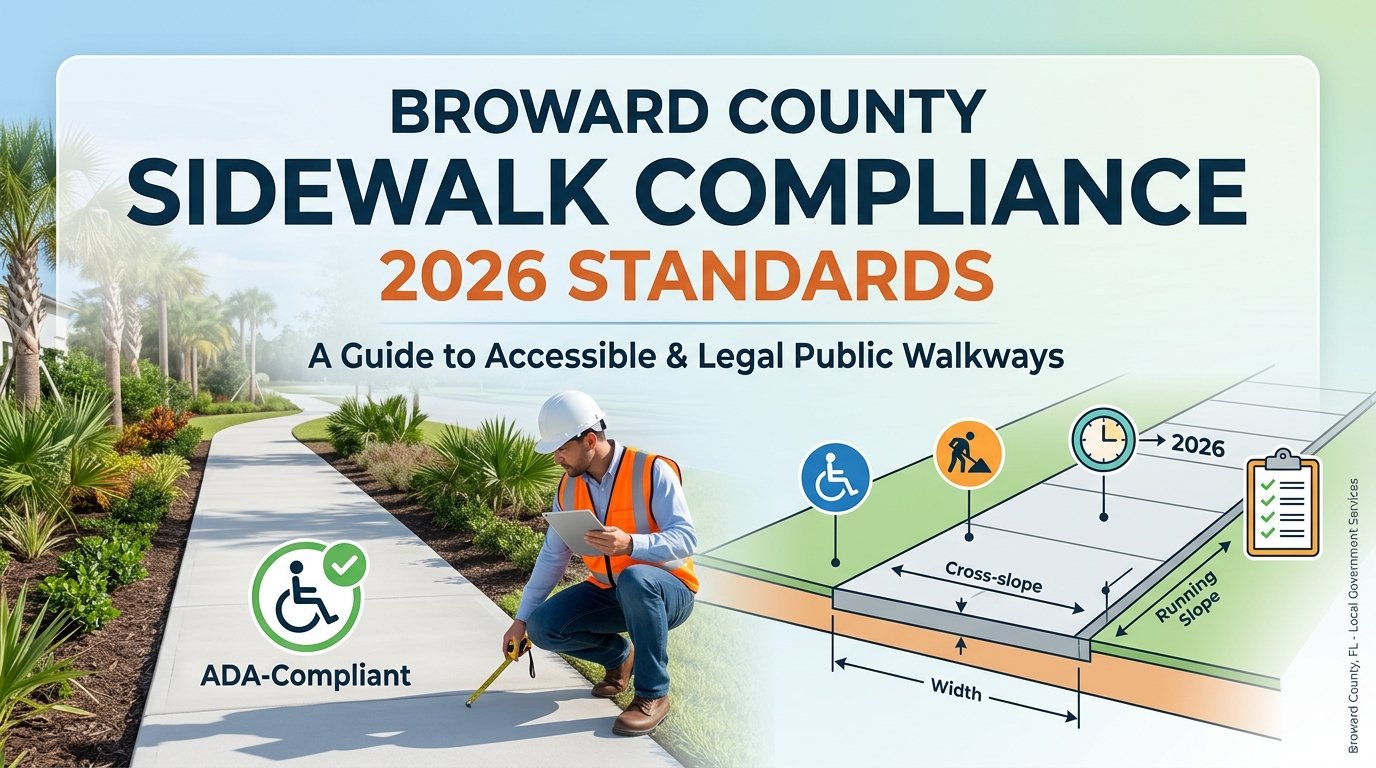
Broward County has implemented updated sidewalk compliance standards in 2026, creating new obligations for property owners, municipalities, and facility managers throughout South Florida. These enhanced requirements reflect both federal ADA mandates and local safety initiatives designed to reduce pedestrian injuries and protect against costly liability claims. For decision-makers managing commercial properties, HOA communities, or public facilities, understanding these new standards isn’t optional—it’s essential for legal compliance and financial protection.
What Changed in Broward County’s 2026 Sidewalk Standards
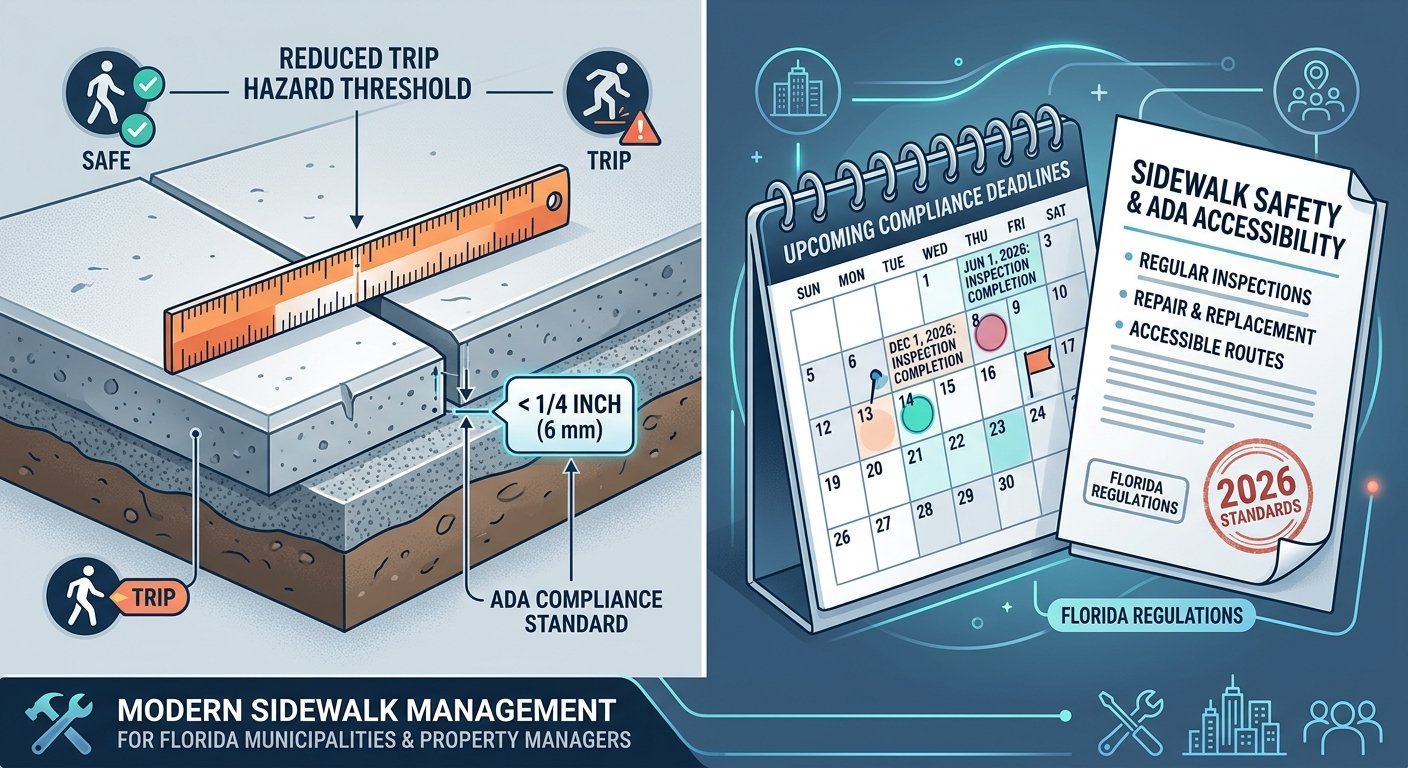
The updated regulations establish stricter enforcement timelines and reduced trip hazard thresholds across Broward County. Property owners now face accelerated compliance deadlines following sidewalk inspection notices, with potential fines starting at $250 per day for unresolved violations. The county has also expanded its proactive inspection program, deploying teams to identify hazards before accidents occur.
Most significantly, the acceptable vertical displacement for sidewalk slabs has been reduced from ½ inch to ¼ inch in high-traffic areas, including shopping centers, schools, government buildings, and multifamily residential properties. This aligns Broward County more closely with stringent ADA sidewalk specifications that prioritize accessibility for individuals using wheelchairs, walkers, or other mobility devices.
The enforcement mechanism has also evolved. Broward County now maintains a public database of properties with documented sidewalk violations, creating potential complications for property sales, refinancing, and insurance renewals. Properties listed in this database may face higher liability insurance premiums or coverage restrictions until violations are remediated.
Understanding ADA Sidewalk Specifications in Broward County
Federal ADA requirements establish baseline standards, but Broward County’s interpretation and enforcement add local nuances that property managers must navigate. The Americans with Disabilities Act specifies that any vertical displacement exceeding ½ inch constitutes a trip hazard requiring correction. However, the practical reality in Broward County is more demanding.
Key ADA Compliance Requirements
- Maximum vertical displacement: ½ inch between adjacent concrete slabs (¼ inch in county-designated high-traffic zones)
- Cross slope: Maximum 2% gradient perpendicular to the path of travel
- Running slope: Maximum 5% grade along the direction of travel (steeper grades require handrails)
- Minimum width: 36 inches clear passage, with 48 inches preferred for passing zones
- Surface requirements: Stable, firm, and slip-resistant conditions throughout
The Department of Justice has consistently ruled that property owners bear responsibility for maintaining ADA-compliant sidewalks, even when the original defect resulted from tree root growth, soil settlement, or other factors beyond direct control. This places ongoing liability squarely on property managers, HOA boards, and commercial owners throughout South Florida.
Financial and Legal Consequences of Non-Compliance
The risks associated with sidewalk trip hazards extend far beyond county fines. A single premises liability lawsuit following a trip-and-fall incident can cost property owners $50,000 to $300,000 or more when factoring in medical expenses, lost wages, pain and suffering, and legal defense costs. Broward County courts have shown increasing willingness to award substantial damages when plaintiffs can demonstrate that property owners knew or should have known about dangerous sidewalk conditions.
In 2025, a Fort Lauderdale shopping center paid $180,000 to settle a lawsuit after a customer tripped on a ¾-inch sidewalk displacement and suffered a fractured hip. The property management company had documented the hazard in routine inspections but delayed repairs for budgetary reasons—a decision that ultimately cost far more than proactive remediation would have.
Beyond individual lawsuits, the U.S. Department of Justice continues to pursue ADA compliance actions against property owners who fail to address accessibility barriers. Federal settlements typically require not only hazard correction but also substantial civil penalties, ongoing monitoring, and comprehensive facility accessibility audits that can reveal additional costly compliance issues.
Traditional Repair Methods: Why They Fall Short
When faced with sidewalk compliance demands, many property managers initially consider conventional approaches like concrete grinding or complete slab replacement. Understanding the limitations of these methods explains why more sophisticated solutions deliver better outcomes.
Concrete Grinding Limitations
Surface grinding uses abrasive equipment to gradually wear down elevated concrete slabs until they’re level with adjacent sections. While this approach costs less than replacement, it creates significant problems for Broward County properties:
- Removes the durable finished surface, exposing porous concrete that deteriorates rapidly in South Florida’s climate
- Creates unsightly cosmetic damage with visible grinding marks and color variations
- Generates extensive concrete dust that impacts neighboring businesses and residents
- Provides only temporary relief, as ground surfaces often develop new trip hazards within 12-24 months
- May violate HOA architectural standards or local aesthetic requirements
Property managers frequently discover that grinding addresses immediate compliance requirements while creating long-term maintenance problems that ultimately cost more to resolve.
Complete Replacement Drawbacks
Full slab removal and replacement guarantees ADA compliance but introduces substantial expenses and disruptions:
- Costs averaging $8-15 per square foot in Broward County
- Requires 3-7 days of curing time before pedestrian traffic can resume
- Generates demolition waste requiring disposal at licensed facilities
- Often damages adjacent landscaping, irrigation systems, and underground utilities
- Creates liability exposure during extended construction periods
For large commercial properties or extensive HOA sidewalk networks, replacement costs can easily reach six figures—budgets that many organizations simply cannot accommodate without special assessments or deferred maintenance in other areas.
Precision Concrete Cutting: The Superior Solution for Broward County
Florida Sidewalk Solutions addresses sidewalk trip hazards through patented precision cutting technology that removes the exact amount of concrete necessary to achieve ADA compliance while preserving the structural integrity and appearance of existing slabs. This surgical approach delivers outcomes that neither grinding nor replacement can match.
The process involves diamond-blade equipment that makes precise vertical and horizontal cuts to remove raised concrete sections. The result is a smooth, level transition that meets or exceeds ADA sidewalk specifications for Broward County while maintaining the original surface finish on the remaining concrete.
Measurable Advantages for Property Managers
Decision-makers throughout South Florida choose precision cutting for concrete trip hazard removal because the method delivers quantifiable benefits:
- Cost savings of 70-90% compared to complete slab replacement
- Same-day completion with immediate pedestrian access restoration
- Zero aesthetic impact on surrounding concrete surfaces
- Permanent solution that doesn’t compromise concrete durability
- Minimal disruption to business operations or resident activities
- Environmental responsibility through waste elimination and resource conservation
A Coral Springs homeowners association recently contracted Florida Sidewalk Solutions to address 47 trip hazards identified during a county inspection. The precision cutting approach resolved all violations in two days for $6,200—compared to replacement estimates exceeding $28,000 with projected timelines of three weeks. The HOA board avoided a special assessment while ensuring resident safety and ADA compliance throughout the community.
Municipal Sidewalk Solutions for Public Works Departments
Broward County municipalities face unique challenges managing extensive sidewalk networks with limited budgets and increasing compliance demands. Public works directors must balance pedestrian safety, legal liability, accessibility requirements, and taxpayer concerns while maintaining miles of concrete infrastructure.
Precision cutting technology provides municipal sidewalk solutions that address these competing priorities. The speed and efficiency of the method allow public works teams to remediate more hazards per budget dollar, extending limited resources across broader geographic areas. Cities throughout Palm Beach County and Broward County have adopted this approach as their standard response to sidewalk displacement issues.
The minimal disruption factor proves particularly valuable for municipal projects. Traditional replacement methods require extensive traffic control, generate resident complaints about noise and access restrictions, and create political pressure on elected officials. Precision cutting typically completes municipal projects in hours rather than days, with virtually no impact on nearby residents or businesses.
Selecting a Trip Hazard Contractor in Broward County
Not all sidewalk repair contractors deliver equivalent results. Property managers evaluating trip hazard repair services should prioritize several critical factors:
Experience with Florida Conditions
South Florida’s unique combination of limestone substrate, high water tables, aggressive tree root systems, and extreme weather patterns creates sidewalk challenges that differ substantially from other regions. Contractors with extensive Florida experience understand these variables and how they impact long-term repair durability.
ADA Compliance Expertise
Federal accessibility standards contain technical nuances that general concrete contractors may overlook. Specialized trip hazard contractors with specific ADA training ensure repairs meet all regulatory requirements, protecting property owners from compliance violations and discrimination claims.
Technology and Methods
The equipment and techniques contractors employ directly determine repair quality, longevity, and cost-effectiveness. Property managers should request detailed explanations of repair methods and understand whether contractors use precision cutting, surface grinding, or other approaches. The differences in outcomes justify careful evaluation.
Liability Protection
Comprehensive general liability insurance and workers’ compensation coverage protect property owners from financial exposure during repair projects. Request certificates of insurance and verify coverage limits meet your organization’s risk management standards before authorizing any sidewalk work.
Taking Action on Broward County Sidewalk Compliance
The 2026 standards create immediate obligations for property owners throughout Broward County. Proactive compliance offers multiple advantages over reactive responses to violations or lawsuits: lower costs, controlled timing, risk mitigation, and protection of property values.
Begin with a comprehensive sidewalk assessment identifying all existing trip hazards and potential problem areas. This inventory provides the foundation for prioritizing repairs based on risk levels, traffic volumes, and budget availability. High-traffic areas near building entrances, parking lots, and public sidewalks warrant immediate attention due to increased liability exposure.
Document all sidewalk conditions with photographs and measurements. This creates evidence of your organization’s commitment to safety and due diligence—valuable protection should litigation arise before remediation is complete. Regular inspections, typically quarterly or semi-annually, identify emerging hazards before they violate compliance thresholds or cause injuries.
Partner with Florida’s Sidewalk Safety Experts
Florida Sidewalk Solutions has spent more than two decades protecting South Florida property owners from sidewalk liability while ensuring ADA compliance. Our patented precision cutting technology has resolved thousands of trip hazards across Broward County, Palm Beach County, and throughout the region, delivering the cost savings, speed, and quality that decision-makers require.
Don’t wait for county violation notices or premises liability claims to address sidewalk safety. Contact Florida Sidewalk Solutions today for a complimentary property assessment and detailed proposal. We’ll identify all trip hazards, explain your compliance obligations under the 2026 standards, and provide a fixed-price quote for permanent repairs that protect your organization while preserving your budget. Let us demonstrate why property managers throughout South Florida trust our proven approach to sidewalk safety and ADA compliance.