
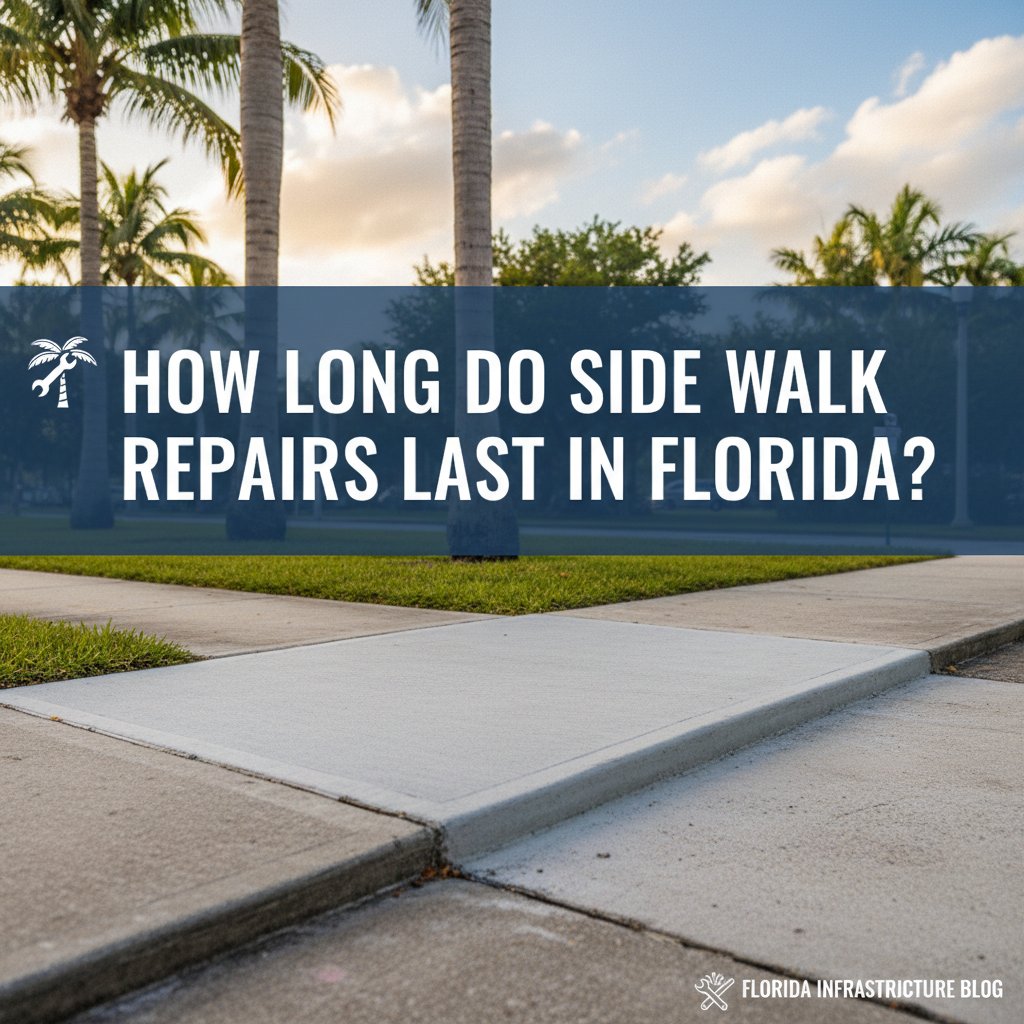
When budgeting for concrete maintenance, property managers and HOA boards need reliable data on repair longevity. The question isn’t just about initial costs—it’s about understanding which repair method delivers the best return on investment over time. In Florida’s unique climate, this calculation becomes even more critical.
The durability of sidewalk repairs depends primarily on the method used, not the climate where they’re installed. Quality concrete cutting repairs typically last 8-12 years or longer, while grinding solutions may need retreatment in 3-5 years. Traditional replacement, though lasting 20-30 years, costs 10 times more upfront. Understanding these timelines helps decision-makers choose solutions that balance budget constraints with long-term maintenance planning.
Comparing Repair Method Longevity
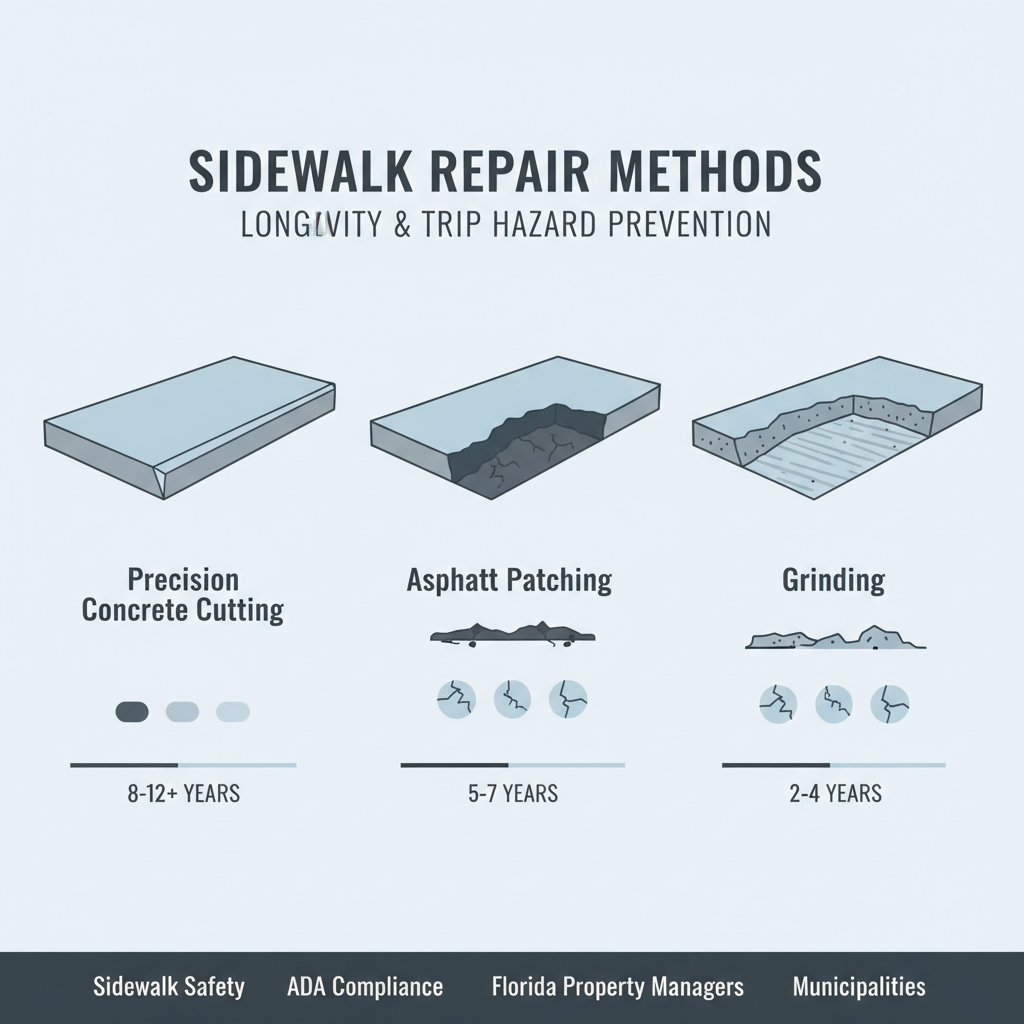
Not all sidewalk repair methods deliver equal durability. The lifespan of your repair depends fundamentally on the technique employed and how well it addresses the root cause of the problem.
Precision Concrete Cutting: 8-12+ Years
Precision concrete cutting technology removes the raised portion of concrete that creates trip hazards, establishing a smooth, permanent transition between slabs. This method addresses the displacement that occurred rather than simply masking it. Because the cutting process removes material precisely and creates clean edges, the repair remains effective until underlying soil conditions cause new movement.
This concrete sidewalk repair approach has demonstrated consistent performance across thousands of installations. The key advantage is that it corrects the actual problem—the height differential between slabs—rather than attempting to build up lower sections or grind down raised areas to questionable tolerances.
Grinding: 3-5 Years
Concrete grinding uses abrasive discs to reduce raised sections, theoretically bringing them level with adjacent slabs. However, this method has significant limitations that affect longevity. Grinding removes the hardened top surface of concrete, exposing the more porous aggregate layer beneath. This compromised surface absorbs moisture, deteriorates faster, and often leaves a rough, discolored appearance.
More critically, grinding cannot always achieve ADA-compliant slopes when height differentials exceed certain thresholds. When forced beyond its practical limits, grinding creates weak, thin sections prone to cracking and spalling. Many ground repairs require retreatment within 3-5 years as the exposed surface degrades or movement continues.
Complete Replacement: 20-30 Years
Full slab replacement provides the longest lifespan when done correctly with proper base preparation and soil stabilization. However, this longevity comes at substantial cost—typically 10-15 times more than precision cutting. Replacement also requires 3-7 days of cure time before use, creates significant disruption, and generates considerable waste.
For most trip hazard situations where the concrete itself remains structurally sound, replacement represents overbuilding. The existing concrete hasn’t failed; it simply shifted due to soil settlement, root growth, or erosion. When comparing sidewalk repair vs replacement cost over a 30-year horizon, multiple cutting repairs still cost less than one replacement while maintaining safety and compliance throughout.
Florida Climate Factors That Actually Matter
Property managers often express concern about Florida’s climate affecting repair longevity. While it’s true that Florida presents unique environmental conditions, quality repairs withstand these factors effectively.
The Real Issue: Soil Movement, Not Weather
Concrete durability in Florida isn’t compromised by climate—the state’s infrastructure proves this daily. What affects sidewalk longevity is soil movement caused by:
- Sandy soil composition: Much of Florida sits on sandy soils that shift more easily than clay or rocky substrates
- Tree root growth: Fast-growing tropical and subtropical trees create pressure under slabs
- Water table fluctuations: Seasonal water level changes cause soil expansion and contraction
- Erosion: Heavy rains can wash away supporting soil beneath slabs
These factors affect all concrete equally, whether it’s a new installation or a repair. A precision-cut repair on a slab that has already moved sits on soil that has largely stabilized. New replacement concrete often experiences its own settling within the first several years as the base compacts under weight.
Moisture and Concrete Surface Integrity
Florida’s humidity and rainfall do interact with concrete surface conditions. This is where repair method makes a measurable difference. Precision cutting maintains the original finished surface of the concrete—the dense, hardened layer that resists moisture penetration. Grinding removes this protective layer, exposing porous material that absorbs water and deteriorates faster in any climate, but especially in high-moisture environments.
Quality concrete sidewalk repair preserves the structural integrity that helps concrete withstand decades of exposure to the elements.
ADA Compliance Durability Standards
For trip hazard repair to remain effective long-term, it must maintain ADA compliance throughout its service life. The Americans with Disabilities Act specifies that vertical discontinuities in walking surfaces cannot exceed 1/4 inch (0.5 inch if beveled).
Precision cutting creates a permanent slope that meets these specifications. Because material is removed rather than worn away, the compliant profile remains stable. This matters significantly for liability protection—a repair that degrades below compliance standards within 2-3 years hasn’t truly solved the problem.
Municipalities and property managers face potential lawsuits when trip hazards cause injuries. Courts evaluate whether property owners took reasonable steps to maintain safe conditions. A repair method with documented 8-12 year performance demonstrates due diligence. Short-term solutions that require frequent retreatment may not provide the same legal protection, especially if hazards redevelop between inspection cycles.
Cost Analysis Over Time: Repair vs Replace
Understanding sidewalk restoration florida costs requires evaluating total expenditure over realistic planning horizons rather than just initial outlay.
15-Year Cost Comparison
Consider a typical scenario: 100 linear feet of sidewalk with multiple trip hazards requiring correction.
Precision Cutting Approach:
- Initial repair: $1,500-$2,500
- Possible second repair at year 10: $1,500-$2,500
- Total 15-year cost: $3,000-$5,000
Grinding Approach:
- Initial treatment: $1,200-$2,000
- Retreatment at year 4: $1,200-$2,000
- Retreatment at year 8: $1,200-$2,000
- Retreatment at year 12: $1,200-$2,000
- Total 15-year cost: $4,800-$8,000
Complete Replacement:
- Full replacement: $15,000-$25,000
- Total 15-year cost: $15,000-$25,000
These figures demonstrate why concrete repair vs replace decisions favor strategic repair for trip hazards. Replacement makes sense when concrete is structurally compromised with extensive cracking, spalling, or deterioration. For displacement issues where the concrete remains sound, precision cutting delivers safety and compliance at a fraction of replacement cost.
Factors That Extend Repair Lifespan
Property managers can maximize repair durability through complementary maintenance practices:
Root Management
When tree roots cause displacement, addressing only the symptom—the raised concrete—provides temporary relief. Professional root barrier installation or selective root pruning prevents recurrence. This investment, combined with precision cutting repair, can extend the repair interval significantly.
Drainage Improvements
Standing water accelerates soil erosion beneath slabs. Simple drainage solutions like French drains, regrading, or downspout extensions protect repairs by stabilizing the supporting soil. These preventive measures benefit both repairs and existing concrete.
Regular Inspections
Catching small displacements early prevents them from becoming major hazards. Annual sidewalk inspections identify new issues when they’re less expensive to address and prevent liability exposure from known hazards.
When Replacement Actually Makes Sense
Precision cutting and sidewalk repair vs replacement cost advantages apply specifically to trip hazards caused by displacement. Replacement becomes the appropriate choice when:
- Concrete shows structural failure with extensive cracking throughout the slab
- Surface spalling or deterioration has compromised more than 30% of the slab
- The base or subgrade requires reconstruction due to severe settlement or void formation
- Property renovations create opportunities to upgrade sidewalk width, routing, or specifications
Experienced concrete professionals assess each situation individually, recommending the most cost-effective solution that ensures safety and compliance.
Choosing a Repair Method for Long-Term Value
Decision-makers evaluating sidewalk restoration florida options should prioritize proven performance over lowest initial cost. Questions to ask potential contractors include:
- What is the documented lifespan of repairs using your method?
- Can you provide references from commercial or municipal clients with 5+ year old repairs?
- Will the repair maintain ADA compliance throughout its service life?
- What warranties or guarantees back your work?
- How does your method preserve or compromise the original concrete surface?
Companies with decades of experience and thousands of installations provide valuable insight into real-world repair performance. This track record matters more than theoretical claims or lowest-bid pricing.
Making the Smart Investment Decision
Sidewalk trip hazard repair represents risk management as much as maintenance expense. The cost of one slip-and-fall lawsuit typically exceeds the price of repairing every trip hazard on a property. Choosing repair methods with documented longevity ensures continuous compliance and protection.
For Florida property managers, HOA boards, and municipal officials, precision concrete cutting delivers the optimal balance of cost-effectiveness, durability, and performance. With proper assessment of underlying causes and strategic complementary measures, these repairs provide 8-12 years or more of service—protecting both pedestrians and budgets.
Florida Sidewalk Solutions has spent over two decades refining precision concrete cutting techniques that deliver lasting results for properties throughout the state. Our approach corrects trip hazards permanently while preserving your existing concrete investment. Whether you manage a single property or oversee maintenance for entire municipalities, we provide cost-effective solutions that meet ADA standards and stand the test of time.
Ready to address trip hazards with repairs that last? Contact Florida Sidewalk Solutions today for a free property assessment. We’ll evaluate your specific situation, explain your options clearly, and provide transparent pricing for solutions that deliver long-term value. Don’t let trip hazards compromise safety or expose your organization to liability—let us show you how precision cutting technology solves these problems efficiently and permanently.