
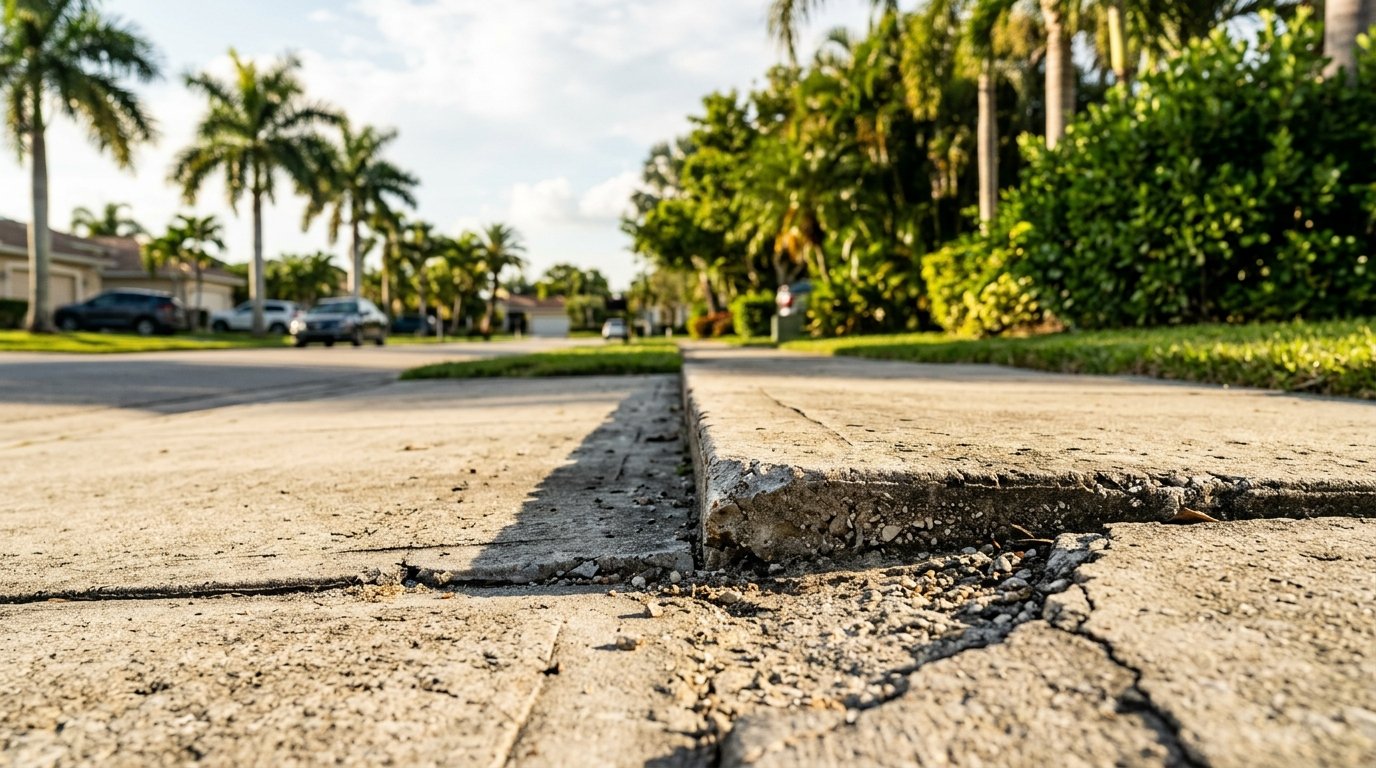
A single cracked sidewalk panel costs far more than the repair. In Florida, municipalities and property owners collectively face tens of millions of dollars in trip-and-fall settlements each year — and a significant portion of those claims stem from defects that could have been corrected for a few hundred dollars. If you manage a municipal property, HOA community, or commercial facility in Palm Beach County or Broward County, understanding your legal exposure in 2026 is not optional. It is essential.
This guide breaks down Florida’s sidewalk liability framework, what property managers and public works directors need to know right now, and how proactive repair strategies can dramatically reduce your risk — and your costs.
How Florida Premises Liability Law Applies to Sidewalks
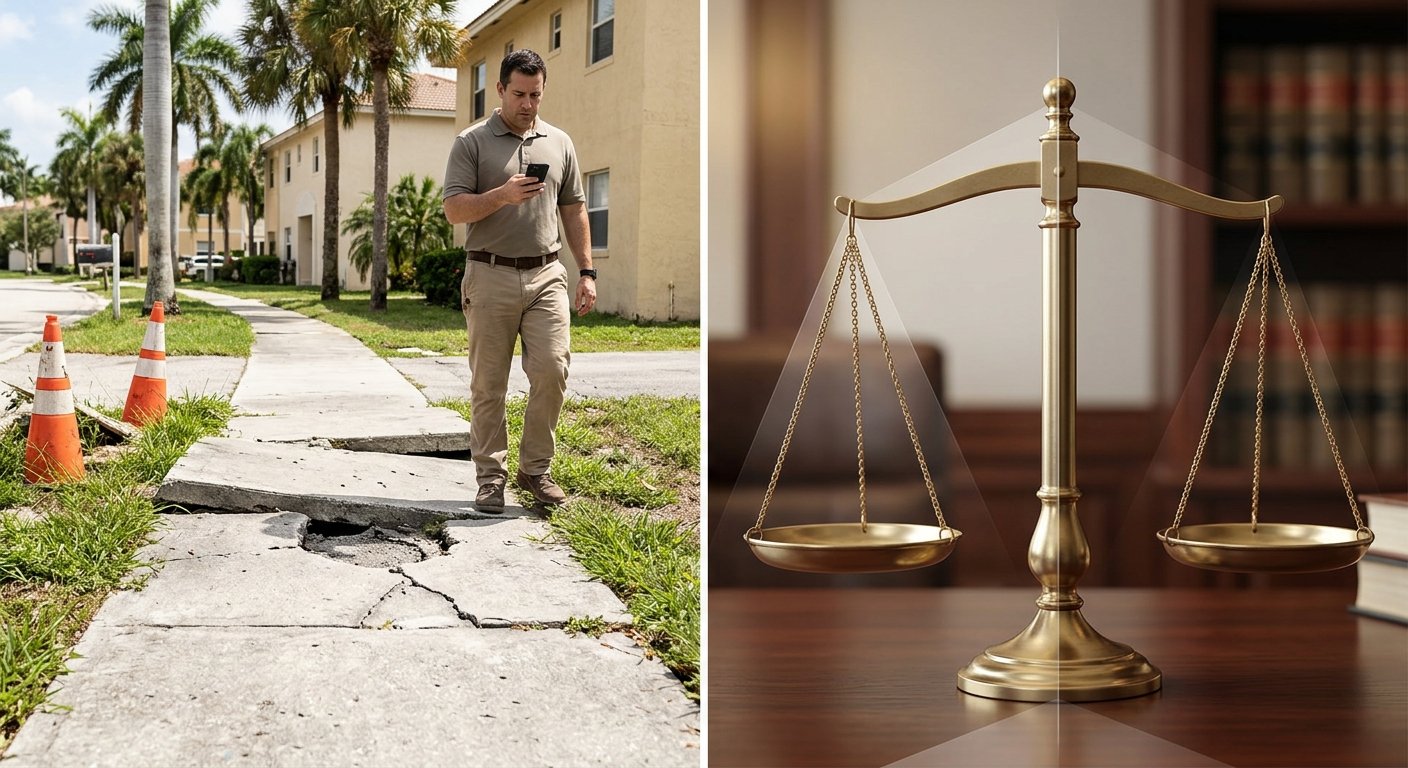
Florida premises liability law holds property owners and controllers responsible for maintaining reasonably safe conditions for visitors. Under Florida Statute §768.0755, property owners must demonstrate that they had actual or constructive knowledge of a hazardous condition and failed to take corrective action. This standard applies directly to sidewalk trip hazards — uneven slabs, raised edges, cracked concrete, and tree-root-displaced panels are among the most frequently cited conditions in slip-and-fall litigation.
The critical factor is constructive knowledge. You do not need to personally know the hazard exists. If a reasonable inspection would have revealed it, courts may find liability. This means that property managers who skip routine sidewalk inspections are not protected — they are exposed.
Who Bears Liability: Municipalities vs. Private Property Owners
Liability assignment depends on who controls the sidewalk. In Florida, this varies by municipality. Some cities and counties maintain sidewalks adjacent to private property as part of the public right-of-way. Others place that maintenance obligation squarely on the adjacent property owner. HOAs often carry responsibility for common-area sidewalks throughout their communities.
Before assuming the municipality bears full responsibility, property managers and HOA boards should verify their specific local ordinances. Misunderstanding this distinction has resulted in costly legal defeats for private owners who assumed a public entity would absorb the claim.
The Real Cost of Inaction
Trip-and-fall lawsuits are expensive by any measure. According to data from the National Safety Council, falls are among the leading causes of unintentional injury-related costs in the United States, with average medical costs per incident running into the tens of thousands of dollars. When litigation follows, defense costs, settlements, and increased insurance premiums compound the financial damage significantly.
For municipalities in Palm Beach County and Broward County, a single sidewalk trip-and-fall claim that proceeds to verdict can result in payouts ranging from $50,000 to well over $500,000, depending on injury severity and circumstances. Multiply that by the frequency of such incidents across an aging sidewalk inventory, and the argument for proactive repair becomes financially undeniable.
Notice of Hazard: The Clock Starts Earlier Than You Think
Many property managers believe that liability only attaches once someone is formally injured and reports a hazard. In practice, plaintiff attorneys are skilled at establishing prior notice through maintenance logs, neighbor complaints, inspection records, and even social media posts showing the defect. If any documentation exists showing the hazard was known — or should have been known — liability exposure increases substantially.
This is why regular sidewalk inspections and prompt remediation are not just best practices. They are legal risk management tools. Learn more about how Florida premises liability and sidewalk liability lawsuits interact in our detailed resource.
ADA Compliance: A Separate but Parallel Liability
Beyond premises liability, sidewalk defects frequently trigger ADA compliance violations. The Americans with Disabilities Act requires accessible routes that are stable, firm, and slip-resistant, with cross-slopes not exceeding 2% and changes in level greater than ½ inch requiring beveled or ramped transitions.
For municipalities, ADA compliance is not discretionary. Public entities are required under Title II of the ADA to ensure their pedestrian infrastructure remains accessible. For commercial properties and HOAs serving the public, Title III applies equally. Failure to maintain compliant sidewalks opens a second channel of legal exposure entirely separate from personal injury claims.
Our dedicated resource on ADA sidewalk compliance in South Florida provides in-depth guidance on standards, inspection protocols, and remediation requirements specific to our region.
Identifying High-Risk Sidewalk Conditions
Not all sidewalk damage carries equal liability weight. The defects most likely to cause injury — and generate litigation — share common characteristics:
- Vertical displacement exceeding ½ inch: The ADA benchmark and the threshold most commonly cited in trip-and-fall cases
- Tree root heaving: Extremely common in Palm Beach County and Broward County communities with mature tree canopies
- Spalling and surface deterioration: Creates uneven surfaces that catch feet, especially for elderly pedestrians
- Settlement cracks: Panels that have sunk or tilted create sudden level changes
- Missing or damaged curb cuts: A direct ADA violation affecting wheelchair users and individuals with mobility impairments
A systematic inspection program that maps and documents these conditions — with date-stamped records — serves two purposes: it guides repair prioritization and it demonstrates due diligence in the event of a claim.
Why Concrete Cutting Outperforms Grinding and Replacement
When property managers and public works directors identify trip hazards, they typically face three remediation options: grinding, full panel replacement, or precision concrete cutting. Understanding the differences matters both for budget planning and for compliance outcomes.
Grinding
Concrete grinding removes material from the raised edge to reduce the vertical displacement. It is faster than replacement but produces a sloped, beveled finish that can itself become a tripping surface over time. Grinding also does not address the underlying cause of displacement, meaning the repaired area often redevelops the hazard relatively quickly.
Full Panel Replacement
Replacement resolves the problem permanently at that location but comes at significant cost — typically 70% to 90% higher than cutting-based solutions for comparable repairs. It also requires demolition, disposal of concrete debris, curing time before reopening, and significant disruption to surrounding areas. For municipalities managing large sidewalk inventories on constrained budgets, full replacement as a default strategy is financially unsustainable.
Precision Concrete Cutting
Florida Sidewalk Solutions uses patented precision concrete cutting technology to remove the exact material causing the trip hazard, creating a clean, flush, ADA-compliant transition. The result is structurally sound, visually professional, and compliant with the ADA’s requirements for changes in level. Because no demolition or panel removal is required, repairs are completed quickly with minimal disruption — critical for schools, retail centers, and municipalities that cannot afford extended sidewalk closures.
The cost advantage is substantial. Precision cutting consistently delivers repairs at 70% to 90% less than full replacement costs, allowing property managers and municipalities to address far more hazards within the same budget cycle. Explore the full scope of our sidewalk trip hazard repair services to understand what this approach means for your property.
Building a Defensible Sidewalk Safety Program
For municipal public works directors, HOA boards, and commercial property managers in Palm Beach County and Broward County, a defensible safety program includes four core elements:
- Scheduled inspections: Walk all pedestrian routes on a documented schedule. Quarterly is a minimum standard for high-traffic areas.
- Hazard documentation: Photograph and log every identified defect with location data and discovery date.
- Prioritized remediation: Address the highest-risk defects — those with the greatest vertical displacement or highest pedestrian traffic — first.
- Repair verification: Document completed repairs with post-remediation photos and contractor records.
This system does not eliminate the possibility of a future incident, but it substantially reduces both the likelihood of injury and the legal exposure if a claim is filed.
Frequently Asked Questions
What constitutes a trip hazard under Florida law?
Florida courts and ADA standards generally recognize a vertical displacement of ½ inch or greater as a trip hazard. However, smaller displacements can still support liability claims if injury results and the condition was known. The specific threshold matters less than the overall standard of reasonable care.
Is a municipality automatically protected from sidewalk liability in Florida?
No. Florida’s sovereign immunity statute limits but does not eliminate municipal liability. Under Florida law, government entities can be sued for negligent maintenance of public property, including sidewalks, subject to statutory caps. Sovereign immunity is a partial defense, not a blanket shield.
How quickly does a sidewalk trip hazard need to be repaired after discovery?
There is no universal statutory deadline, but prompt action is legally significant. The longer a known hazard remains unaddressed, the stronger a plaintiff’s negligence argument becomes. Best practice is to remediate high-risk hazards within days of discovery, not weeks or months.
Does precision concrete cutting actually meet ADA compliance standards?
Yes. When performed correctly, precision concrete cutting creates transitions that comply with ADA requirements for changes in level. Florida Sidewalk Solutions’ patented technology is specifically designed to achieve ADA-compliant results efficiently and without panel replacement.
What is the difference between sidewalk maintenance responsibility for HOAs versus municipalities in Florida?
This varies by location and governing documents. HOAs are generally responsible for sidewalks within private community areas. Sidewalks within public rights-of-way may fall to the municipality, though some local ordinances assign adjacent-property-owner responsibility. Legal review of your specific governing documents and local ordinances is the only reliable way to confirm your obligations.
Take Control of Your Sidewalk Liability Today
Municipal sidewalk liability in Florida is a defined, manageable risk — but only for those who address it proactively. With over 20 years of Florida-specific sidewalk safety experience, Florida Sidewalk Solutions has helped municipalities, HOAs, property managers, and commercial facility owners throughout Palm Beach County and Broward County transform liability exposure into documented compliance.
Our licensed and insured team uses patented precision concrete cutting technology to deliver fast, cost-effective, ADA-compliant repairs that protect your organization, your budget, and the people who use your property every day.
Contact Florida Sidewalk Solutions today for a professional sidewalk safety assessment. Identify your hazards, quantify your risk, and get a clear remediation plan — before the next trip-and-fall becomes your problem to solve in court.