
Florida schools face mounting pressure in 2026 to address sidewalk safety and ADA compliance. With new enforcement initiatives from the Department of Justice and increased litigation targeting educational facilities, administrators and facilities managers cannot afford to ignore deteriorating concrete walkways. A single trip-and-fall incident can result in lawsuits exceeding $500,000, not to mention the potential for serious student injuries and reputational damage to the institution.
This compliance guide addresses the specific requirements Florida schools must meet, the liability risks of non-compliance, and cost-effective solutions that protect students while preserving limited educational budgets.
Understanding ADA Requirements for School Sidewalks in 2026
The Americans with Disabilities Act (ADA) sets strict standards for pedestrian pathways at educational facilities. Schools serving students of any age—from elementary through university level—must maintain accessible routes throughout their campuses. These requirements apply to public schools, private institutions receiving federal funding, and charter schools across Florida.
Critical ADA Standards for Educational Walkways
The ADA requires that sidewalks and walking surfaces maintain specific measurements to ensure accessibility:
- Vertical displacement limits: Changes in level cannot exceed 1/4 inch without beveling, and anything between 1/4 inch and 1/2 inch requires beveled edges at a 1:2 slope maximum
- Cross slope requirements: Sidewalks cannot have a cross slope exceeding 1:48 (2%)
- Running slope standards: Walking surfaces with slopes greater than 1:20 (5%) must meet ramp specifications
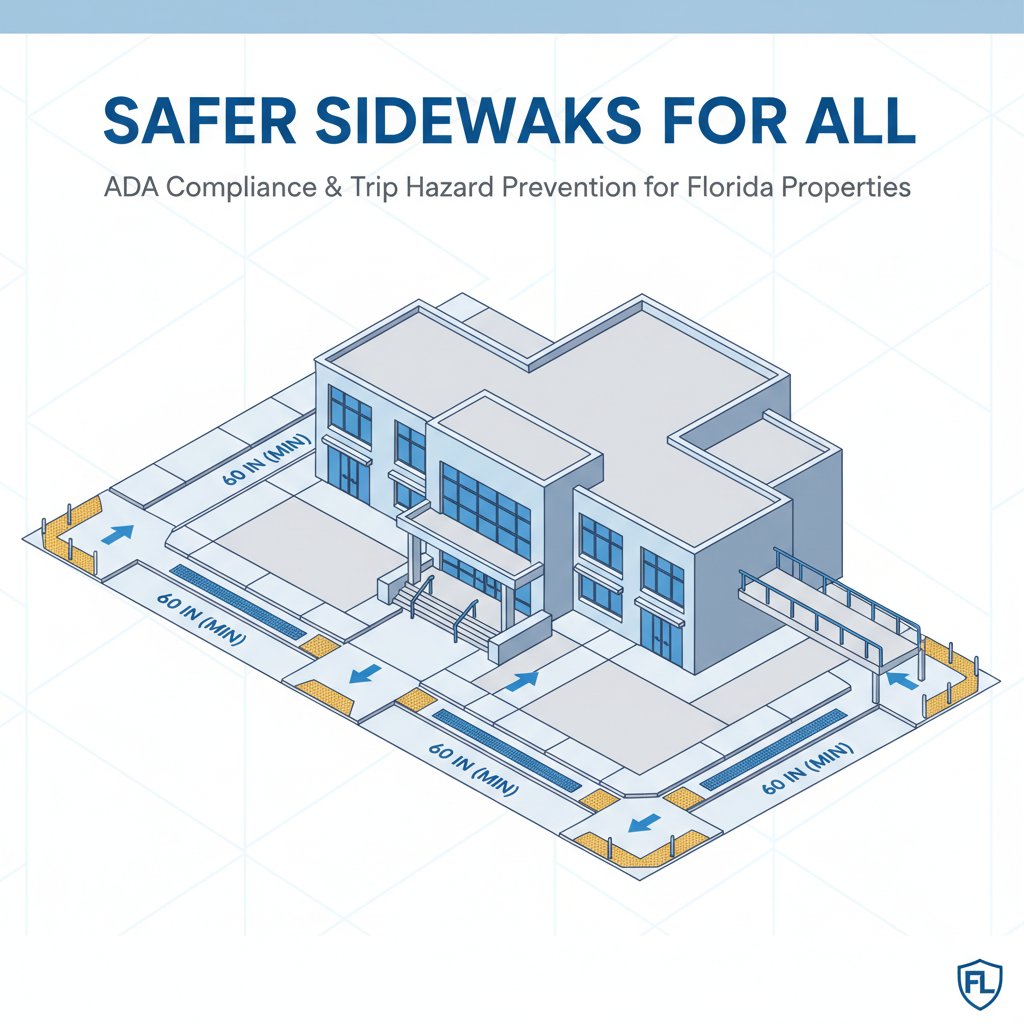
- Width minimums: Accessible routes must be at least 36 inches wide, with 60-inch passing zones at reasonable intervals
- Surface stability: Walking surfaces must be stable, firm, and slip-resistant
When concrete sidewalk repair florida facilities managers address, even small violations of these standards can trigger compliance issues. A 3/4-inch raised panel—common with root intrusion or soil settlement—creates both an ADA violation and a dangerous trip hazard that must be corrected immediately.
Florida-Specific Compliance Challenges for Schools
Florida’s unique environmental conditions create accelerated sidewalk deterioration at educational campuses. Expansive clay soils, aggressive root systems from palm and oak trees, intense rainfall, and the subtropical climate all contribute to uneven concrete settlement and displacement.
The state’s rapid growth has also increased scrutiny on accessibility compliance. Florida’s Department of Education has partnered with advocacy groups to audit school facilities, resulting in compliance orders for dozens of districts since 2024. Miami-Dade, Broward, Palm Beach, Orange, and Hillsborough counties have all faced investigations related to sidewalk accessibility violations.
Legal Liability Exposure for Florida Schools
Schools face liability from multiple angles when sidewalk trip hazard liability florida issues go unaddressed:
Personal Injury Claims: When students, staff, or visitors suffer injuries from trips and falls, schools may be held liable for negligence. Florida’s premises liability laws require property owners to maintain reasonably safe conditions and warn of known hazards. Educational facilities owe an especially high duty of care to minor children.
ADA Violation Lawsuits: Private citizens can file lawsuits under Title III of the ADA. These cases often result in court-ordered repairs plus attorney’s fees, which can exceed the actual repair costs. Serial litigants have increasingly targeted Florida schools, filing dozens of lawsuits against districts with documented accessibility barriers.
Federal Funding Consequences: Schools receiving federal funding must comply with Section 504 of the Rehabilitation Act. Non-compliance can jeopardize funding streams critical to educational programs, creating financial consequences far beyond repair costs.
The True Cost of Sidewalk Trip Hazards at Schools
Beyond legal exposure, unrepaired trip hazards create cascading costs that strain already limited educational budgets. Consider these documented expenses from Florida school incidents:
A Pinellas County elementary school paid $485,000 to settle a lawsuit after a parent visiting campus tripped on a raised sidewalk panel and suffered a fractured hip. The concrete displacement measured just over one inch—a problem that could have been corrected for under $500 with proper trip hazard repair.
A Central Florida middle school spent $127,000 defending against an ADA complaint, then paid an additional $340,000 for emergency sidewalk replacement to comply with the settlement agreement. Proactive maintenance would have cost less than $15,000.
These examples illustrate a critical reality: prevention costs pennies compared to litigation dollars.
Trip Hazard Repair Solutions: Comparing Your Options
When sidewalk panels become uneven, facilities managers face three primary options: replacement, grinding, or precision cutting. Each approach has distinct advantages and limitations for school environments.
Complete Sidewalk Replacement
Traditional replacement involves demolishing existing concrete, removing debris, preparing the base, and pouring new concrete. While this creates a fresh surface, the costs and disruptions make it impractical for many school situations.
Replacement typically costs $8-15 per square foot in Florida, requires 3-7 days for curing before the area can be reopened, generates substantial landfill waste, and necessitates extensive cordoning off of walkways during active school hours. The noise and equipment also disrupt classroom instruction.
Concrete Grinding
Grinding uses abrasive wheels to gradually wear down raised concrete until it’s level with adjacent panels. This approach costs less than replacement but creates significant problems in educational settings.
Grinding generates enormous amounts of concrete dust that infiltrates nearby buildings through HVAC systems. The process weakens the concrete edge by removing the strongest surface layer, creating rough, unfinished appearances that look unprofessional. Grinding also takes significantly longer than cutting methods, extending disruption periods.
Precision Concrete Cutting Technology
Advanced cutting technology offers the optimal solution for ada compliant sidewalks south florida schools need. This patented system uses specialized saws to create precise, clean cuts that remove trip hazards while maintaining structural integrity.
The process works by cutting away the raised portion of the displaced panel at precise angles that meet ADA beveling requirements. The result is a smooth, safe transition that eliminates the trip hazard while leaving the concrete strong and aesthetically pleasing.
Precision cutting costs 70-90% less than replacement, typically $3-4 per linear foot of cut. Treated areas can be reopened immediately after cutting—no curing time required. The process creates minimal dust with proper equipment, produces clean, professional finishes that maintain curb appeal, and generates no demolition waste for landfills.
For school administrators balancing safety requirements with budget constraints, cutting technology delivers compliant results without the costs and disruptions that interfere with educational operations.
Implementing a Proactive Sidewalk Safety Program
Florida schools should establish systematic inspection and maintenance protocols rather than waiting for accidents or complaints to trigger reactive repairs.
Annual Safety Audits
Conduct comprehensive walkway inspections at the start of each school year. Use a simple gauge to measure vertical displacements—anything exceeding 1/4 inch without proper beveling requires attention. Document all findings with photographs and location notes to track problem areas over time.
Priority-Based Repair Scheduling
Not all trip hazards pose equal risks. Prioritize repairs based on these factors:
- High-traffic areas (main entrances, cafeteria approaches, between classroom buildings)
- Routes used by students with mobility devices
- Pickup and drop-off zones where parents and visitors walk
- Areas near playgrounds and athletic facilities
- Pathways with documented near-miss incidents
Address the highest-risk locations first, then systematically work through lower-priority areas as budget allows.
Summer Maintenance Windows
Schedule major sidewalk repairs during summer breaks when campus disruption affects fewer people. However, don’t delay critical safety repairs until summer if they pose immediate risks. Modern trip and fall prevention techniques like precision cutting allow for quick repairs during school sessions with minimal disruption.
Handicap Ramp Requirements Florida Schools Must Meet
Beyond general sidewalk standards, schools must ensure all handicap ramp requirements florida regulations mandate are met at building entrances, parking areas, and anywhere elevation changes occur.
Ramps must maintain slopes no steeper than 1:12 (one inch of rise for every 12 inches of run). Landings are required at the top and bottom of each ramp run, measuring at least 60 inches deep. Handrails must be installed on both sides when the rise exceeds six inches, positioned 34-38 inches above the ramp surface.
Deterioration around ramps creates particular hazards. Settlement that causes ramps to exceed maximum slope ratios or creates lips at transitions must be corrected promptly to maintain compliance and safety.
Cost-Effective Compliance: Real Numbers for Florida Schools
A typical Florida elementary school with 50,000 square feet of sidewalks might have 15-25 trip hazards requiring attention during a standard inspection. Using precision cutting technology, the entire campus can be brought into compliance for $4,000-7,000.
The same repairs using complete replacement would cost $30,000-65,000 and require weeks of staged work. This price difference allows schools to address safety issues immediately rather than deferring repairs due to budget limitations—a decision that exposes the institution to unnecessary liability.
For multi-campus districts, the savings multiply. A medium-sized Florida school district with 15 campuses can implement system-wide sidewalk safety compliance for under $100,000 using advanced repair technologies, versus $500,000+ for traditional approaches.
Choosing the Right Concrete Sidewalk Repair Partner
Not all concrete contractors understand the unique requirements of educational environments or possess the specialized equipment needed for precision repairs. When selecting a repair partner, Florida schools should verify:
- Experience specifically with educational facilities and ADA compliance work
- Proper licensing, insurance, and background screening for working on school grounds
- Availability to work during summer breaks or around school schedules
- Use of advanced cutting technology rather than outdated grinding methods
- Understanding of Florida-specific requirements and environmental challenges
- References from other educational institutions
Companies with decades of Florida experience understand how local conditions affect concrete and can recommend maintenance schedules that prevent future problems.
Protecting Students and Budgets Through Smart Sidewalk Management
Florida schools face genuine challenges balancing comprehensive safety requirements with constrained budgets. Sidewalk trip hazards represent a solvable problem when administrators implement proactive inspection programs and utilize cost-effective repair technologies.
The consequences of inaction—from student injuries to expensive litigation to federal compliance orders—far exceed the costs of maintaining safe, accessible walkways throughout campus. Modern repair solutions make compliance achievable without the budget-breaking expenses of traditional replacement methods.
Educational facilities managers protecting their students, staff, and institutions should prioritize sidewalk safety as a fundamental component of campus risk management. The investment in proper maintenance delivers returns through reduced liability exposure, enhanced accessibility, and the peace of mind that comes from providing safe learning environments.
Is your school campus compliant with 2026 ADA standards? Florida Sidewalk Solutions specializes in cost-effective trip hazard repair for educational facilities throughout the state. Our patented precision cutting technology eliminates dangerous sidewalk displacements at a fraction of replacement costs, with minimal disruption to campus operations. Contact us today for a complimentary safety assessment and discover how we’ve helped hundreds of Florida schools achieve full compliance while protecting their budgets. Call now to schedule your inspection and protect your students, staff, and institution from preventable accidents and costly litigation.