
Property managers in Miami-Dade County face mounting pressure in 2026 as ADA enforcement intensifies and legal liability costs continue to climb. A single non-compliant sidewalk can trigger lawsuits exceeding $75,000, damage your property’s reputation, and create dangerous conditions for residents and visitors. Understanding current ADA sidewalk requirements and having a clear compliance strategy isn’t optional—it’s essential risk management.
The landscape of ADA compliance has shifted dramatically. Federal enforcement agencies are conducting more proactive audits, while private lawsuits under Title III have increased by 14% year-over-year. For property managers overseeing commercial properties, HOAs, or municipal facilities, the question isn’t whether to address sidewalk compliance, but how to do it cost-effectively and correctly.
Current ADA Sidewalk Requirements in Florida
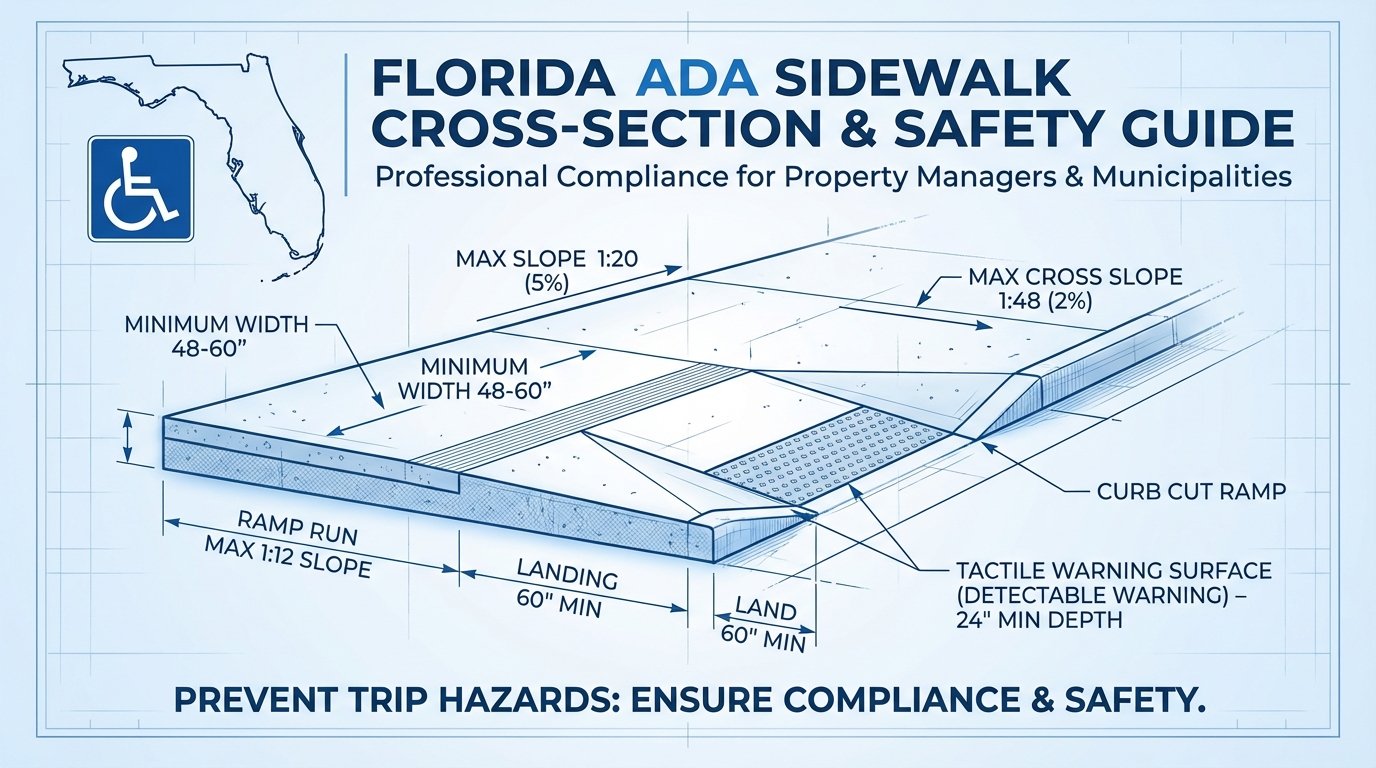
ADA compliant sidewalks in South Florida must meet specific technical standards outlined in the ADA Standards for Accessible Design and Florida Building Code Chapter 11. These requirements apply to all public accommodations and commercial facilities, regardless of when they were constructed.
Critical Width and Surface Requirements
Sidewalks must maintain a minimum clear width of 36 inches, though 48 inches is recommended for comfortable two-way traffic. The running slope cannot exceed 5% in the direction of travel, and cross slopes must remain under 2%. Any deviation from these standards creates a non-compliant condition requiring immediate attention.
Surface conditions matter significantly. The ADA defines trip hazards as vertical elevation changes exceeding 1/4 inch (0.25 inches) without beveling, or 1/2 inch even with beveling. In Miami-Dade’s climate, tree root growth, soil settlement, and weathering frequently create these hazardous conditions within just a few years of installation.
Curb Ramp and Transition Standards
Every intersection where pedestrian routes cross curbs requires compliant curb ramps. These ramps must have slopes no steeper than 8.33% (1:12 ratio), detectable warning surfaces, and landing areas at least 36 inches long. Side flares, when used instead of returned curbs, cannot exceed 10% slope.
For property managers, understanding that sidewalk ADA compliance in Miami-Dade extends beyond the main walking surface to include all transitions, landings, and connecting elements is crucial for comprehensive risk mitigation.
Legal Liability and Enforcement Realities
The consequences of non-compliance extend far beyond theoretical risk. Miami-Dade property managers are operating in one of the most active ADA litigation environments in the country.
Title III Lawsuit Trends
Serial plaintiffs and specialized law firms systematically survey commercial properties for ADA violations. A typical demand letter starts at $25,000 for settlement, but cases proceeding to litigation regularly result in judgments between $50,000 and $100,000 when attorney fees and court costs are included.
Florida saw over 2,300 ADA-related lawsuits filed in 2025, with Miami-Dade accounting for approximately 18% of these cases. The average settlement increased to $38,000, not including the costs of actually correcting the violations.
Personal Injury Claims
Beyond ADA compliance issues, trip-and-fall incidents on defective sidewalks generate premises liability claims. When a property manager knows or should have known about a dangerous condition and fails to remedy it, the property owner faces significant exposure. Verdicts in serious injury cases routinely exceed $500,000.
Insurance carriers are responding by increasing premiums for properties with documented sidewalk defects and, in some cases, excluding sidewalk-related claims entirely from coverage.
Understanding ADA Compliance Miami Requirements
Miami-Dade County has additional local requirements that property managers must navigate alongside federal ADA standards. The county’s public works department conducts regular inspections of sidewalks adjacent to commercial properties, issuing violation notices that mandate corrections within specified timeframes.
ADA walkway requirements in Florida also intersect with state accessibility codes. The Florida Building Code adopts the federal standards but adds specific provisions for hurricane resistance and tropical climate considerations. Property managers must ensure solutions meet all three levels of regulation: federal ADA, state building codes, and local ordinances.
Why Traditional Repair Methods Fall Short
When faced with non-compliant sidewalks, property managers traditionally consider two approaches: grinding or complete replacement. Both have significant limitations in the Miami-Dade context.
The Grinding Problem
Concrete grinding uses rotating stones to reduce high sections of concrete, theoretically eliminating trip hazards. However, this method creates rough, porous surfaces that quickly deteriorate in South Florida’s intense weather conditions. The abraded surface traps moisture, accelerates degradation, and often looks unprofessional within months.
More critically, grinding cannot address many common issues. When low sections create ponding water or when panels have tilted creating slope violations, grinding offers no solution. It’s a temporary fix that rarely provides lasting ADA sidewalk compliance in South Florida.
Replacement Cost Reality
Complete sidewalk replacement delivers compliant results but at extraordinary cost. Current Miami-Dade pricing for removal and replacement averages $18-24 per square foot when factoring in demolition, disposal, concrete, finishing, and curing time.
The disruption factor adds hidden costs. Sidewalk replacement requires extended closures (minimum 3-7 days for curing), impacts business operations, creates liability during construction, and generates substantial debris requiring disposal. For property managers overseeing occupied facilities, these operational impacts often exceed the direct construction costs.
The Precision Cutting Solution
Advanced concrete cutting technology offers property managers a superior alternative that addresses the shortcomings of both grinding and replacement while delivering 70-90% cost savings.
How the Process Works
Patented cutting equipment makes strategic cuts in concrete panels, allowing precise realignment to meet ADA specifications. High sections are lowered, low sections raised, and slopes corrected—all without removal or replacement. The process restores surfaces to within ADA-compliant tolerances of less than 1/4 inch elevation change.
The cutting method uses diamond-tipped saws that create clean edges and preserve the existing concrete surface. Unlike grinding, which damages the finished surface, cutting maintains the original appearance and structural integrity.
Speed and Minimal Disruption
Most repairs are completed within hours rather than days. Sidewalks typically reopen to pedestrian traffic immediately after work concludes, with no curing time required. For commercial properties and HOAs, this minimal disruption means residents and customers experience virtually no inconvenience.
A typical 100-square-foot section requiring compliance corrections takes 2-4 hours with cutting technology versus 5-7 days for replacement. Property managers can schedule work during off-peak hours to further minimize any impact.
Cost Comparison
The economic advantage becomes clear in direct comparison. ADA sidewalk repair in South Florida using precision cutting typically costs $4-7 per square foot compared to $18-24 for replacement. For a property manager addressing 500 square feet of non-compliant walkways, the savings reach $7,000-10,000 per project.
These savings compound when considering the avoided costs: no dumpsters or disposal fees, no extended closures affecting operations, no liability during multi-day construction periods, and no disruption to landscaping or adjacent improvements.
Environmental and Long-Term Benefits
Sustainability considerations increasingly influence property management decisions, and concrete cutting delivers significant environmental advantages. The process generates zero demolition waste, eliminating the carbon footprint associated with hauling debris to landfills and manufacturing new concrete.
Existing concrete represents substantial embodied energy—the total energy consumed in material extraction, manufacturing, and installation. Preserving this material through repair rather than replacement aligns with green building principles and can contribute to LEED certification goals for commercial properties.
Long-term performance data shows properly executed cutting repairs maintain compliance for 10-15 years or longer, comparable to new installation lifespans. Property managers gain durable solutions without the premium cost of replacement.
Creating Your Compliance Action Plan
Property managers should implement a systematic approach to achieving and maintaining sidewalk ADA compliance in Miami-Dade.
Step 1: Comprehensive Assessment
Document all sidewalk conditions across your properties. Use a digital level or specialized gauge to measure vertical displacements, noting any exceeding 1/4 inch. Photograph conditions and create a priority list based on hazard severity and pedestrian traffic volume.
Step 2: Budget and Timeline
Develop realistic budgets using accurate cost estimates. For properties with multiple compliance issues, phased approaches allow spreading costs across fiscal periods while addressing the highest-risk areas first. Work with experienced contractors who can provide firm pricing and efficient scheduling.
Step 3: Ongoing Monitoring
ADA compliance isn’t a one-time achievement. Institute regular inspection protocols—ideally quarterly walkthroughs with annual professional assessments. Early detection of developing issues allows proactive repairs before conditions become hazardous or legally problematic.
Why Florida-Specific Expertise Matters
Handicap accessible sidewalks in Palm Beach, ADA walkway requirements in Florida, and compliance throughout South Florida require understanding of regional factors. Soil conditions, aggressive root systems from tropical vegetation, heavy rainfall patterns, and salt air exposure all affect sidewalk performance differently than in other regions.
Contractors with decades of Florida experience understand these variables and engineer solutions that account for local conditions. The combination of proven Precision Concrete Cutting technology and deep regional knowledge delivers results that meet both immediate compliance needs and long-term durability requirements.
Taking Action Now
The risk of delaying sidewalk compliance continues growing as enforcement intensifies and legal exposure increases. Property managers who proactively address violations protect their properties, organizations, and the people who use their facilities.
The technology exists to achieve full compliance without breaking budgets or disrupting operations. The choice between expensive, disruptive replacement and cost-effective, minimally invasive cutting is clear for property managers focused on smart risk management.
Don’t wait for a lawsuit or serious injury to force action. Contact Florida Sidewalk Solutions today for a comprehensive assessment of your properties. Our experts will identify compliance issues, provide detailed cost estimates, and create a customized action plan that addresses your specific needs and budget. With over 20 years of experience delivering ADA-compliant solutions across South Florida, we understand exactly what Miami-Dade property managers need—and we deliver results that last. Schedule your free property evaluation now and take the first step toward complete compliance and peace of mind.