Why Sidewalk Trip Hazards Are Costing You More Than You Think
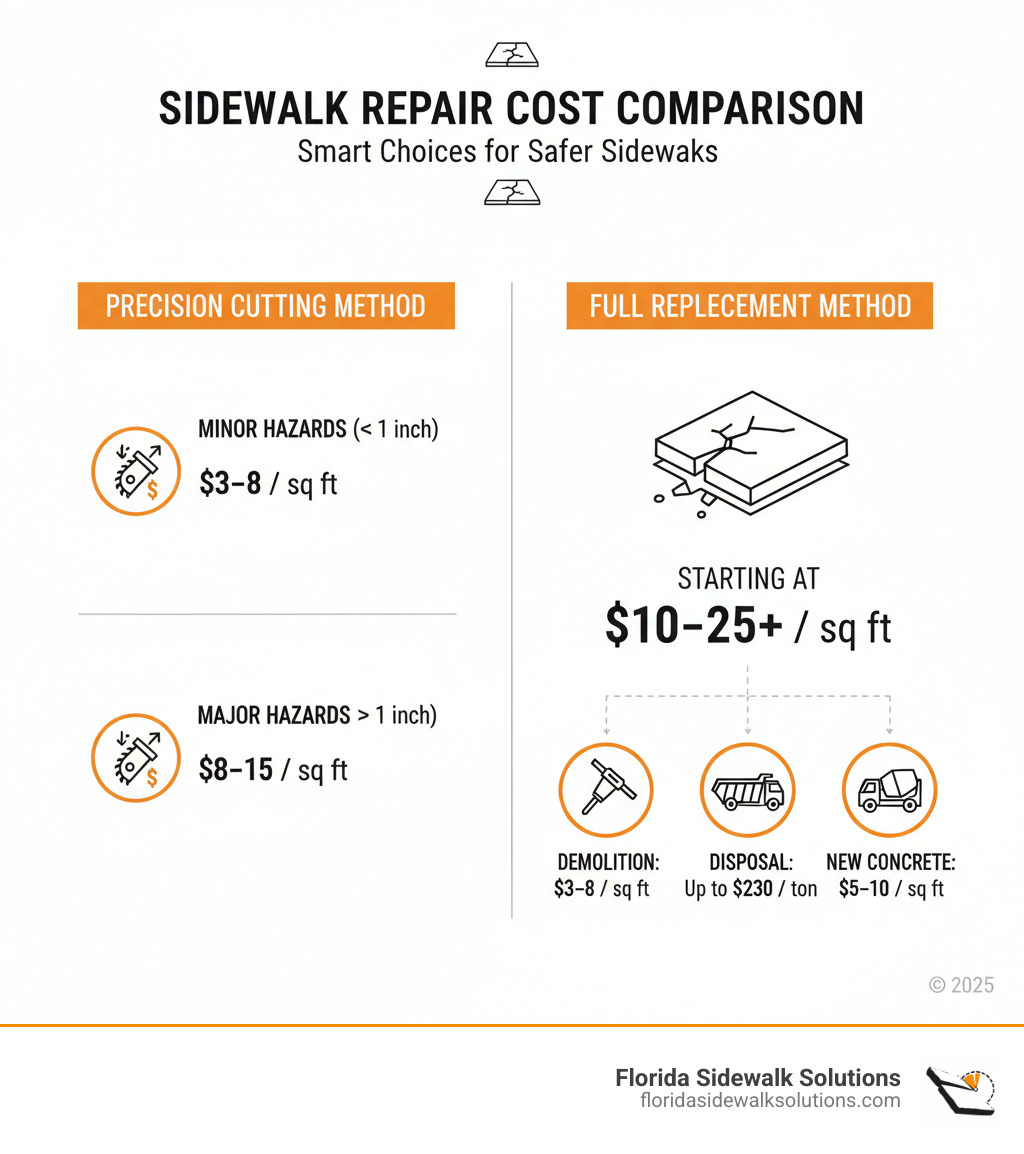
Sidewalk repair cost depends on the hazard’s severity and the repair method. Here’s a quick overview:
Quick Cost Overview:
- Minor trip hazards (under 1 inch): $3-$8 per square foot using precision cutting
- Major trip hazards (over 1 inch): $8-$15 per square foot for cutting or leveling
- Full sidewalk replacement: $10-$25+ per square foot
- Average repair project: $726-$2,485, with most homeowners paying around $1,599
If you manage public sidewalks, you know the risks. Every uneven slab is a potential lawsuit. A single trip-and-fall claim can cost thousands in legal fees and settlements, and pressure to meet ADA compliance and budget constraints makes that cracked sidewalk a serious headache.
The good news is you don’t always need a full replacement. While traditional jackhammering and repouring takes days and drains budgets, modern precision cutting can fix most trip hazards in minutes per location, often at 70-90% less cost than replacement.
Understanding your options is key. The repair method, damage extent, and your location all impact the final price. This guide breaks down what you’ll pay, compares cutting versus replacement, and helps you choose the most cost-effective solution to keep pedestrians safe and your sidewalks compliant.
Understanding the Key Factors That Influence Sidewalk Repair Cost
Sidewalk repair cost isn’t one-size-fits-all. Understanding the key factors helps you plan your budget and avoid surprises. The price of a project is influenced by:
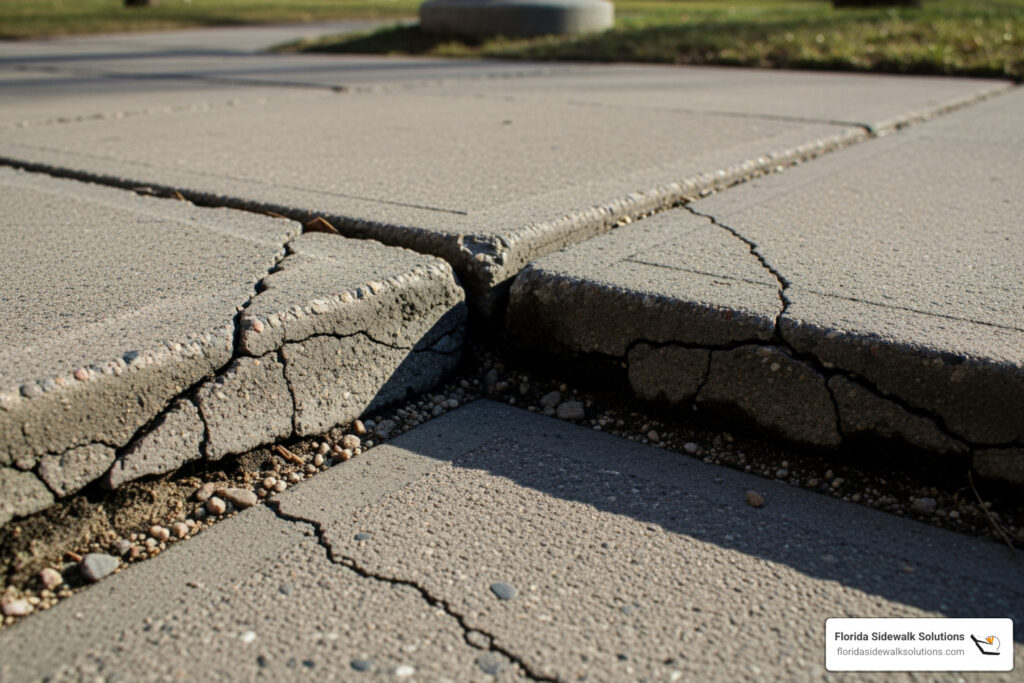
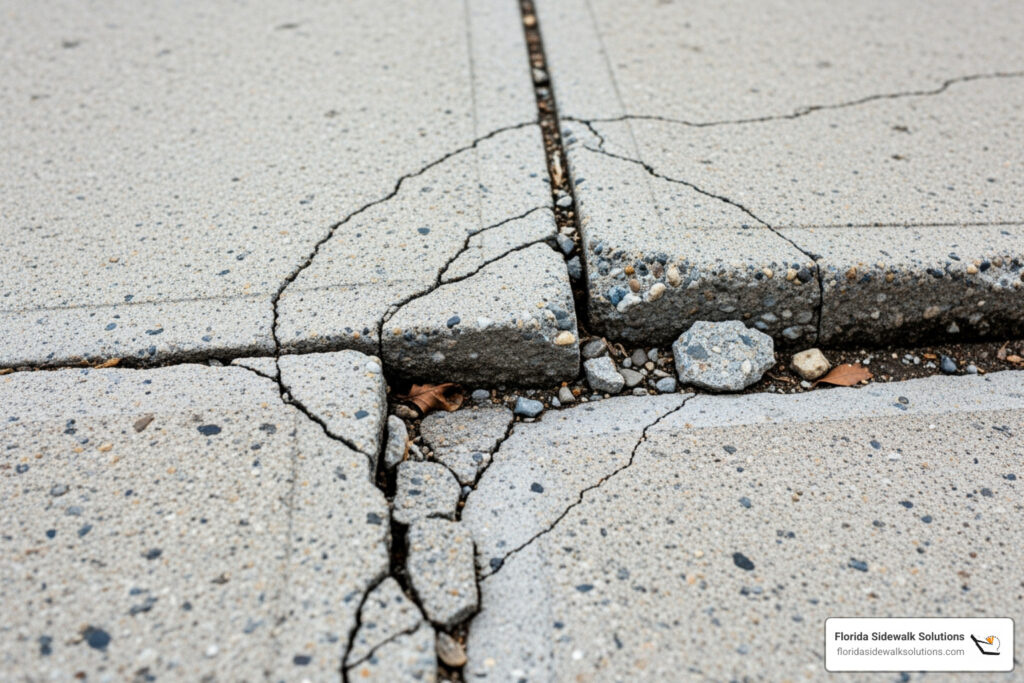
- The extent of damage: A hairline crack is a completely different animal than a slab that’s lifted three inches. The more severe the damage, the more work it takes to fix.
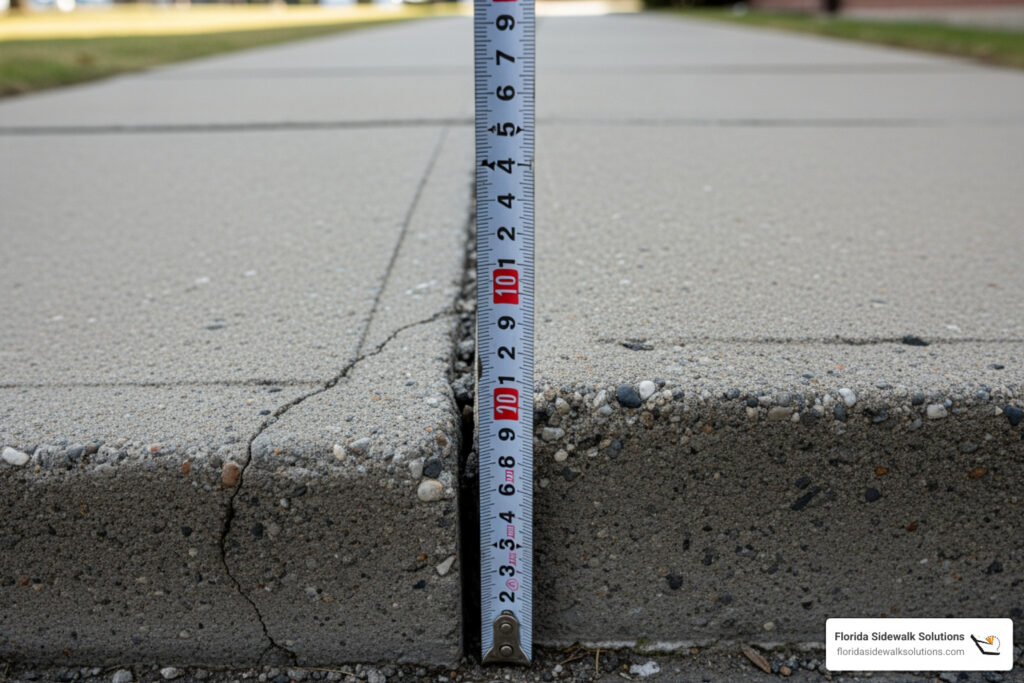
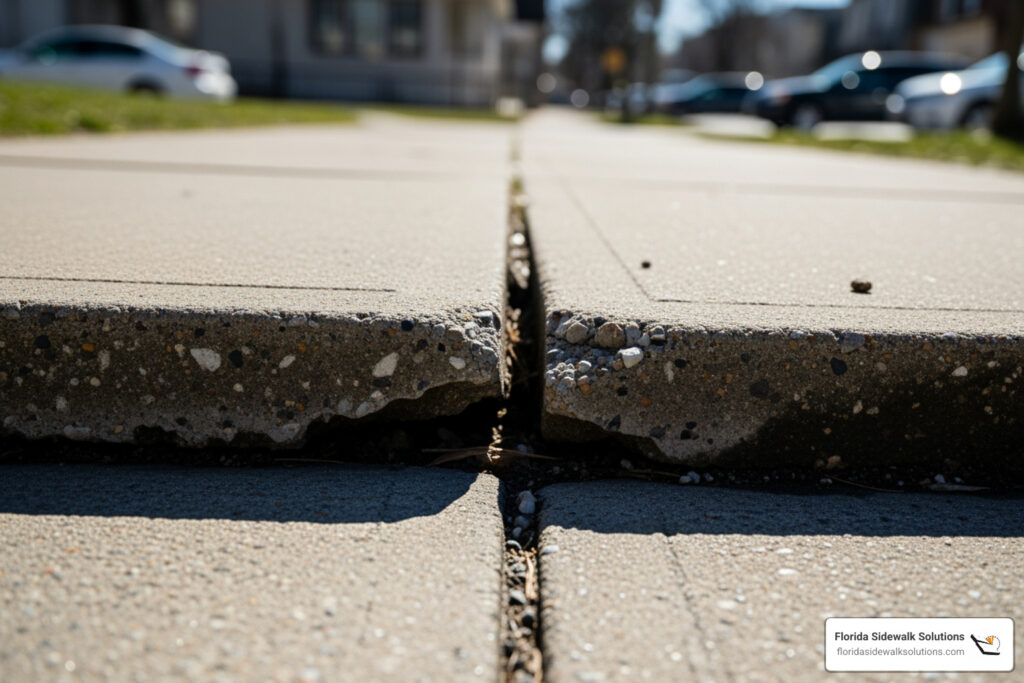
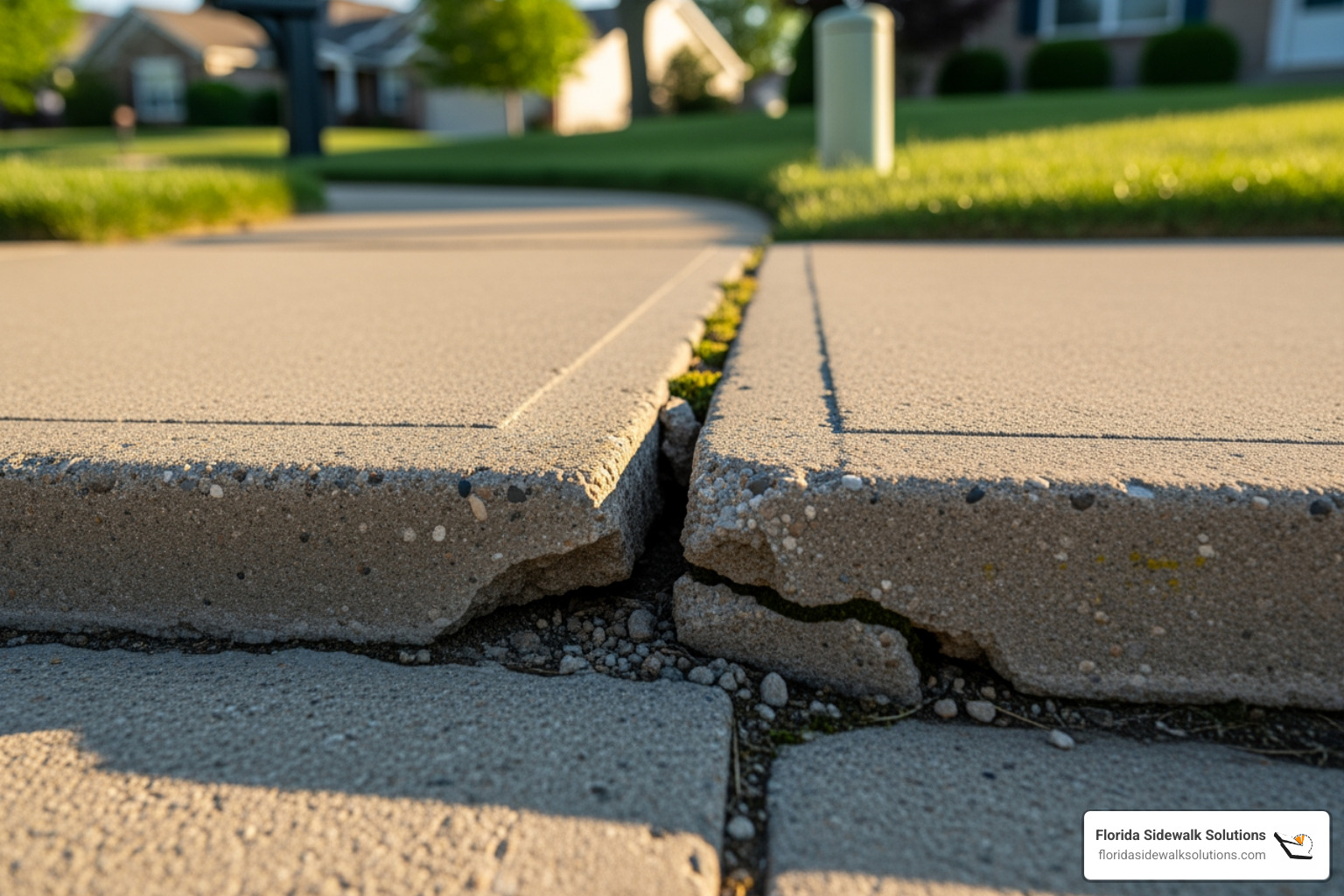
- The trip hazard height: A quarter-inch lip is a straightforward fix, while a two-inch elevation difference is a more complex repair requiring careful assessment.
- Sidewalk size in square feet: Fixing a small 10-square-foot section costs far less than a 200-foot stretch. For perspective, repairing a 200-square-foot sidewalk with moderate trip hazards might cost $600 to $1,600.
- The repair method you choose: This can make the biggest difference. Full replacement is expensive and disruptive. Our precision cutting method addresses most trip hazards by removing just enough material to create a smooth, level transition—no demolition or multi-day wait times.
- Local labor rates and location: Skilled concrete workers in Florida typically charge $50 to $100 per hour, but rates in Miami may be higher than in smaller cities. The Bureau of Labor Statistics tracks occupational employment and wage data that shows these regional variations. Material costs and permit fees can also vary by city.
- Site accessibility: If we’re navigating tight spaces or landscaping obstacles, the job takes longer and requires more manual work, which is reflected in the final price.
Who is Responsible for Sidewalk Repair?
In most Florida municipalities, homeowner liability extends to the sidewalk in front of your property. You are often responsible for keeping it safe, and if someone is injured, you could be liable for damages.
However, municipal responsibility exists in certain situations. If damage came from city-owned tree roots or public utility work, the city might cover repairs. Some cities also offer cost-sharing programs to help homeowners manage costs.
The key is checking local ordinances. Rules in Coral Springs might be different from regulations in Boca Raton or Davie. A quick call to your local public works department can clarify who is responsible.
If you live in a planned community, HOA rules might have specific requirements for how and when repairs are done. Always check your HOA documents. Tree root damage policies are also important, as cities may help cover repair costs if municipal trees are the cause.
Are Permits Required for Sidewalk Repair?
Permits exist to ensure work meets safety standards and protect you from liability.
When permits are needed depends on the scope of the repair. Major repairs—like replacing entire slabs or altering the sidewalk structure—almost always require permits. Minor repairs like sealing small cracks typically don’t. If you’re addressing a trip hazard, assume you’ll need one.
Permit costs usually run $50 to $200 and cover inspection fees. A local official will inspect the finished work to verify it meets code, including ADA compliance standards.
Working with a contractor who handles permits saves you time and headaches. At Florida Sidewalk Solutions, we manage the permit process regularly across our service areas from Miami to Fort Myers. We handle the bureaucratic details so you don’t have to.

Comparing Trip Hazard Repair Methods: Precision Cutting vs. Replacement
When facing an uneven sidewalk, you have two choices: fix it or replace it. For your wallet, the repair often makes more sense. The decision comes down to sidewalk repair cost, durability, time, and environmental impact.
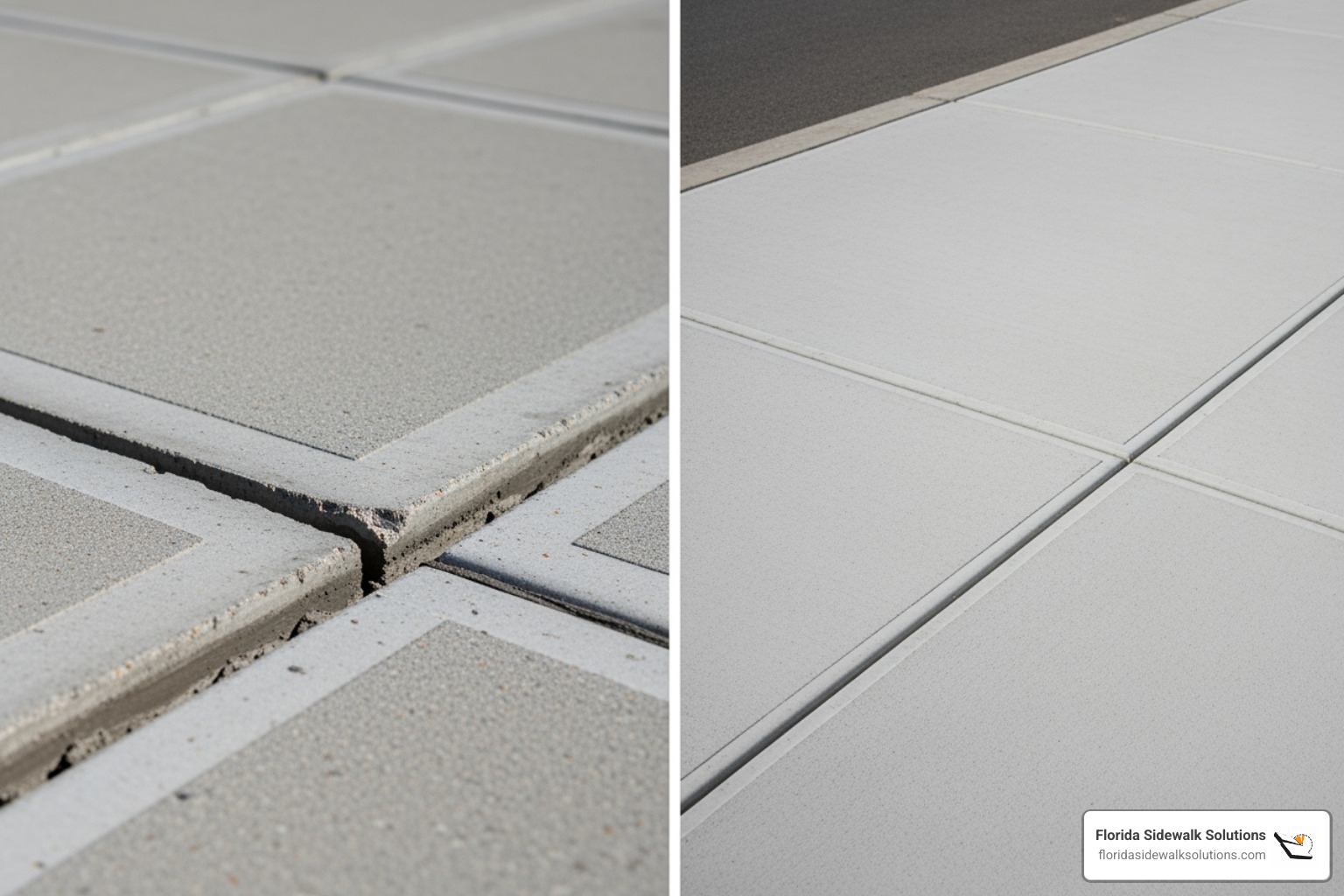
- Cost-effectiveness: Precision cutting typically costs 70-90% less than replacement because we fix the actual problem instead of rebuilding everything.
- Durability: A proper replacement can last 25-50 years. Our precision cutting method creates a permanent, level transition that is just as durable as the surrounding concrete.
- Repair time: Replacement can shut down a sidewalk for days. Our method fixes trip hazards in minutes per location, and the sidewalk is safe to walk on immediately.
- Environmental impact: Replacement creates tons of concrete waste. Our precision cutting method produces minimal waste, is quieter, and uses a fraction of the resources.
The Cost of Full Sidewalk Replacement
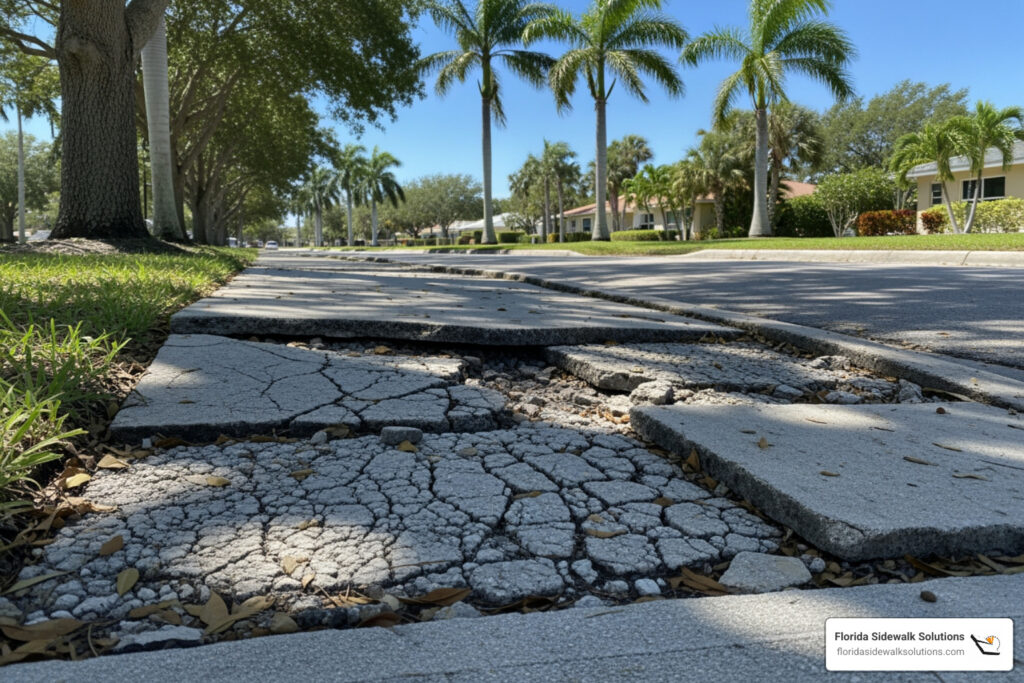
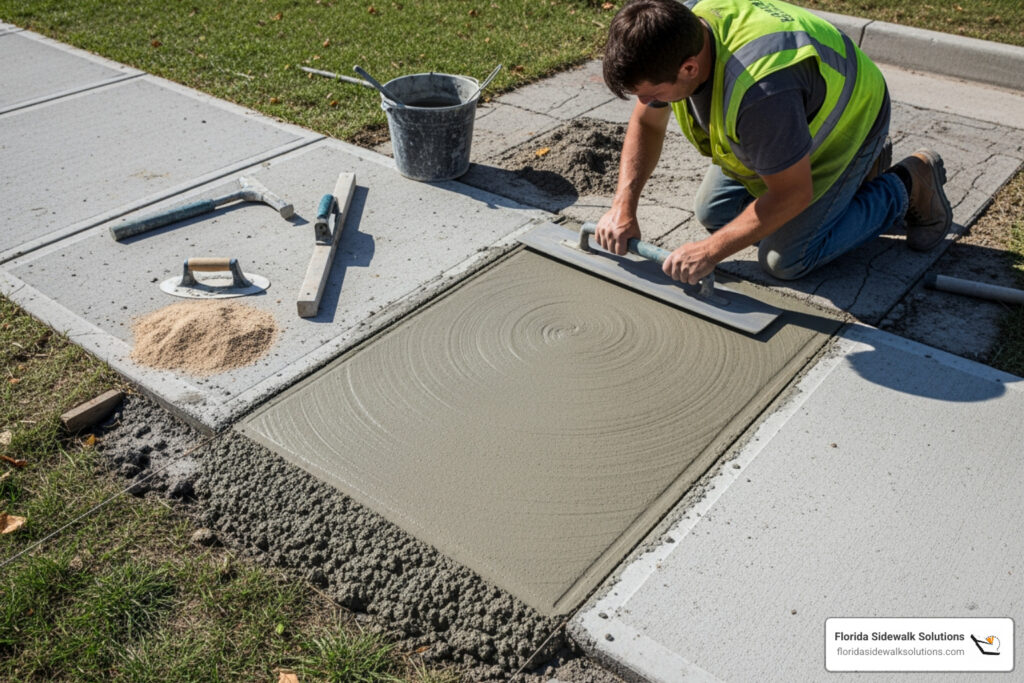
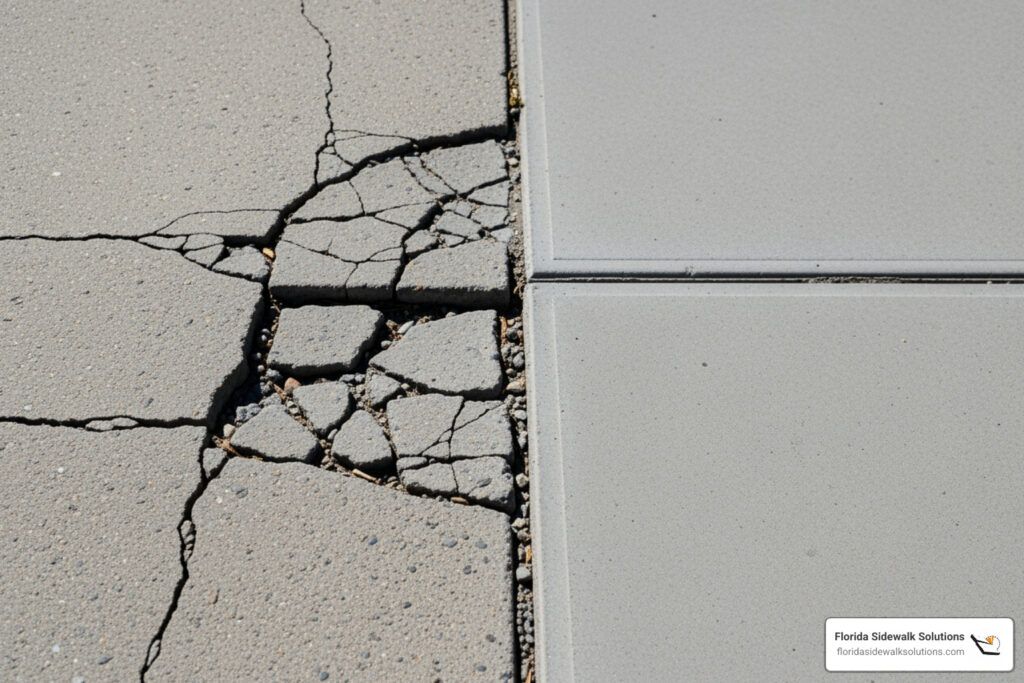
Sometimes a sidewalk is too far gone, with extensive cracking or crumbling concrete. In these cases, replacement is the only option. The costs add up quickly:
- Demolition costs: $3 to $8 per square foot.
- Concrete removal and disposal fees: $2 to $6 per square foot, plus disposal fees that can reach $230 per ton.
- Pouring new concrete: $5 to $10 per square foot for basic installation. Decorative finishes cost more.
In total, the cost per square foot for full replacement typically lands between $10 and $25 or higher. For a 200-square-foot sidewalk, you’re looking at $2,000 to $5,000 minimum. Replacement is a significant investment, and one that often isn’t needed if the underlying concrete is still sound.
The Cost of Precision Sidewalk Cutting (Florida Sidewalk Solutions Method)
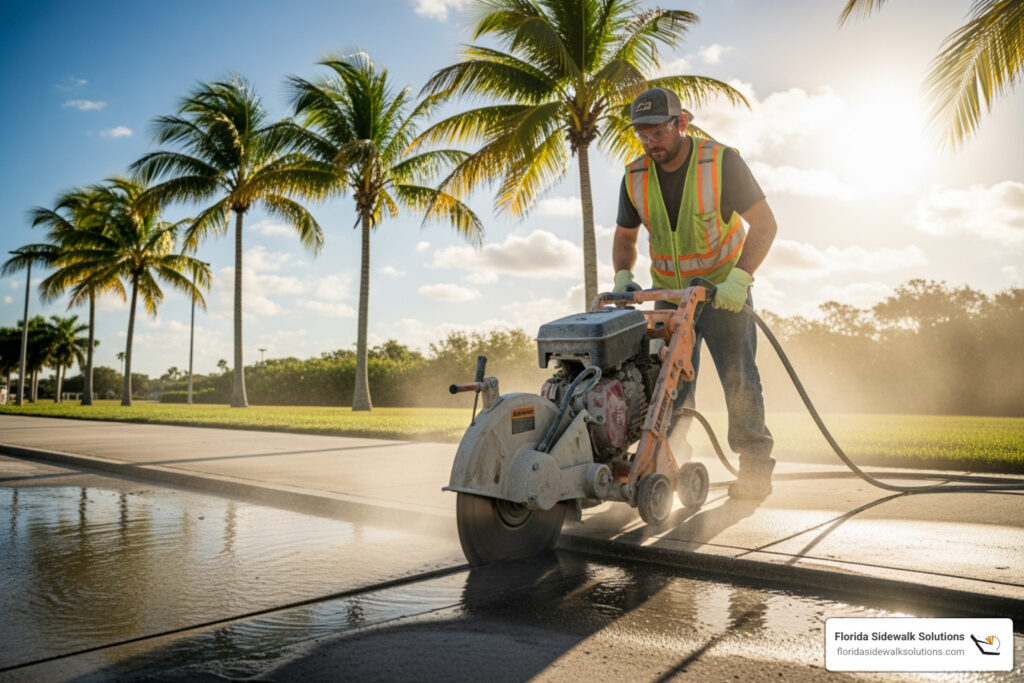
Our patented precision cutting technology is designed to eliminate trip hazards without the cost and hassle of replacement.
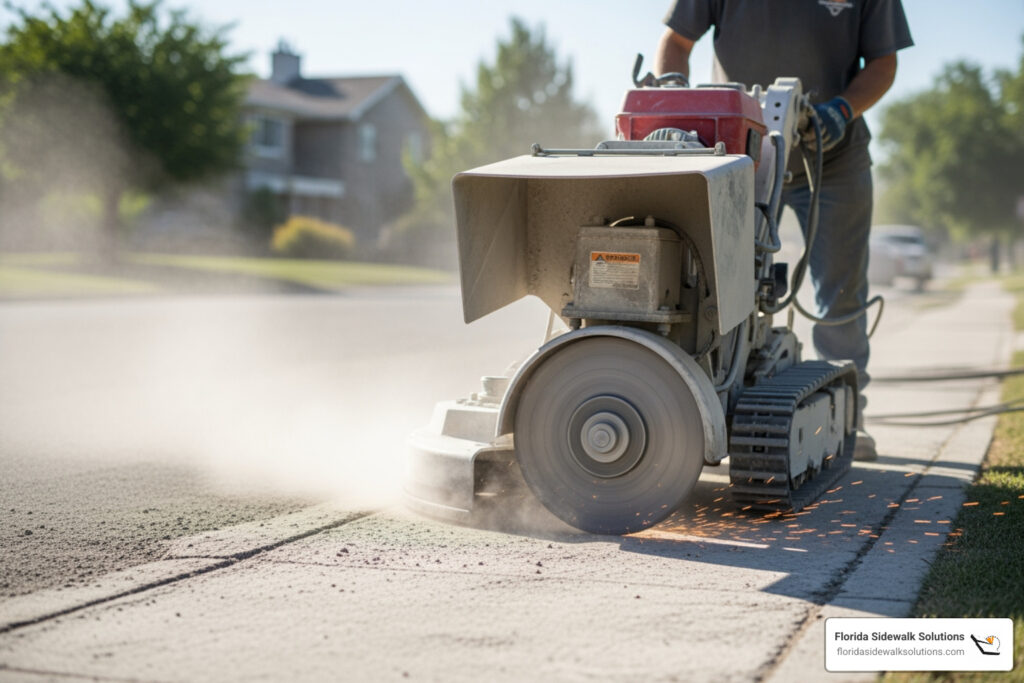
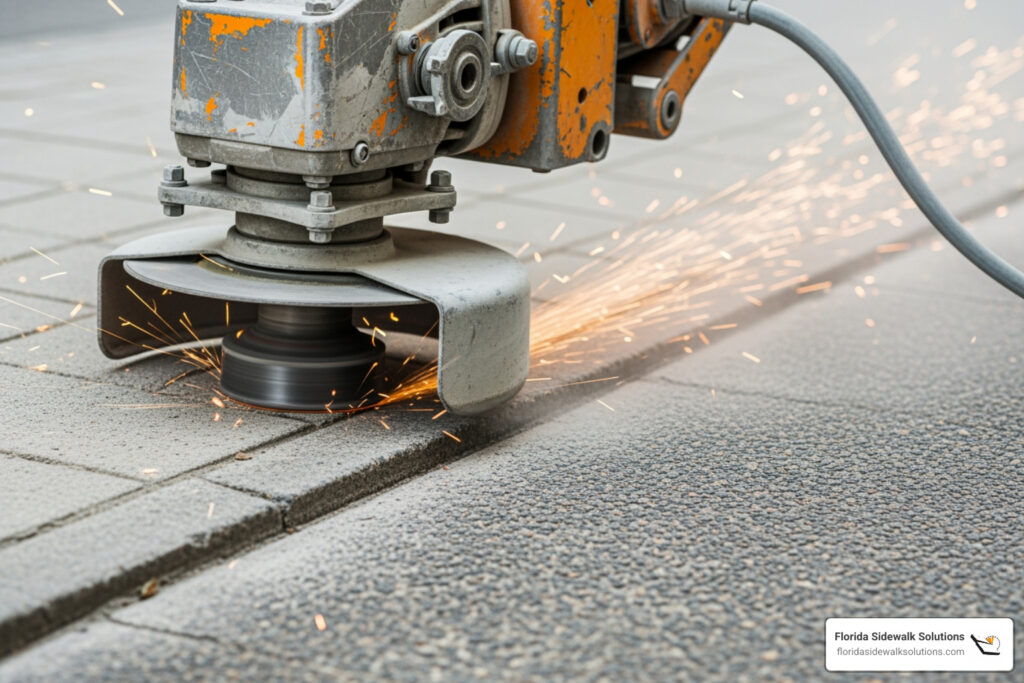
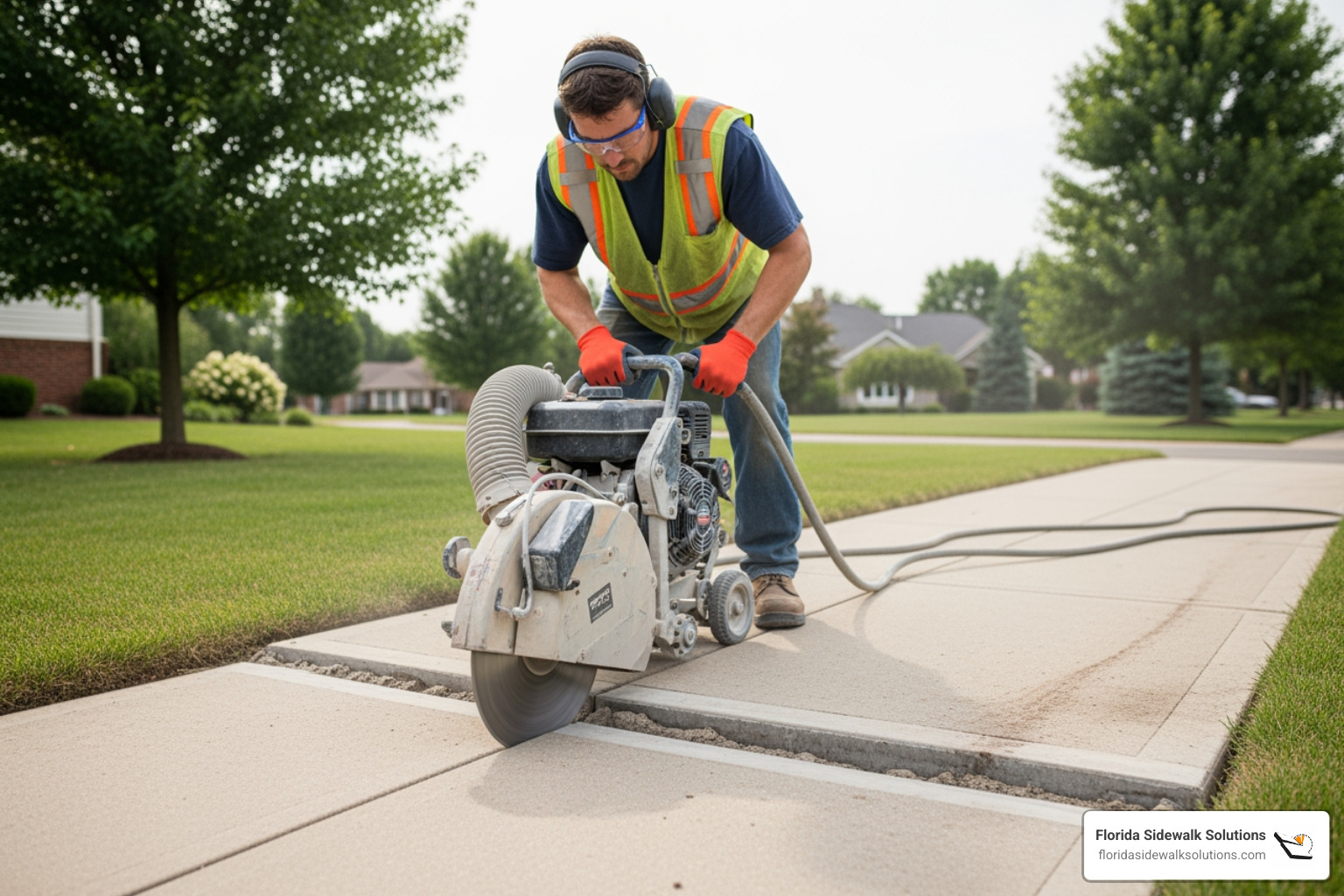
How the method works: Instead of tearing out slabs, we use specialized equipment to precisely cut and grind down the raised portion of the concrete. This creates a smooth, gradual, ADA-compliant transition between the two slabs, eliminating the dangerous lip.
Let’s talk numbers. The cost per square foot for our method is dramatically lower than replacement:
- Minor trip hazards (under 1 inch): $3 to $8 per square foot.
- Major trip hazards (over 1 inch): $8 to $15 per square foot.
Compare that to the $10 to $25+ per square foot for replacement, and the savings are obvious.
When this method is most effective: This method is ideal when the concrete is still in good shape but has become uneven due to tree roots, settling, or weather. If the concrete isn’t crumbling, our method can fix it.
The advantages over traditional methods are clear: it’s cost-effective, fast, clean, quiet, environmentally friendly, and immediately usable. Most importantly, our method ensures ADA compliance, making sidewalks safe for everyone, whether they’re walking, using a wheelchair, or pushing a stroller.
We believe this approach offers the best value for most trip hazard situations. It’s not about cutting corners—it’s about cutting concrete in a smarter way.
Sidewalk Repair Cost Breakdown: Minor vs. Major Trip Hazards
Not all trip hazards are created equal. The height of an uneven slab significantly impacts the complexity and cost of the repair. Both minor and major hazards create liability risks and ADA compliance issues, but they require different levels of intervention.
Here’s what you can typically expect to pay for different severity levels:
| Hazard Severity | Precision Cutting (Florida Sidewalk Solutions) | Full Replacement (Traditional) |
|---|---|---|
| Minor Trip Hazard (Under 1 inch) | $3 – $8 per square foot | $10 – $25+ per square foot |
| Major Trip Hazard (Over 1 inch) | $8 – $15 per square foot | $10 – $25+ per square foot |
(Note: These are general estimates. Actual costs can vary based on location, contractor, and specific site conditions.)
For a 10-square-foot section, a minor trip hazard repair with our method would run $30-$80, while a major hazard would be $80-$150. Compare that to full replacement at $100-$250+ for the same area, not including minimum charges for demolition and disposal.
Minor Trip Hazard Repair Cost (Under 1 inch)
Even though they’re under an inch, minor trip hazards are still dangerous and often violate ADA requirements. The good news is they are perfect candidates for our precision cutting method. We create a smooth, beveled transition that eliminates the hazard completely.
Because we’re only addressing a small elevation change, the work is fast, which keeps labor time low and your costs down. There’s virtually no material cost since we’re reshaping what’s already there. The average cost range for fixing these minor issues with our method is $3 to $8 per square foot, and the sidewalk is safe to use immediately.
Major Trip Hazard Repair Cost (Over 1 inch)
Major trip hazards over an inch are obviously dangerous and often result from significant issues like ground settling or aggressive tree roots—common problems in Florida.
These larger disparities require more intensive work and greater precision to create a safe, gradual slope that meets ADA standards. Even with major hazards, our precision cutting method is usually the best solution, as we can level most elevation differences without full replacement.
That said, we’re always honest with our clients. Sometimes replacement is the better choice. If the concrete is severely crumbled or cracked, we’ll tell you. We’d rather recommend the right solution upfront than have you pay for a temporary fix.
For major hazards that are good candidates for our method, you’re typically looking at $8 to $15 per square foot. While it’s more than fixing a minor issue due to higher labor and equipment costs, it’s still a fraction of the $10-$25+ per square foot you’d spend on full replacement.
DIY vs. Hiring a Professional for Trip Hazard Repair
When you spot an uneven sidewalk, it’s tempting to tackle it yourself. But fixing trip hazards isn’t like patching a small crack; it’s a safety-critical repair that carries real risks.
An improperly repaired trip hazard can be even more dangerous than the original problem, creating serious liability if someone falls. Furthermore, the Americans with Disabilities Act (ADA) has specific requirements for sidewalk surfaces that require precision and proper technique to meet.
Our patented precision cutting method uses specialized equipment that isn’t available for rent and requires training to operate safely and accurately. When you hire professionals, you’re investing in long-term results that keep pedestrians safe and protect you from liability. If you’re ready to explore professional solutions, you can Find Local Pros throughout Florida.
The Risks and Costs of DIY Repair
We understand the appeal of saving on sidewalk repair cost. DIY materials for small cracks are inexpensive, and some sources suggest DIY material costs are around $3-$4 per square foot. You can browse options at retailers like Home Depot Concrete and Masonry Materials.
But for trip hazards, the risks are significant:
- Incorrect repairs: Without the right equipment, you can easily make the problem worse by creating a new, uneven surface.
- Liability issues: If someone is injured on your DIY repair, your homeowner’s insurance may not cover it if the work wasn’t done to code. You could be personally liable for a $50,000 problem from a $50 repair kit.
- Not meeting local codes: Most municipalities have standards for sidewalk repairs. A non-compliant DIY job can lead to fines and an order to hire a professional to redo the work, forcing you to pay twice.
For trip hazard removal, the small upfront savings of DIY aren’t worth the risks.
The Value of Hiring a Professional
When you hire a professional, you’re paying for expertise, proper equipment, legal compliance, and peace of mind.
- Guaranteed compliance: We know ADA standards and local building codes in Miami, Fort Lauderdale, and every Florida city we serve. Our repairs meet all requirements.
- Proper equipment: Our patented precision cutting technology ensures accurate, smooth, and lasting repairs that can’t be replicated with rented tools.
- Efficiency and speed: We can complete a job in minutes per hazard, not an entire weekend. The sidewalk is safe to use immediately.
- Warranty on work: We stand behind our repairs. If any issues arise, we’ll make it right.
Before hiring any contractor, ask these questions:
- How long have you specialized in trip hazard removal?
- Can you show me examples of ADA-compliant repairs you’ve completed?
- Do you handle permits and inspections?
- What does your warranty cover, and for how long?
- Can you provide a detailed breakdown of the sidewalk repair cost?
These questions help ensure you’re hiring a true specialist who will deliver safe, compliant results. At Florida Sidewalk Solutions, we’re always happy to answer these questions because we know our expertise and technology deliver superior value.
Frequently Asked Questions about Sidewalk Repair
We get a lot of questions about sidewalk repair cost and the process. Here are some of the most common ones.
How can I save money on sidewalk repair costs?
Saving money means making smart decisions. Here’s our advice:
- Address issues early: Fixing small cracks and minor unevenness is much cheaper than tackling major hazards later.
- Choose repair over replacement (when appropriate): For trip hazards, our precision cutting method saves 70-90% of the cost of replacement.
- Get multiple quotes: Contact at least three qualified professionals to compare pricing and methods to ensure you get a fair price.
- Check for municipal programs: Your local city or county may offer cost-sharing programs, especially if damage is from city trees.
How long does sidewalk repair typically take?
The duration depends on the method and extent of damage.
Our precision cutting timeline is remarkably fast. We can address individual trip hazards in minutes, with most projects taking only 1 to 3 days. The sidewalk is safe to walk on immediately after we finish.
In contrast, replacement and curing time is a much longer process. It involves days of work, and new concrete requires at least 24 hours before it can be walked on and up to 28 days to reach full strength.
What is the lifespan of a repaired or replaced sidewalk?
The longevity of your sidewalk depends on the repair method and maintenance.
The durability of a precision-cut surface is excellent. The repair is permanent and designed to last as long as the surrounding slab, assuming no new underlying issues emerge.
A full replacement, when properly installed, can have a longevity of 25 to 50 years.
Regardless of the method, the importance of sealing cannot be overstated. Applying a concrete sealer every 2 to 3 years protects the surface from water and UV damage, significantly extending its lifespan.
Conclusion
The key takeaway is that sidewalk repair cost doesn’t have to break the bank. While full replacement is sometimes necessary for severely deteriorated concrete, most trip hazards can be fixed more quickly and affordably with modern repair methods.
The difference in cost between repairing trip hazards versus replacing slabs is substantial, with potential savings of 70-90% when using precision cutting technology instead of demolition.
More importantly, prioritizing safety and ADA compliance protects everyone from trip-and-fall accidents and liability. Florida Sidewalk Solutions’ expertise and patented technology were designed to solve this exact problem—making sidewalks safe, compliant, and accessible without the cost and disruption of traditional methods. Our crews work efficiently across communities from Miami to Fort Myers, ensuring every repair meets ADA specifications.
The sidewalks in your community deserve to be safe for everyone. Ready to fix those trip hazards the smart way? Get a quote for sidewalk repairs near me and let’s talk about the most cost-effective solution for your specific situation.