
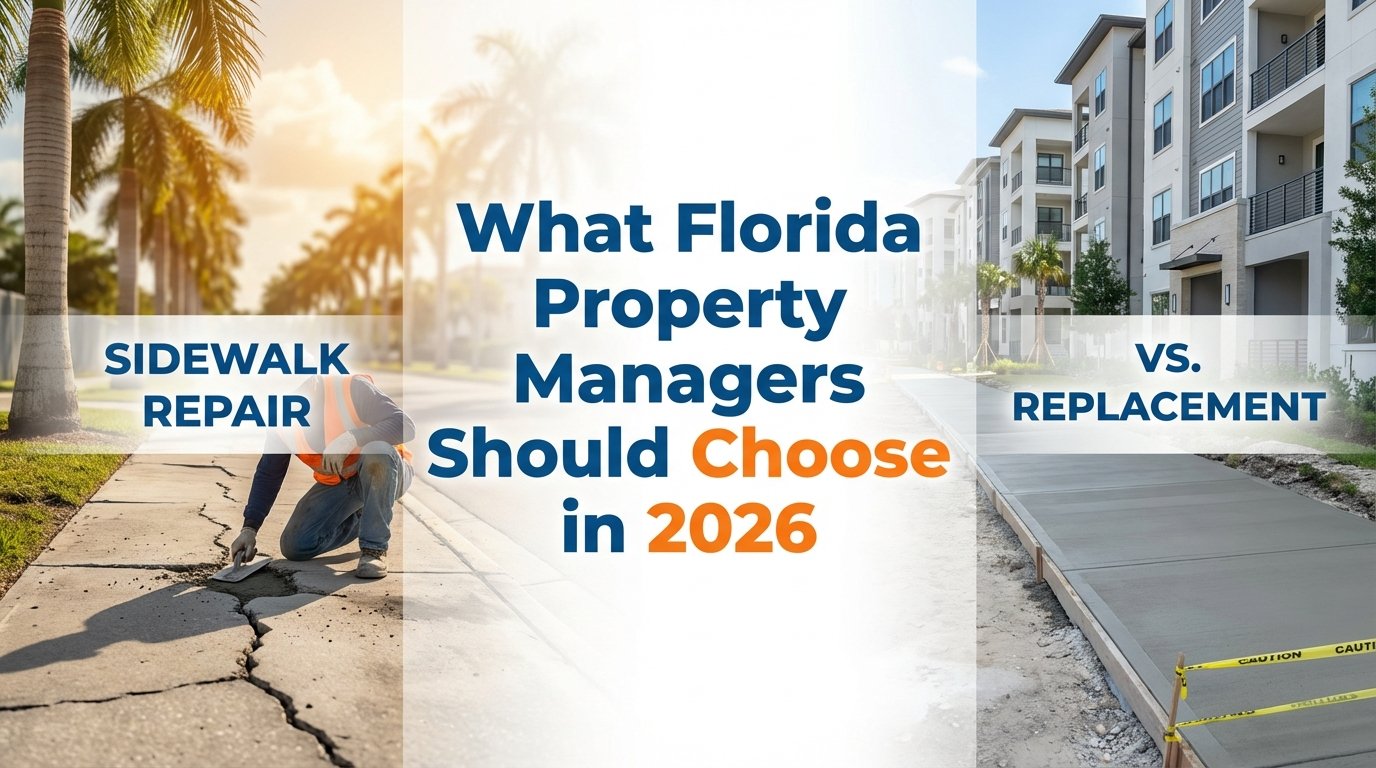
Florida property managers face a persistent challenge: concrete sidewalks that crack, settle, and create dangerous trip hazards. When those familiar raised edges appear, the question becomes critical—should you repair or replace? In 2026, with construction costs continuing to rise and liability lawsuits increasingly common, making the wrong decision can drain budgets and expose properties to significant legal risk.
The stakes are higher than many realize. A single trip-and-fall lawsuit in Florida can cost property owners hundreds of thousands of dollars, and ADA non-compliance penalties start at $75,000 for first violations. Meanwhile, traditional sidewalk replacement projects can run $8-12 per square foot, creating budget headaches for communities already managing rising insurance premiums and maintenance costs.
Understanding your options—and their true costs—has never been more important.
The Real Cost of Sidewalk Replacement in Florida
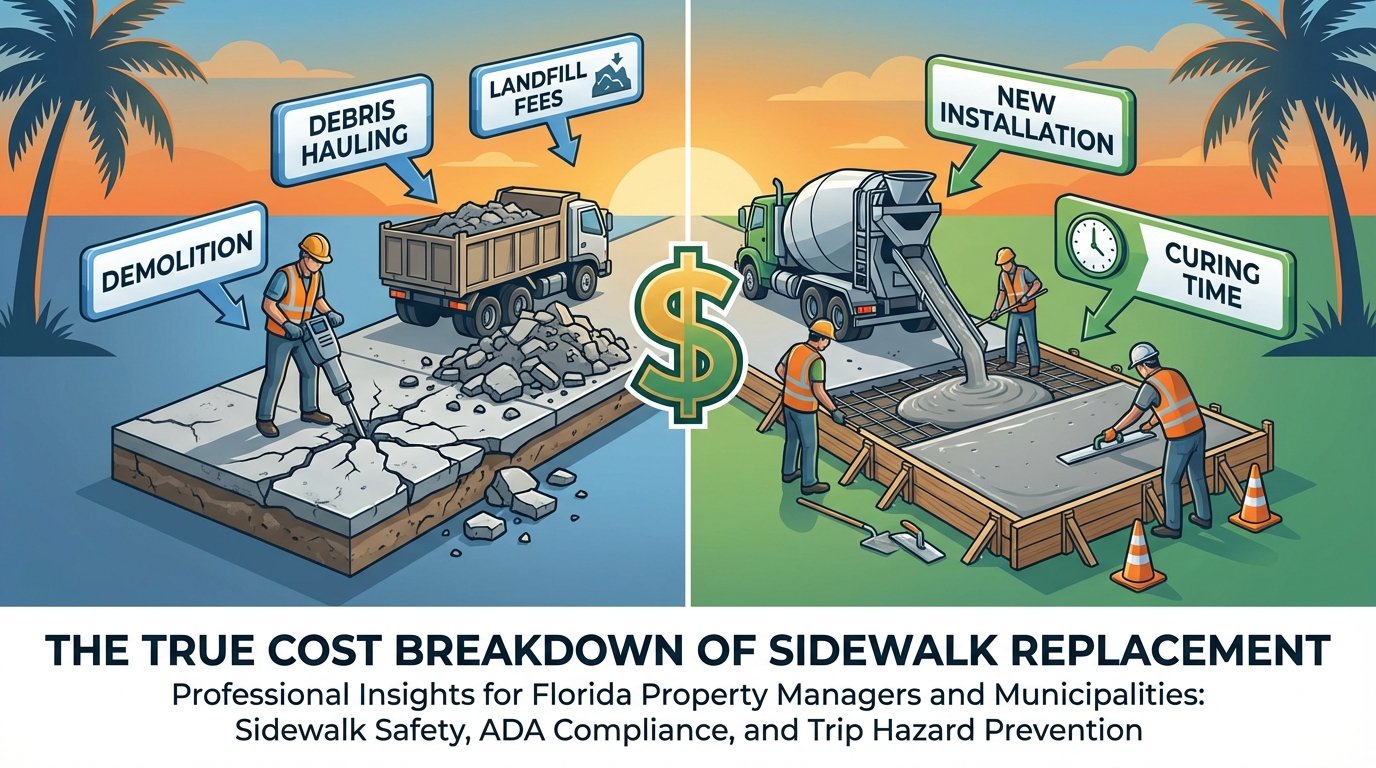
Complete sidewalk replacement remains the default recommendation from many general contractors, but the financial reality extends far beyond the initial estimate. When you factor in demolition, hauling debris to increasingly expensive landfills, new concrete installation, curing time, and additional landscaping repairs, costs escalate quickly.
In 2026, typical concrete sidewalk replacement costs in Florida include:
- Demolition and removal: $2-3 per square foot
- New concrete installation: $4-6 per square foot
- Disposal fees: $50-100 per ton of concrete waste
- Landscaping restoration: $500-2,000 per project
- Traffic control and safety measures: $300-1,500
A modest 500-square-foot sidewalk replacement project easily reaches $4,000-6,000, with larger properties spending $50,000 or more annually on concrete work. For HOAs managing miles of walkways or municipalities responsible for public infrastructure, these numbers become unsustainable.
But replacement costs represent only part of the equation. Property managers must also consider downtime—sidewalks typically remain closed for 5-7 days while concrete cures, creating accessibility issues and resident complaints. Schools face particular challenges when replacement projects coincide with the academic year, and retail properties lose foot traffic during extended closures.
Understanding Modern Sidewalk Repair Options in Florida
The good news: replacement isn’t your only option. Modern repair technologies have evolved significantly, offering solutions that address the root cause of trip hazards while preserving existing concrete infrastructure.
Concrete Grinding
Grinding uses diamond-tipped blades to shave down raised concrete edges, creating a smoother transition. While less expensive than replacement at $3-5 per linear foot, grinding has notable limitations. The process creates a beveled edge that wears quickly under Florida’s heavy rainfall and traffic, often requiring retreatment within 2-3 years. The ground surface also appears noticeably different from surrounding concrete, creating aesthetic concerns for properties where appearance matters.
Mudjacking and Polyurethane Foam Lifting
These techniques address sunken concrete by injecting material underneath slabs to raise them back to level. Mudjacking uses a cement slurry, while newer polyurethane foam methods offer lighter weight and faster curing. Both work well for settled concrete but don’t address the root problem when tree roots or soil expansion cause upward displacement. Costs typically range from $5-15 per square foot—more affordable than replacement but often treating symptoms rather than causes.
Precision Concrete Cutting
The most advanced sidewalk repair option uses patented cutting technology to permanently remove raised edges and create ADA-compliant transitions. Unlike grinding’s beveled slope, precision cutting removes concrete vertically and cuts strategic relief joints that prevent future displacement. This approach addresses both immediate trip hazards and their underlying causes, delivering results that last decades rather than years.
Cost-effective sidewalk repair through precision cutting typically saves 70-90% compared to replacement, with most projects completed in hours rather than days. A sidewalk section that would cost $1,500 to replace often requires just $200-400 in cutting repairs—a difference that adds up dramatically across large properties.
ADA Compliance Requirements for Florida Sidewalks
Federal ADA standards apply to all public accommodations and commercial properties, with specific requirements that Florida property managers must understand. According to the Americans with Disabilities Act, sidewalk vertical displacements exceeding 1/4 inch create accessibility violations requiring immediate correction.
Key ADA sidewalk requirements include:
- Maximum vertical edge change of 1/4 inch (changes between 1/4 and 1/2 inch must be beveled)
- Minimum 36-inch continuous clear width for pedestrian passage
- Cross slope not exceeding 2% (1:48 ratio)
- Running slope matching adjacent roadway grade where applicable
- Stable, firm, and slip-resistant surfaces
Non-compliance carries serious consequences. The Department of Justice has increased enforcement in recent years, with first-time violation penalties starting at $75,000 and subsequent violations reaching $150,000. Private lawsuits add another layer of risk—Florida sees hundreds of ADA accessibility lawsuits filed annually, with settlements often exceeding $20,000 plus attorney fees.
The repair versus replacement decision directly impacts ADA compliance timelines. When a violation is identified, property managers must act quickly. Replacement projects requiring weeks of planning, bidding, and execution leave properties exposed to continued liability. Repair solutions that can be implemented within days dramatically reduce this risk window.
The Hidden Costs of Delaying Sidewalk Repairs
Budget constraints often push sidewalk repairs down the priority list, but this delay creates compounding problems. Trip hazards don’t improve with time—they worsen as temperature fluctuations, root growth, and soil movement continue their effects.
Consider the liability exposure. Florida follows a comparative negligence standard, meaning property owners who knowingly ignore trip hazards face substantial liability when injuries occur. Legal precedent consistently holds that visible sidewalk defects—especially those exceeding one inch in displacement—constitute negligence when left unaddressed.
A single serious injury can result in:
- Medical expenses: $15,000-100,000+ for fractures and head injuries
- Pain and suffering damages: Often 2-3 times medical costs
- Legal defense costs: $10,000-50,000 even for cases that settle
- Insurance premium increases: 10-25% following claims
- Potential punitive damages if negligence is proven
For property managers, the math is straightforward: a $500 repair that’s delayed can easily become a $100,000 problem. Insurance may cover some costs, but deductibles, premium increases, and potential coverage limits make prevention the only sound financial strategy.
Why Precision Cutting Outperforms Other Sidewalk Repair Options
After two decades of Florida concrete repair experience, a clear pattern emerges: precision cutting delivers superior long-term results compared to grinding, mudjacking, or partial replacement approaches.
The technology’s advantages stem from how it addresses trip hazards. Rather than simply smoothing edges or lifting sunken sections, precision cutting removes displaced concrete and creates strategic relief joints that accommodate future ground movement. When tree roots push against concrete, these joints allow controlled separation rather than random cracking and heaving.
The process works particularly well in Florida’s unique environment. Our sandy soils, aggressive root systems from mature trees, and dramatic wet-dry seasonal cycles create concrete movement that defeats simple grinding solutions. Precision cutting accounts for these forces, creating repairs that remain effective through countless weather cycles.
Environmental benefits matter increasingly to Florida communities. Traditional replacement generates tons of concrete waste heading to already-stressed landfills. A single mile of sidewalk replacement produces approximately 500 tons of debris. Precision cutting eliminates this waste stream entirely, preserving existing infrastructure while meeting modern safety standards. For properties pursuing LEED certification or sustainability goals, this distinction becomes significant.
The speed advantage cannot be overstated. Property managers who’ve experienced replacement projects understand the disruption—residents complaining about blocked access, delivery vehicles unable to reach buildings, accessibility issues for disabled individuals. Precision cutting typically completes repairs in a single day with walkways reopening immediately after work finishes. No curing time, no extended closures, no angry phone calls.
Making the Right Choice for Your Property in 2026
The sidewalk repair versus replacement decision depends on several factors specific to your property’s condition and requirements.
Replacement makes sense when:
- Concrete shows extensive surface deterioration with exposed aggregate and deep cracks
- Multiple slabs have failed completely, creating safety hazards beyond simple trip edges
- The existing sidewalk lacks proper base preparation, causing repeated failures
- You’re already undertaking major renovation work requiring concrete removal
Precision cutting repair offers the better solution when:
- Concrete remains structurally sound with isolated trip hazards from settlement or heaving
- Budget constraints require cost-effective solutions that don’t compromise safety
- Timeline demands quick resolution to address liability concerns or compliance deadlines
- Environmental considerations favor preservation over replacement
- Properties need to maintain continuous access during repairs
Most Florida properties fall into the second category. The concrete itself performs adequately—the problem is displacement caused by external forces. Removing and replacing perfectly good concrete makes no financial or environmental sense when precision repair delivers equivalent or superior safety outcomes.
Questions Property Managers Should Ask Contractors
When evaluating concrete sidewalk repair options in Florida, these questions help identify qualified professionals who understand both technical requirements and regulatory compliance:
- What specific method will you use to achieve ADA compliance for vertical displacements?
- Can you provide documentation showing repairs meet the 1/4-inch maximum differential standard?
- What warranty or guarantee covers your repair work, and what does it include?
- How do your repairs prevent future displacement in the same location?
- What is the realistic lifespan of your repair solution in Florida’s climate?
- Can you provide references from similar properties (HOAs, municipalities, commercial sites)?
- How quickly can repairs be completed, and when can the sidewalk reopen?
Contractors offering precision cutting should readily provide answers demonstrating their understanding of both the technology and Florida-specific challenges. More than two decades of proven performance with the patented Precision Concrete Cutting system has established clear benchmarks for quality and durability.
Take Action Before Small Problems Become Major Liabilities
Florida property managers juggle countless responsibilities, but sidewalk safety deserves immediate attention. Every day that trip hazards remain unaddressed increases liability exposure and the risk of serious injuries on your property.
The good news: you don’t need to choose between budget constraints and safety compliance. Modern precision cutting technology delivers ADA-compliant repairs at a fraction of replacement costs, with minimal disruption to your property operations. Most projects complete in a single day, eliminating the extended closures and accessibility issues that accompany traditional replacement.
Florida Sidewalk Solutions brings over 20 years of specialized experience addressing concrete trip hazards throughout the state. Our patented cutting technology has resolved thousands of sidewalk safety issues for HOAs, municipalities, schools, and commercial properties—delivering permanent repairs that save 70-90% compared to replacement costs.
Don’t wait for an injury lawsuit or ADA complaint to force action. Contact Florida Sidewalk Solutions today for a free property assessment and discover how precision concrete cutting can solve your sidewalk safety challenges while protecting your budget. Your residents, visitors, and liability insurance provider will thank you.