
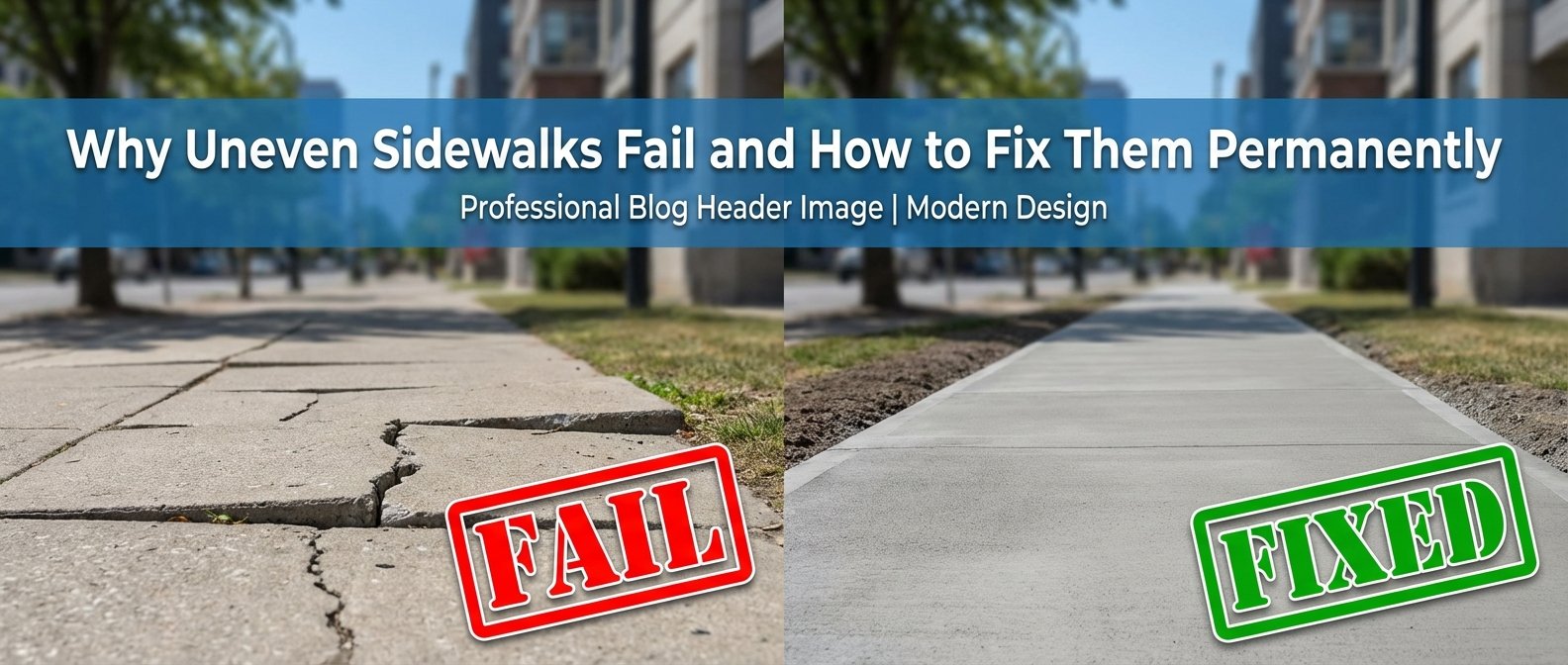
Concrete sidewalks don’t fail overnight. That dangerous lip creating a trip hazard in front of your commercial property or HOA community developed gradually through a predictable chain of events. Understanding why concrete slabs settle and heave helps property managers and decision-makers choose repair methods that actually last, rather than temporary fixes that waste money and expose organizations to ongoing liability.
The difference between a repair that holds for decades versus one that fails within months often comes down to addressing root causes rather than just symptoms. Let’s examine the mechanics of sidewalk failure and explore permanent solutions that protect both pedestrians and budgets.
The Real Reasons Concrete Sidewalks Become Uneven

Uneven sidewalks result from differential settlement—when adjacent concrete slabs sit at different heights. This happens through several mechanisms, often working in combination:
Soil Erosion and Washout
Water infiltration beneath concrete slabs gradually erodes the soil base that supports them. In Florida, heavy rainfall events accelerate this process. Water enters through joints between slabs, washing away fine soil particles and creating voids. Once the supporting soil disappears, gravity takes over and the slab settles into the empty space below.
This erosion pattern explains why sidewalk problems often worsen near drainage areas, downspouts, or irrigation systems. The constant water flow systematically removes the foundation supporting your concrete.
Soil Compression and Consolidation
Even without erosion, soil naturally compresses over time under the weight of concrete. Poor compaction during initial construction accelerates this problem. When contractors rush the base preparation phase, air pockets remain in the soil that gradually collapse, causing the concrete above to sink.
Clay soils common throughout Florida are particularly prone to compression cycles. These soils expand when wet and contract when dry, creating repeated stress that destabilizes concrete slabs.
Tree Root Interference
Growing tree roots exert tremendous force, easily lifting concrete slabs and creating trip hazards. Roots seek moisture and nutrients, often finding both beneath sidewalks where irrigation runoff collects. As roots expand, they force slabs upward on one side while potentially causing voids and settlement on the other.
Poor Drainage Design
Inadequate site drainage concentrates water in specific areas, accelerating all the failure mechanisms mentioned above. When water pools against or beneath sidewalks regularly, failure becomes inevitable rather than possible.
Why Traditional Repairs Often Fail
Understanding failure mechanisms reveals why common repair approaches deliver disappointing results:
Concrete Grinding Limitations
Grinding down the raised slab creates a sloped transition rather than a level surface. While this eliminates the immediate trip hazard, it doesn’t address the underlying settlement. The lower slab continues sinking, and the differential gap widens again. Property managers find themselves grinding the same spots repeatedly, each time removing more concrete and weakening the slab further.
Grinding also leaves an obvious, rough patch that differs noticeably from the surrounding surface. The abraded area collects dirt and weathers differently, creating an unsightly reminder of the ongoing problem.
Mud Jacking Drawbacks
Mud jacking pumps a cement slurry beneath sunken slabs to lift them. However, this heavy material adds significant weight to already unstable soil. If erosion or poor compaction caused the original settlement, adding more weight often accelerates the problem. The slab lifts temporarily but settles again as the new material compresses the weak soil beneath it.
The injection process also requires large holes drilled through the concrete surface, creating permanent visual evidence of the repair and potential weak points for future cracking.
Complete Replacement Costs
Removing and replacing sunken sections creates new concrete that looks different from the surrounding sidewalk and requires extended curing time. The demolition process disrupts pedestrian access, creates disposal expenses, and costs 70-90% more than advanced repair alternatives.
Replacement also doesn’t prevent recurrence unless contractors address the soil conditions that caused the original failure—work that significantly increases project costs and complexity.
The Permanent Solution: Precision Concrete Cutting
Advanced concrete sidewalk repair techniques focus on restoring level surfaces while addressing the underlying causes of settlement. The patented cutting method pioneered by Precision Concrete Cutting and utilized by Florida Sidewalk Solutions represents the most effective approach for permanent uneven sidewalk repair.
How Precision Cutting Works
Rather than grinding down raised slabs or attempting to lift sunken ones, precision cutting removes the specific height differential through controlled material removal. Specialized equipment makes exact cuts that create smooth, level transitions meeting ADA standards for slope and lippage.
The process involves:
- Detailed assessment of the height differential and slab condition
- Precision cutting that removes only necessary material to achieve level surfaces
- Creating smooth transitions that are virtually undetectable once complete
- Cleaning and sealing joints to prevent water infiltration
- Addressing drainage issues that contributed to the original problem
This approach solves trip hazard repair challenges permanently because it eliminates the height difference while maintaining structural integrity. Unlike grinding, which weakens slabs through excessive material removal, precision cutting makes targeted modifications that preserve concrete strength.
Why Cutting Outperforms Other Methods
Superior Finished Appearance
Precision cuts create clean, professional results that blend seamlessly with existing concrete. Property managers appreciate that repairs don’t advertise themselves with discolored patches or rough surfaces. The finished product maintains the property’s professional appearance while eliminating liability.
Immediate Accessibility
Sidewalks remain accessible during most of the repair process, and the surface can handle pedestrian traffic immediately after completion. For commercial properties, HOAs, and municipalities, this minimal disruption prevents complaints and maintains normal operations.
Cost Effectiveness
Sidewalk leveling Florida property managers budget for cutting services at 70-90% less than replacement costs. A repair that might cost $8-12 per linear foot using precision cutting could run $40-60 per linear foot for complete replacement. These savings multiply across large properties with extensive sidewalk systems.
Environmental Benefits
Avoiding demolition eliminates disposal fees and reduces the environmental impact associated with concrete waste. The repair preserves existing materials while solving safety problems—an increasingly important consideration for organizations with sustainability commitments.
Meeting ADA Compliance Requirements
The Americans with Disabilities Act establishes specific standards for sidewalk surfaces. Vertical displacements exceeding 1/4 inch create non-compliant conditions that expose property owners to legal action. However, compliance requires more than just meeting minimum standards:
Transitions between surfaces must provide safe passage for wheelchairs, walkers, and individuals with mobility challenges. Precision cutting achieves compliance by creating beveled transitions that meet or exceed ADA requirements while eliminating trip hazards for all pedestrians.
Property managers dealing with ADA violation notices or accessibility complaints need solutions that demonstrably resolve compliance issues. Documentation showing professional concrete sidewalk repair that meets specific ADA standards provides crucial protection against future claims.
Addressing Liability and Risk Management
Uneven sidewalks represent significant liability exposure. Slip-and-fall incidents generate lawsuits that cost organizations tens of thousands in legal fees and settlements—even when the property owner ultimately prevails. The legal standard focuses on whether the property owner knew or should have known about the hazard and failed to address it appropriately.
Once notified of a trip hazard, property managers face a critical decision point. Choosing inappropriate or temporary repairs that fail to resolve the hazard permanently strengthens plaintiff arguments that the organization didn’t take the problem seriously. Conversely, implementing professional-grade permanent repairs demonstrates responsible risk management.
Insurance carriers increasingly scrutinize property maintenance practices when reviewing claims. Evidence of proactive, professional uneven sidewalk repair supports the property owner’s position, potentially reducing settlement amounts or preventing claim approval entirely.
When to Repair vs. Replace
Not every sidewalk problem warrants cutting or repair. Severely cracked, spalled, or structurally compromised concrete requires replacement. However, most settlement-related unevenness responds excellently to precision cutting when the concrete itself remains in good condition.
Ideal candidates for cutting include:
- Slabs with vertical displacement between 1/4 inch and 2 inches
- Concrete in good structural condition without major cracking
- Situations where the raised slab has sufficient thickness to allow material removal
- Properties requiring ADA compliance with minimal disruption
Professional assessment determines the most cost-effective approach for each specific situation, considering factors like concrete condition, displacement severity, and underlying soil stability.
Long-Term Maintenance Strategies
Permanent repairs last longer when combined with proactive maintenance. Property managers should implement regular inspections identifying early signs of settlement before major height differences develop. Addressing small problems costs less and prevents the liability exposure that comes with obvious trip hazards.
Maintaining proper drainage prevents many sidewalk problems. Ensuring downspouts discharge away from concrete, fixing irrigation leaks promptly, and addressing grade changes that direct water toward sidewalks all extend the lifespan of concrete flatwork.
Joint sealing represents another critical maintenance component. High-quality sealants prevent water infiltration that erodes supporting soil. Regular resealing—typically every 3-5 years depending on climate and traffic—provides inexpensive protection against expensive settlement problems.
Making the Right Choice for Your Property
Property managers, HOA boards, and facility directors facing sidewalk safety issues need solutions that resolve problems permanently while fitting realistic budgets. The decision between grinding, replacement, or precision cutting depends on understanding what each approach actually accomplishes.
Grinding addresses symptoms temporarily but allows underlying problems to continue. Replacement costs significantly more while often failing to prevent recurrence. Precision concrete cutting delivers permanent results at reasonable costs with minimal disruption—the combination most decision-makers need.
Florida Sidewalk Solutions brings over 20 years of experience solving sidewalk safety and ADA compliance challenges throughout Florida using the proven Precision Concrete Cutting technology. Our approach eliminates trip hazards permanently while saving 70-90% compared to replacement costs.
Don’t let uneven sidewalks continue exposing your property to liability and your pedestrians to injury risk. Contact Florida Sidewalk Solutions today for a professional assessment of your concrete sidewalk repair needs. We’ll show you exactly how precision cutting can solve your sidewalk problems permanently, safely, and cost-effectively.