
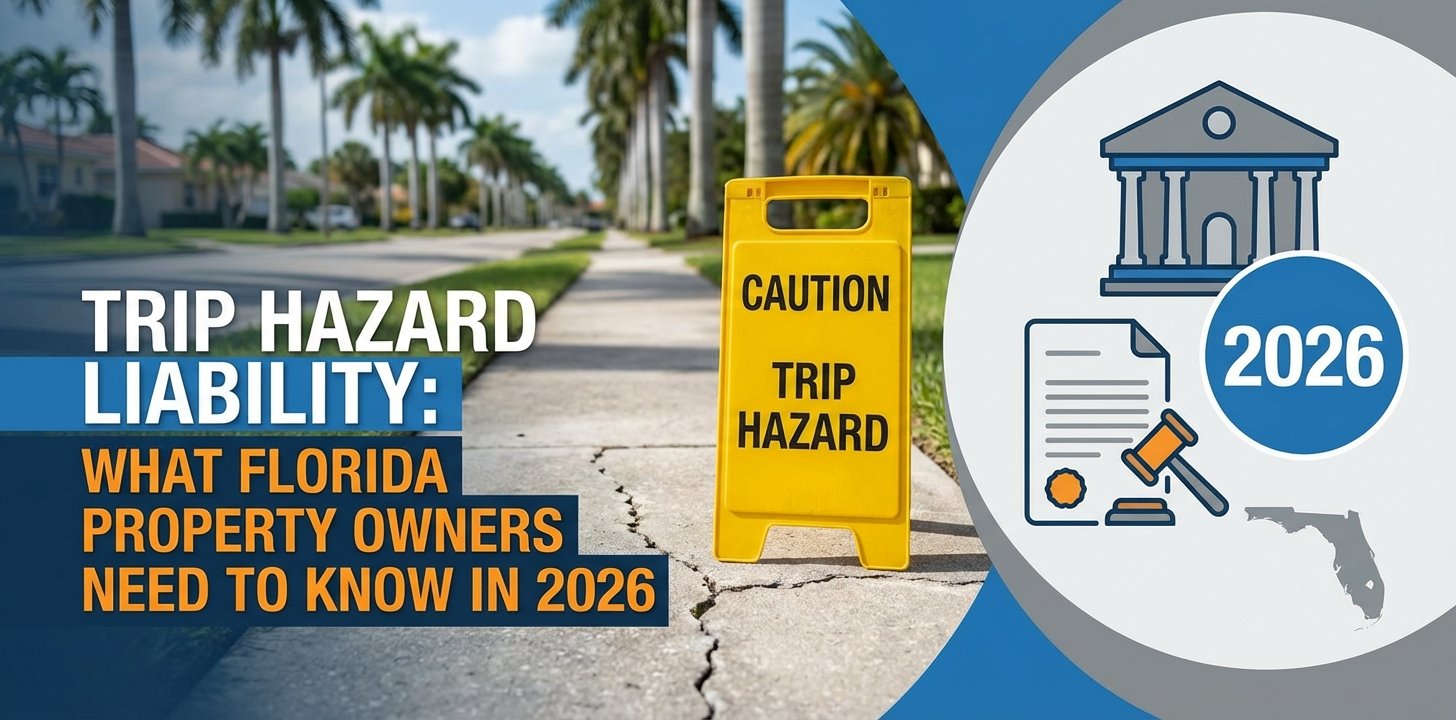
A two-inch concrete lip on a sidewalk seems insignificant until it generates a six-figure lawsuit. In Florida, slip and fall claims involving sidewalk trip hazards have resulted in settlements ranging from $50,000 to over $1 million, with property owners and municipalities bearing the financial burden. As liability standards tighten and insurance companies scrutinize premises maintenance more closely in 2026, understanding your legal obligations regarding sidewalk safety has never been more critical.
The Legal Framework: Florida Premises Liability and Sidewalk Responsibility
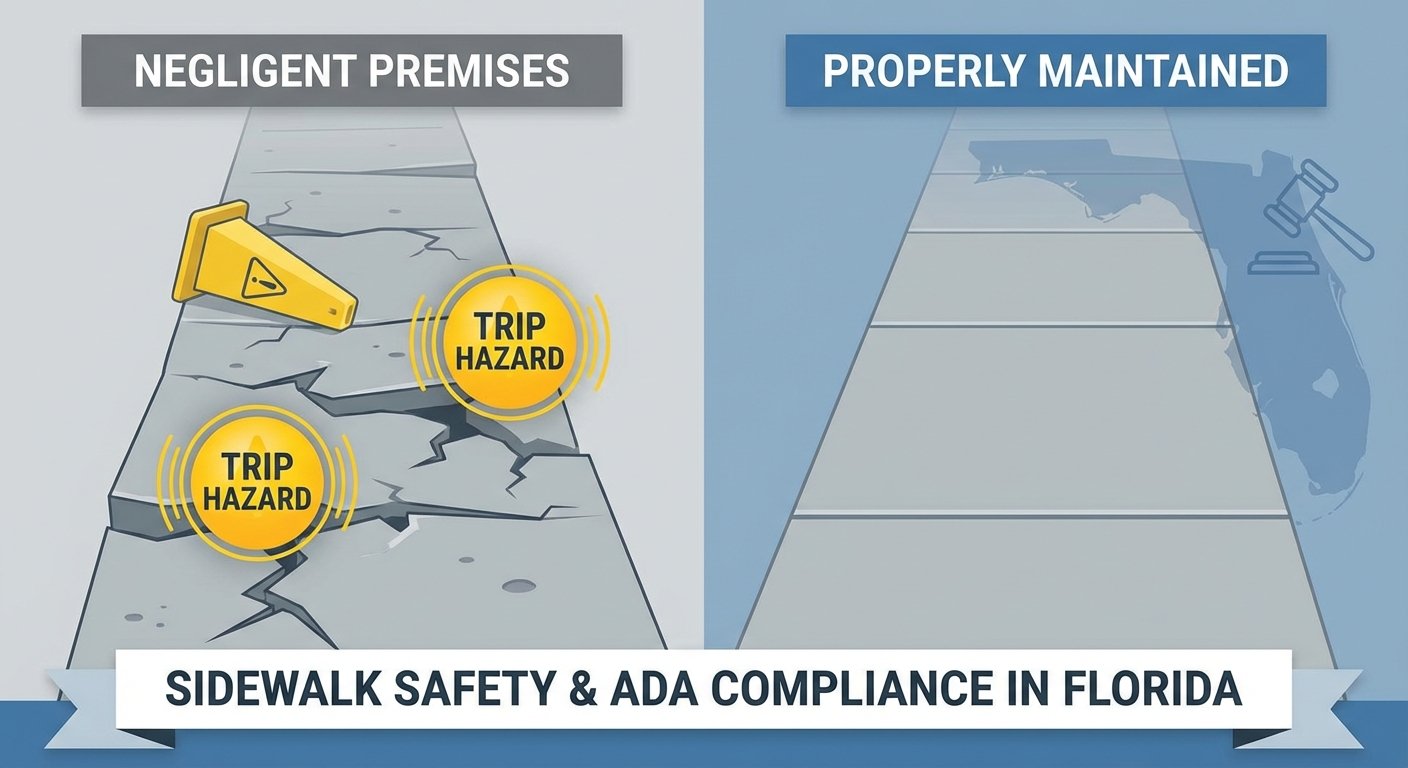
Florida premises liability law places a clear duty on property owners to maintain safe conditions for visitors and pedestrians. Under Florida Statutes Section 768.0755, property owners must address known hazards or conditions they reasonably should have known about. This “constructive knowledge” standard means ignorance is not a valid defense—if regular inspections would have revealed a trip hazard, you’re liable.
The responsibility varies by property type. Commercial property owners bear liability for sidewalks on their property and often for adjacent public walkways. Homeowners associations face exposure for all common areas including sidewalks throughout the community. Municipalities own public sidewalk infrastructure but can face lawsuits when maintenance falls short. In all cases, property owner sidewalk liability in Florida extends to ensuring safe passage for pedestrians.
The threshold for what constitutes an actionable defect has evolved. Courts have found property owners liable for height differentials as small as one inch, though defects between 1.5 to 2 inches almost universally trigger liability in Florida premises liability sidewalk cases. Factors beyond height include the visibility of the hazard, lighting conditions, pedestrian traffic volume, and whether warning signs were posted.
Understanding Trip and Fall Lawsuit Exposure
Trip and fall lawsuit prevention begins with recognizing the true cost of sidewalk negligence. The average settlement for a sidewalk trip and fall in Florida ranges from $75,000 to $150,000, but severe injuries can push verdicts significantly higher. A 2025 Tampa case resulted in a $1.2 million judgment against a shopping center after a 68-year-old woman suffered a fractured hip on a raised sidewalk panel.
Beyond settlement costs, property owners face:
- Legal defense fees averaging $30,000-$75,000 even for cases that settle early
- Increased insurance premiums following claims, sometimes doubling annual costs
- Potential loss of insurance coverage if hazards were documented but not corrected
- Negative publicity damaging reputation and property values
- Investigation costs and time commitment from management and staff
Insurance companies have become increasingly aggressive about denying coverage when property owners failed to address documented hazards. Trip hazard insurance claims submitted in 2026 undergo rigorous review of inspection records, maintenance logs, and prior incident reports. If insurers can demonstrate negligent maintenance, they may deny coverage entirely, leaving property owners personally liable for the full judgment amount.
HOA Sidewalk Liability: Unique Challenges for Community Associations
Homeowners associations face distinct liability challenges. HOA sidewalk liability in Florida extends across miles of walkways serving hundreds or thousands of residents. Board members, acting as fiduciaries, can face personal liability if they knowingly ignore documented hazards or fail to maintain adequate insurance.
A 2024 Florida appellate court decision reinforced that HOAs cannot avoid liability by claiming budgetary constraints prevented repairs. The court ruled that lack of funds does not eliminate the duty to maintain safe conditions. This places HOA boards in a difficult position: they must allocate sufficient reserves for sidewalk maintenance while keeping assessments reasonable.
The solution lies in proactive management. Successful HOAs in 2026 conduct biannual sidewalk inspections, document all findings, prioritize hazards by severity, and address violations promptly. When budget constraints exist, demonstrating immediate action on the most dangerous hazards—even temporary measures like warning signage—can significantly reduce liability exposure.
Municipal Sidewalk Liability: Public Entity Obligations
Municipal sidewalk liability operates under similar principles but with additional complexity. Florida’s sovereign immunity laws provide limited protection to government entities, capping damages at $200,000 per person and $300,000 per incident. However, these caps offer cold comfort when cities face multiple lawsuits simultaneously.
Public works directors in 2026 confront a perfect storm: aging infrastructure installed decades ago, limited budgets, increasing pedestrian traffic, and heightened public awareness of rights. Cities like Jacksonville and Orlando have allocated millions to sidewalk repair programs after experiencing lawsuit spikes.
Documentation becomes critical for municipalities. Systematic inspection programs, work order tracking systems, and transparent prioritization criteria help demonstrate reasonable care even when hazards exist temporarily. Courts recognize that municipalities cannot fix every defect immediately, but they must show organized, ongoing efforts to identify and remediate hazards.
ADA Compliance: The Federal Layer of Liability
The Americans with Disabilities Act adds another dimension to sidewalk trip hazard liability in Florida. ADA standards permit maximum vertical displacement of 0.5 inches between adjacent surfaces—far stricter than common law negligence thresholds. Walkways must also maintain compliant slopes, cross-slopes, and clear widths.
ADA violations create exposure through two channels: Department of Justice enforcement actions and private lawsuits. While DOJ actions typically seek compliance rather than damages, private plaintiffs can recover attorney’s fees, making these cases attractive to specialized law firms. Several Florida property owners have faced serial ADA litigation from the same plaintiffs targeting multiple non-compliant locations.
The intersection of ADA requirements and general liability creates a compelling case for addressing even minor elevation changes. A 0.75-inch differential might escape notice during a general safety inspection but violates federal accessibility standards and creates trip hazard exposure for all pedestrians.
The Cost-Benefit Analysis: Prevention vs. Litigation
Property owners often defer sidewalk repairs due to perceived costs. Traditional replacement runs $8-$15 per square foot in Florida, making a typical project for a commercial property or HOA easily exceed $50,000-$100,000. Faced with these estimates, decision-makers frequently choose to “wait and see.”
This calculation fundamentally misunderstands the economics. A single lawsuit costs more than most comprehensive sidewalk remediation programs. When comparing the $75,000 average settlement plus $40,000 in legal fees against proactive repair costs, prevention emerges as the fiscally responsible choice.
Modern concrete cutting technology has transformed this equation. Precision cutting methods remove the raised portion of concrete, eliminating trip hazards at 70-90% less cost than replacement. A project that would cost $75,000 for complete replacement can often be addressed for $7,500-$15,000 using cutting techniques. The work completes in hours rather than weeks, with no demolition debris, no curing time, and immediate usability.
Proven Solutions: Cutting Technology for Sidewalk Trip Hazards
The most effective trip and fall prevention strategy combines regular inspection with prompt remediation using appropriate technology. For raised concrete panels—the most common sidewalk trip hazard—precision concrete cutting offers distinct advantages over grinding or replacement.
Grinding reduces elevated concrete gradually but creates a sloped transition that can violate ADA requirements and may not fully eliminate the hazard. The result often looks patched and requires frequent re-grinding as the slope wears unevenly. Replacement addresses the root cause but costs exponentially more, creates weeks of disruption, and generates substantial landfill waste.
Cutting technology removes the raised portion of concrete with diamond-blade precision, creating a clean vertical edge that eliminates the trip hazard while maintaining ADA compliance. The process involves no demolition, no forms or curing time, and minimal noise or disruption. Properties remain fully accessible throughout the work.
For Florida property owners dealing with sidewalk trip hazard liability concerns, cutting delivers speed and cost-effectiveness. A typical commercial property can have 20-30 trip hazards eliminated in a single day. The finished result looks professional and clean, not patched or compromised. Most importantly, the hazards are genuinely eliminated, not temporarily reduced.
Documentation: Your First Line of Defense
Even with perfect maintenance, lawsuits happen. Your documentation determines whether you’ll prevail. Courts favor property owners who demonstrate systematic safety programs, even when a specific hazard temporarily existed.
Essential documentation includes:
- Regular inspection reports with dates, locations, and photographs of all sidewalk conditions
- Work orders showing when hazards were identified and remediation scheduled
- Completion certificates from contractors with before/after photographs
- Budget allocations demonstrating ongoing commitment to sidewalk maintenance
- Incident reports documenting any prior complaints or falls
Digital documentation systems have become standard in 2026. Mobile apps allow inspectors to photograph defects, GPS-tag locations, and generate immediate work orders. This creates an auditable trail demonstrating reasonable care and prompt response.
Taking Action: A Practical Implementation Plan
Property managers and HOA boards should implement a systematic approach to sidewalk liability management:
Immediate Actions: Conduct a comprehensive sidewalk inspection within 30 days. Document all elevation changes exceeding 0.5 inches with photographs and measurements. Identify ADA violations and high-traffic areas requiring priority attention.
Short-Term Response: Address hazards exceeding 1.5 inches within 60 days through cutting, grinding, or replacement. Install temporary warning signage at defects awaiting repair. Obtain quotes from qualified contractors specializing in sidewalk remediation.
Long-Term Program: Establish biannual inspection schedules. Create a multi-year capital plan for comprehensive sidewalk maintenance. Review insurance coverage limits and exclusions with your broker. Develop written policies documenting your sidewalk safety program.
Protect Your Property and Your Peace of Mind
Sidewalk trip hazards represent one of the most preventable liability exposures facing Florida property owners in 2026. The combination of clear legal duties, aggressive litigation, strict ADA standards, and potential insurance denials creates substantial risk. However, cost-effective solutions exist that eliminate hazards quickly without the expense and disruption of traditional replacement.
The question isn’t whether you can afford to fix sidewalk trip hazards—it’s whether you can afford not to. Every day that documented hazards remain unaddressed increases your liability exposure and weakens your legal defense.
Florida Sidewalk Solutions brings over 20 years of Florida-specific experience in eliminating trip hazards using patented Precision Concrete Cutting technology. Our process costs 70-90% less than replacement, completes in a fraction of the time, and delivers a professional finish that eliminates liability while maintaining ADA compliance. We’ve helped hundreds of HOAs, municipalities, and commercial properties across Florida protect themselves from trip and fall lawsuits while preserving their budgets.
Don’t wait for a lawsuit to force action. Contact Florida Sidewalk Solutions today for a free property assessment and discover how quickly and affordably you can eliminate your sidewalk liability exposure. Your residents, visitors, and insurance company will thank you.