
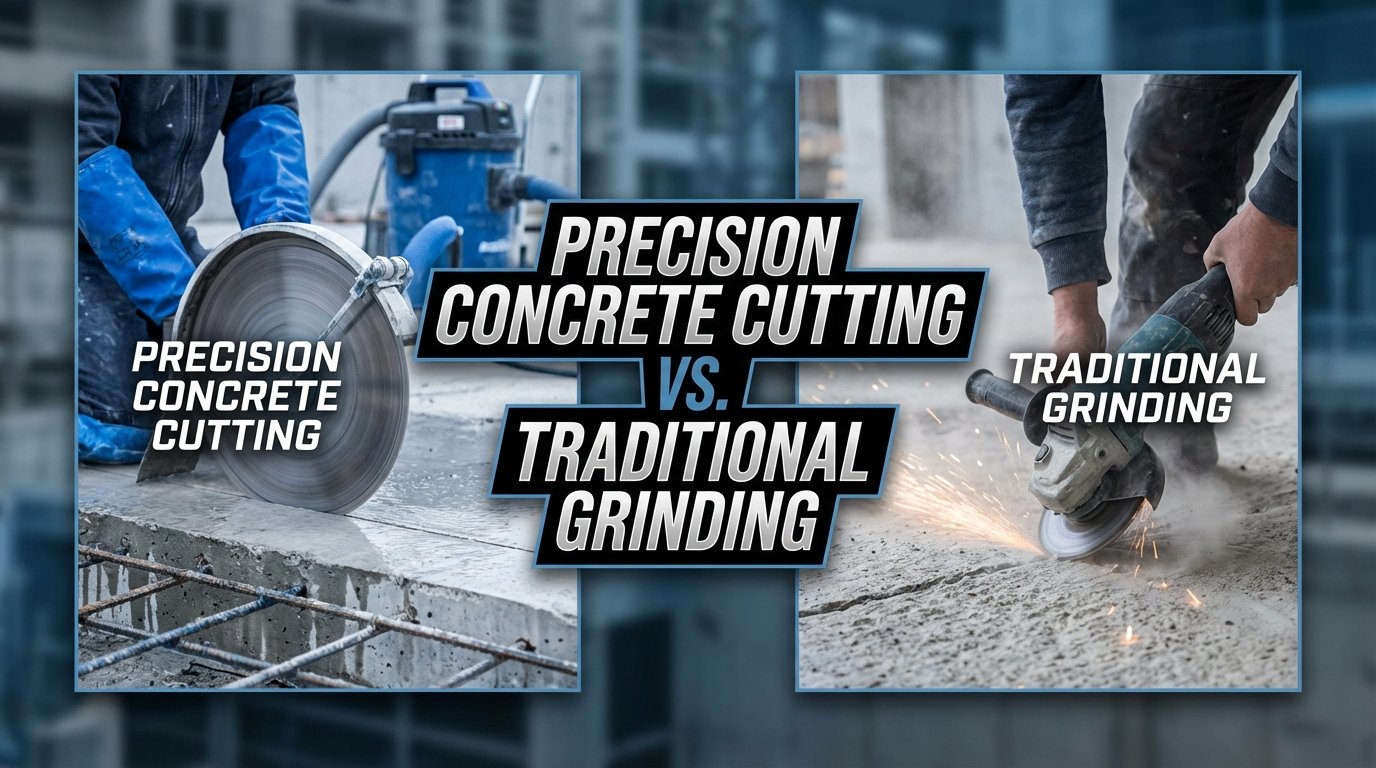
Property managers and municipal decision-makers face a common dilemma when addressing sidewalk trip hazards: invest in expensive full replacement, attempt surface grinding that often creates new problems, or find a better solution. In 2026, the gap between outdated grinding methods and modern precision concrete cutting sidewalks technology has never been more apparent—or more consequential for your liability exposure and budget.
Understanding the fundamental differences between these approaches isn’t just about technical specifications. It’s about choosing between a temporary fix that may worsen your situation and a permanent solution that actually resolves ADA compliance issues while saving 70-90% compared to replacement costs.
The Technology Behind Precision Concrete Cutting
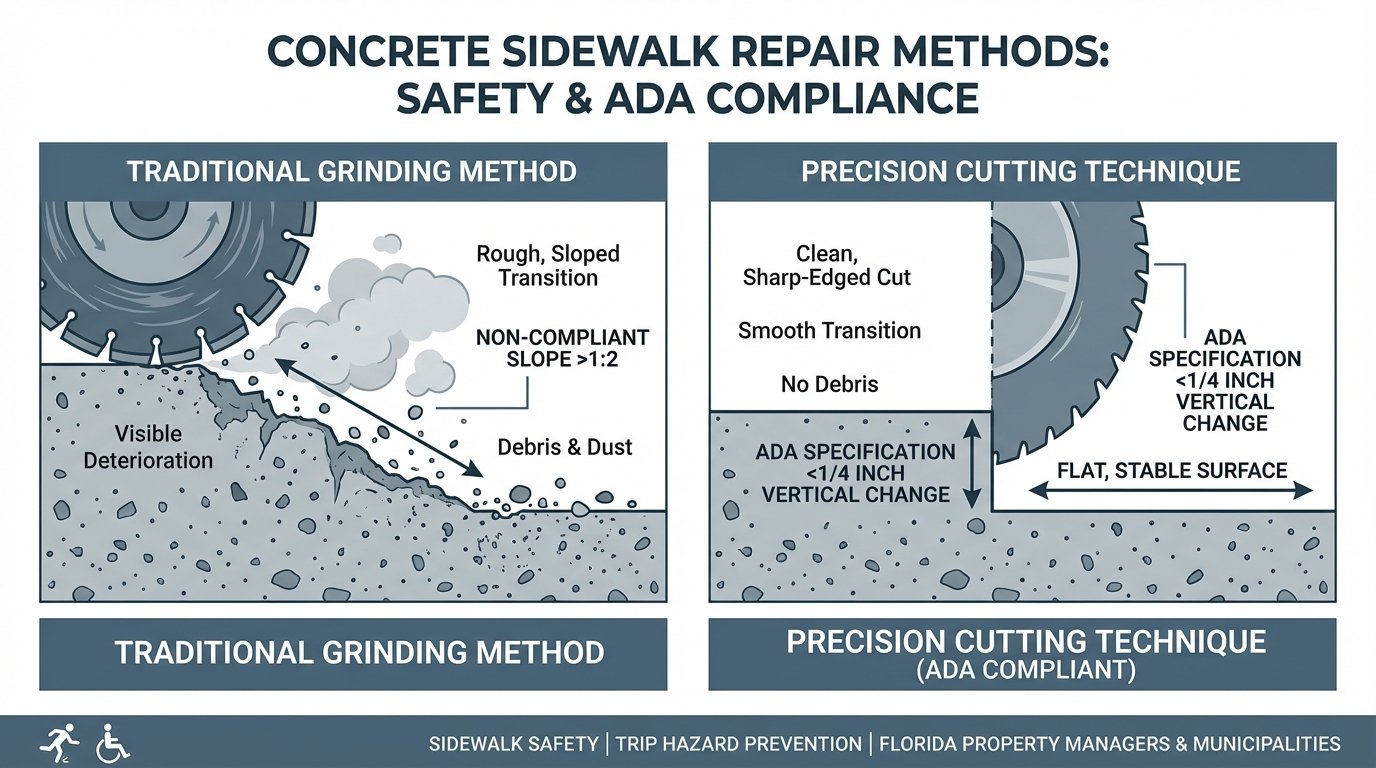
Traditional grinding uses abrasive wheels to sand down raised concrete sections, similar to using sandpaper on wood. The process creates a rough, sloped transition that deteriorates quickly and often fails to meet ADA specifications for slope ratios. Concrete cutting vs grinding represents a fundamental difference in methodology and outcomes.
Precision concrete cutting technology employs diamond-tipped blades that make exact cuts beneath the surface of raised concrete slabs. This patented process removes a precise wedge of material from underneath the elevated section, allowing the slab to drop into proper alignment with adjacent surfaces. The result is a flush, level transition that meets the ADA requirement of no more than 1/4-inch vertical displacement.
The cutting approach addresses the root cause rather than masking symptoms. When a sidewalk panel lifts due to tree roots, soil settlement, or ground movement, grinding simply shaves off the top surface. The underlying structural issue remains, and the panel often continues rising. Precision cutting repositions the entire slab, creating a stable, compliant surface.
Why Grinding Falls Short in 2026
Municipal public works departments and property managers who relied on grinding in the past are increasingly discovering its limitations:
- Surface degradation: Grinding exposes aggregate and creates a rough texture that accelerates weathering, particularly problematic in Florida’s intense sun and rain cycles
- Slope violations: Ground surfaces typically create beveled transitions that exceed ADA’s maximum 1:12 slope ratio, leaving you non-compliant despite the expense
- Aesthetic inconsistency: The contrast between ground and original concrete surfaces creates an unprofessional patchwork appearance that detracts from property values
- Temporary results: Without addressing underlying causes, ground areas often redevelop trip hazards within 12-24 months
- Dust and contamination: The grinding process generates significant concrete dust that enters buildings, vehicles, and landscaping
For facilities managers at schools and universities, these grinding limitations pose particular challenges. The rough surfaces created by grinding become additional maintenance headaches, collecting debris and creating cleaning difficulties. More critically, the failure to achieve true ADA compliance leaves institutions vulnerable to complaints and legal action.
Concrete Cutting Trip Hazard Removal: How It Works
The advanced concrete cutting Florida specialists use follows a precise methodology that delivers consistent results:
First, technicians assess the elevation difference and measure exact displacement between adjacent slabs. This diagnostic phase identifies the specific amount of material requiring removal. Unlike grinding’s guesswork approach, cutting relies on precise measurements to achieve perfect alignment.
Diamond-blade equipment then makes strategic cuts beneath the raised slab at calculated angles and depths. The removed concrete wedge allows the slab to settle into flush alignment with surrounding surfaces. Because cutting occurs underneath rather than on top, the original surface finish remains intact and undisturbed.
The entire process for a typical residential sidewalk trip hazard takes 30-45 minutes, compared to the hours or days required for replacement. Commercial properties and municipal sidewalks with multiple hazards can be addressed in a single day without closing facilities or rerouting pedestrian traffic.
Cost Analysis: The Numbers Decision-Makers Need
Budget-conscious HOA board members consistently find that concrete cutting technology repair delivers superior financial outcomes:
Replacement costs for a standard 4×4 foot sidewalk section in Florida average $450-$650 when accounting for demolition, disposal, materials, labor, and curing time. Properties with multiple trip hazards can easily face $5,000-$15,000 in replacement expenses.
Precision cutting costs for the same section typically range from $75-$150, representing savings of 70-90%. A property with ten trip hazards might spend $800-$1,200 for cutting versus $4,500-$6,500 for replacement—a difference that meaningfully impacts annual maintenance budgets.
The cost advantage extends beyond the initial repair. Replacement requires ongoing expenses: labor to remove old concrete, disposal fees increasingly significant as landfills restrict construction waste, new materials subject to 2026’s elevated concrete prices, and the opportunity cost of unusable sidewalks during 7-10 day curing periods.
Cutting eliminates these secondary costs entirely. No demolition means no disposal fees. No new concrete means no material costs or curing delays. Properties remain fully functional throughout the repair process, avoiding the revenue loss or resident complaints associated with closed walkways.
ADA Compliance: Meeting Legal Requirements
The Americans with Disabilities Act specifies that vertical level changes on walking surfaces cannot exceed 1/4 inch. Changes between 1/4 inch and 1/2 inch must be beveled with a slope no greater than 1:2. Any displacement exceeding 1/2 inch constitutes a violation requiring correction.
Commercial property owners face significant exposure when sidewalk conditions violate these standards. A single ADA complaint can trigger investigations, required corrections, and potential fines. More concerning is the liability for injuries occurring on non-compliant surfaces—claims that can reach six or seven figures when serious injuries occur.
Precision concrete cutting consistently achieves compliant results by eliminating vertical displacement entirely. The flush surface alignment removes the trip hazard and the legal liability simultaneously. Grinding, by contrast, frequently creates beveled transitions that measure compliant initially but fail as the underlying slab continues shifting.
For municipalities, compliance extends beyond individual locations. Public works directors managing miles of sidewalk need solutions that deliver consistent, documented compliance across entire systems. The precision and repeatability of cutting technology supports the systematic risk management that grinding cannot provide.
Environmental Considerations in Modern Repair
Sustainability-focused property managers and institutions increasingly recognize concrete cutting’s environmental advantages. Replacement generates substantial waste—a typical sidewalk section produces 300-500 pounds of concrete debris destined for landfills already struggling with construction waste volumes.
Cutting eliminates demolition waste entirely by preserving existing concrete. The small amount of material removed during the cutting process represents less than 5% of the slab volume, and this minimal waste can often be used as fill material on-site.
The carbon footprint differences are equally significant. New concrete production contributes substantially to CO2 emissions through cement manufacturing. By preserving existing concrete, cutting avoids these emissions while eliminating the fuel consumption associated with demolition equipment, waste hauling, and new material delivery.
Speed and Minimal Disruption
Time equals money for commercial property owners, and accessibility equals satisfaction for residents and tenants. Replacement projects that close sidewalks for over a week create cascading problems: residents forced to use alternative routes, delivery complications, accessibility complaints, and the liability exposure that continues until repairs complete.
Precision cutting addresses most trip hazards in under an hour with no curing time required. Sidewalks remain usable immediately after repair, eliminating access disruptions entirely. For retail properties, this means no lost foot traffic. For residential communities, it means no complaints about blocked walkways. For municipalities, it means no detour signage or traffic control requirements.
The speed advantage compounds when addressing multiple locations. A property with twenty trip hazards might require three to four weeks for sequential replacement as concrete cures between pours. The same property can be completely addressed with cutting in a single day.
Florida-Specific Expertise and Proven Technology
Florida’s unique conditions—aggressive root systems from live oaks and palms, sandy soil settlement, and ground movement—create sidewalk challenges that demand specialized understanding. Generic repair approaches developed for other climates often fail when applied to Florida’s environment.
Advanced concrete cutting Florida specialists bring two decades of experience addressing these specific conditions. The Precision Concrete Cutting technology has proven effective across thousands of Florida properties, from Miami’s coastal areas to Panhandle municipalities, adapting to regional soil conditions and vegetation patterns.
This Florida-focused expertise ensures repairs account for the ongoing forces affecting sidewalks. Rather than applying one-size-fits-all solutions, experienced technicians assess each situation’s unique factors and engineer cuts that accommodate future minor ground movement without redeveloping trip hazards.
Making the Right Choice for Your Property
Decision-makers evaluating sidewalk repair options should consider total cost of ownership, compliance assurance, disruption impact, and long-term performance. Precision concrete cutting delivers advantages across all these dimensions:
- Immediate cost savings of 70-90% compared to replacement
- Consistent ADA compliance that reduces liability exposure
- Same-day completion with zero access disruption
- Professional appearance that maintains property values
- Environmental responsibility through waste elimination
- Long-term performance that avoids repeat repairs
The contrast with grinding becomes clear when examining actual outcomes. Grinding may appear less expensive initially, but the rough surfaces, continued compliance issues, and frequent re-grinding requirements make it the costliest option over time. Replacement delivers compliant results but at prices that strain budgets and timelines that disrupt operations.
Precision cutting occupies the optimal position: compliant, permanent results at a fraction of replacement costs and superior long-term performance compared to grinding.
Take Action on Your Sidewalk Safety
Every day that trip hazards remain unaddressed increases your liability exposure and the probability of injuries. The availability of cost-effective, minimally disruptive repair technology eliminates the justification for delay.
Florida Sidewalk Solutions brings proven precision concrete cutting technology and Florida-specific expertise to your sidewalk safety challenges. Our patented process has protected property managers, municipalities, and commercial owners throughout Florida for over 20 years, delivering compliant results that last while saving 70-90% compared to replacement costs.
Contact Florida Sidewalk Solutions today for a comprehensive property assessment. We’ll identify every trip hazard, provide detailed compliance reporting, and deliver transparent pricing that helps you budget effectively. Don’t wait for an injury or complaint to force action—proactive sidewalk safety protects people, reduces liability, and costs far less than reactive repairs after incidents occur.