
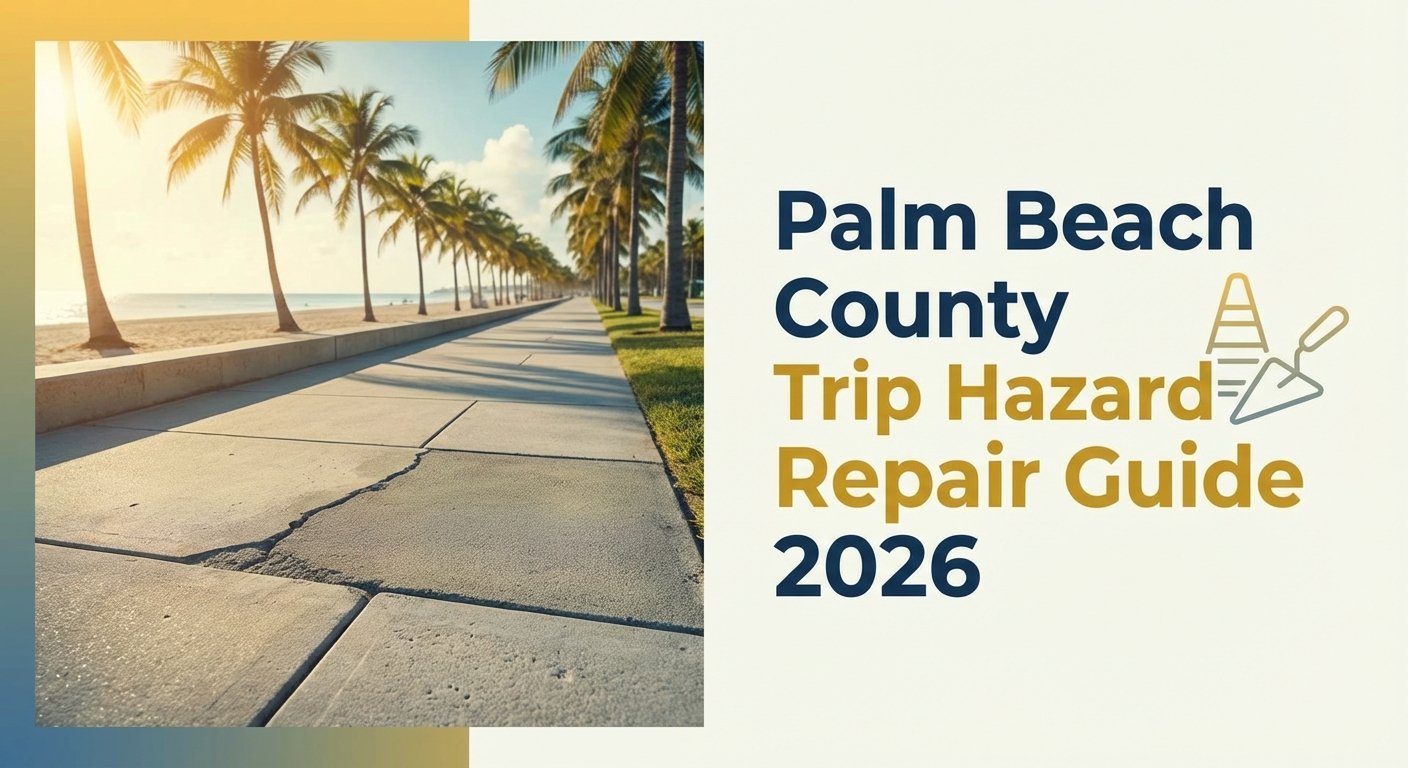
Property owners and managers across Palm Beach County face mounting pressure in 2026 as liability claims from sidewalk trip hazards continue to increase. A single fall can result in lawsuits exceeding $500,000, yet many decision-makers delay repairs due to misconceptions about cost and disruption. Understanding your options for trip hazard repair in Palm Beach County isn’t just about compliance—it’s about protecting your assets and the people who use your property.
The Growing Liability Crisis in Palm Beach County
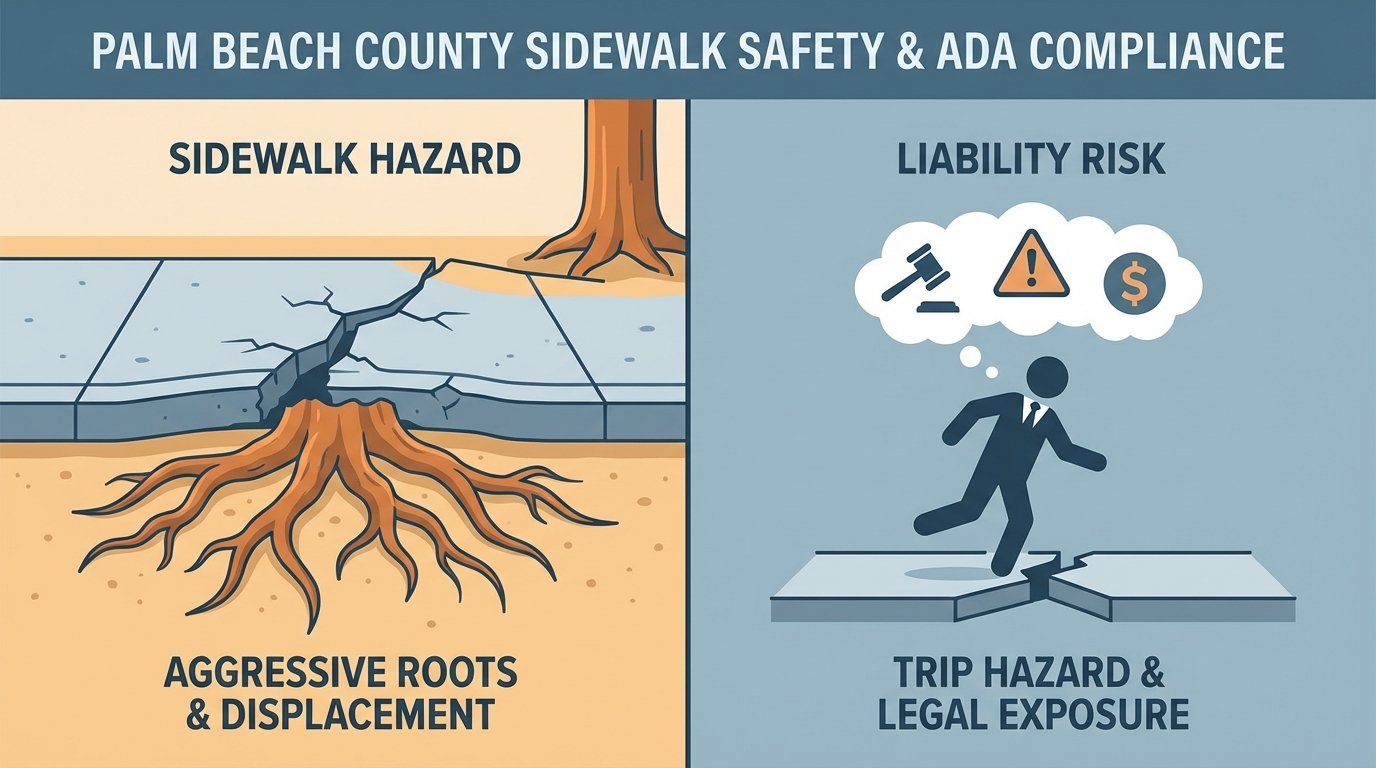
Palm Beach County’s unique combination of aggressive root systems, sandy soil conditions, and high foot traffic creates the perfect environment for sidewalk displacement. Commercial properties, HOAs, and municipalities are discovering that ignoring these hazards carries consequences far beyond aesthetics.
Florida premises liability law holds property owners responsible for maintaining safe walkways. When someone trips on a sidewalk height differential exceeding one-half inch—the ADA threshold—property owners face potential negligence claims. The average settlement for trip-and-fall cases in Florida now ranges from $50,000 to $150,000, with jury verdicts sometimes reaching seven figures when serious injuries occur.
More concerning for budget-conscious managers: insurance companies are increasingly denying coverage for known hazards that weren’t promptly addressed. Documented inspections showing unrepaired trip hazards can void your liability protection entirely.
Understanding ADA Requirements for Sidewalks
The Americans with Disabilities Act sets clear standards for walkway surfaces. Any vertical displacement greater than one-half inch between adjacent concrete slabs constitutes a trip hazard requiring correction. For differences between one-quarter and one-half inch, beveling at a ratio no steeper than 1:2 is acceptable.
These aren’t suggestions—they’re federal requirements with real enforcement teeth. In 2026, the Department of Justice has intensified ADA compliance audits across Florida, with Palm Beach County properties receiving particular scrutiny due to complaint volume.
Commercial properties and any entity receiving federal funding must maintain ADA-compliant walkways. HOAs, while sometimes exempt from certain ADA provisions, still face premises liability under Florida law and must maintain safe conditions for residents and visitors.
Documentation Requirements
Property managers should maintain records of:
- Regular sidewalk inspections with dated photographs
- Measurements of height differentials at problem areas
- Repair quotes and completion certificates
- Maintenance schedules and contractor correspondence
This documentation proves due diligence if liability claims arise and demonstrates good-faith compliance efforts during ADA audits.
Traditional Repair Methods: Costs and Limitations
When facing trip hazard repair in Palm Beach County, most property managers encounter two conventional options: complete replacement or surface grinding. Both carry significant drawbacks.
Concrete Replacement
Full slab replacement involves demolishing existing concrete, excavating the base, installing new forms, pouring fresh concrete, and allowing cure time. For a typical 25-foot sidewalk section, replacement costs range from $1,800 to $3,500 depending on site access and material costs.
Beyond expense, replacement creates substantial disruption. Sidewalk closures lasting 3-7 days force pedestrians into unsafe detours. Jackhammering generates noise complaints. Debris removal requires dumpsters and hauling fees. For HOAs and businesses, the disruption affects resident satisfaction and customer access.
Replacement also doesn’t address the root cause. If tree roots or soil settlement created the original problem, the new concrete will eventually shift again unless underlying issues are resolved—an expense rarely included in basic replacement quotes.
Surface Grinding
Grinding uses abrasive wheels to reduce the raised slab edge, creating a gradual slope. While cheaper than replacement at $6-12 per linear foot, grinding produces an inferior result that accelerates deterioration.
The grinding process exposes aggregate and removes the finished concrete surface, creating a rough texture that traps debris and moisture. This scarred surface weathers faster, develops scaling, and collects dirt that becomes slippery when wet. Property managers often find themselves addressing the same areas repeatedly as ground sections deteriorate prematurely.
Grinding also creates significant dust, requiring extensive cleanup and raising concerns about silica exposure—a regulated health hazard requiring specific containment measures under OSHA rules updated in 2025.
Precision Concrete Cutting: The Superior Solution
Modern concrete cutting technology offers a dramatically better approach to uneven sidewalk repair in Palm Beach County. Rather than removing slabs or scarring surfaces, precision cutting creates a clean control joint that eliminates the trip hazard while preserving the existing concrete.
The process involves cutting a straight vertical joint through the raised portion of the displaced slab, removing a narrow strip (typically 1-2 inches), and positioning the remaining section flush with the adjacent slab. This approach costs 70-90% less than replacement while delivering a clean, professional appearance that maintains the sidewalk’s finished surface.
Why Cutting Outperforms Other Methods
Precision cutting for sidewalk trip hazard removal provides multiple advantages:
- Preserves the finished surface: No exposed aggregate or rough texture—the original smooth finish remains intact
- Immediate usability: Sidewalks reopen within hours, not days
- Minimal disruption: No jackhammers, no dumpsters, no extended closures
- Environmental benefits: Zero demolition waste sent to landfills
- Long-term durability: Properly cut joints perform for decades without premature deterioration
- Cost efficiency: Typical savings of $1,500-$3,000 per section compared to replacement
For large properties with multiple problem areas, these savings multiply quickly. An HOA with fifteen trip hazards might face $40,000-$50,000 in replacement costs but resolve all issues for under $8,000 with cutting technology.
Sidewalk Safety Repair Solutions for Palm Beach Properties
Different property types face unique challenges requiring tailored approaches to sidewalk leveling in Palm Beach County.
HOA Communities
Homeowner associations balance resident safety against budget constraints and assessment tolerance. Trip hazards on common area sidewalks represent potential liability for the entire association, making proactive repair essential.
Precision cutting allows HOAs to address problems systematically without depleting reserves. Board members appreciate the minimal disruption—no angry residents complaining about extended closures or construction noise. The clean finish maintains property aesthetics, an important consideration for communities focused on curb appeal and property values.
Commercial Properties
Retail centers, office parks, and hospitality properties cannot afford extended sidewalk closures that impact customer access. A closed entrance means lost revenue, while visible construction projects suggest maintenance problems to potential tenants and customers.
Same-day trip hazard repair Palm Beach County contractors can complete means minimal business interruption. The professional appearance of cut joints maintains the polished image commercial properties require.
Municipal Facilities
Cities and counties across Palm Beach manage thousands of linear feet of sidewalks with limited budgets. Precision cutting enables public works departments to address more hazards with available funding, improving public safety and reducing municipal liability exposure.
For schools and parks, the quick turnaround and lack of demolition noise make cutting ideal for facilities that remain occupied during repairs.
Choosing a Trip Hazard Contractor in Palm Beach County
Not all concrete contractors offer precision cutting services. This specialized work requires specific equipment, training, and experience. When evaluating contractors for uneven sidewalk repair in Palm Beach County, property managers should verify:
- Specialized equipment: Precision concrete cutting requires diamond-blade saws designed specifically for this application
- ADA knowledge: Contractors must understand compliance requirements and proper measurement techniques
- Insurance coverage: Verify general liability and workers compensation appropriate for concrete work
- Local experience: Florida conditions require understanding of root systems, soil behavior, and climate factors
- References: Request examples of similar projects and contact information for recent clients
Be wary of contractors suggesting grinding as a primary solution or pushing replacement without evaluating cutting as an option. Cost-effective precision cutting should be the first consideration for most trip hazard situations.
The Cost of Inaction
Delaying sidewalk safety repair creates escalating risks. Beyond the obvious liability exposure, property managers face:
Increased damage: Trip hazards worsen over time as roots continue growing and soil continues settling. A one-inch differential today becomes two inches next year, requiring more extensive correction.
Insurance complications: Known hazards documented in inspection reports but left unaddressed can void coverage. Insurance adjusters routinely request maintenance records during claim investigations.
Reduced property values: Obvious safety issues signal deferred maintenance, impacting property values and marketability. Prospective buyers and tenants notice cracked, uneven walkways.
Regulatory action: Code enforcement complaints from residents or visitors can trigger mandatory corrections with tight deadlines and potential fines for non-compliance.
The financial case for proactive repair is clear: spending $3,000-$8,000 on preventive maintenance protects against $50,000-$500,000+ in liability claims while preserving property values and maintaining occupant satisfaction.
Take Action on Palm Beach County Sidewalk Hazards
Property managers and decision-makers who prioritize sidewalk safety demonstrate responsible stewardship while protecting their organizations from preventable liability. Modern precision cutting technology makes addressing trip hazards affordable and minimally disruptive—eliminating the traditional excuses for delay.
Florida Sidewalk Solutions brings over twenty years of Florida-specific experience and patented Precision Concrete Cutting technology to Palm Beach County properties. Our approach delivers ADA-compliant results at a fraction of replacement costs with minimal disruption to your residents, customers, or operations.
Schedule a free property assessment to identify trip hazards and receive a detailed repair proposal. We’ll measure height differentials, document problem areas, and provide clear pricing for permanent solutions that protect your property and the people who use it. Contact Florida Sidewalk Solutions today at (305) 707-9499 or visit our website to request your inspection. Don’t wait for an injury claim to force action—protect your property proactively with expert sidewalk leveling in Palm Beach County.