
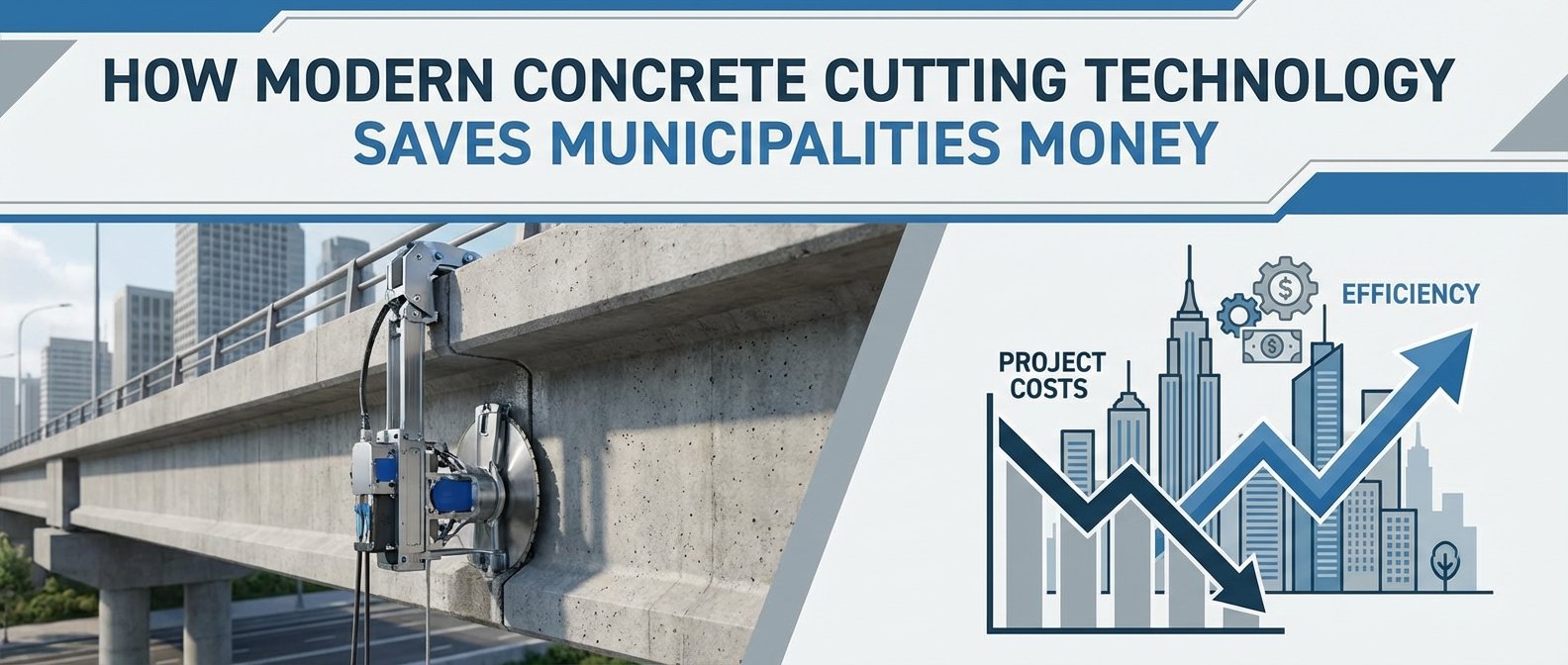
Municipal budgets face relentless pressure from all directions. Infrastructure maintenance competes with public safety, education, and social services for limited funding. When concrete sidewalks develop trip hazards, the traditional response—complete replacement—can consume hundreds of thousands of dollars annually. However, modern concrete cutting technology offers municipalities a way to maintain safe sidewalks while preserving 70-90% of their infrastructure budgets for other critical needs.
The True Cost of Municipal Sidewalk Deterioration

Most municipal public works directors understand that neglected sidewalks create multiple financial drains. Beyond the obvious repair costs, cities and counties face escalating liability exposure. A single trip-and-fall lawsuit settlement can exceed $100,000, with some cases reaching multi-million dollar verdicts when serious injuries occur. Legal defense costs alone average $50,000 to $75,000 per case, even when municipalities prevail.
The American Society of Civil Engineers consistently rates sidewalk infrastructure as deficient across Florida municipalities. As concrete slabs settle unevenly due to soil erosion, tree root growth, and ground shifting, vertical displacement creates dangerous elevation changes. Under ADA standards, any vertical displacement exceeding ½ inch constitutes a violation requiring remediation.
When municipalities delay repairs, they compound their problems. Small displacements worsen over time, increasing both injury risk and eventual repair complexity. Meanwhile, complaint volumes rise, citizen satisfaction drops, and legal liability grows with each passing month.
Traditional Repair Methods Drain Municipal Budgets
For decades, municipalities defaulted to two approaches when addressing uneven sidewalks: concrete grinding or complete replacement. Both methods carry significant disadvantages that strain public budgets.
Concrete Grinding Limitations
Grinding uses abrasive wheels to shave down raised concrete sections. While initially cheaper than replacement, grinding creates its own problems. The process exposes the aggregate below the surface, creating a rough, porous finish that collects moisture and accelerates deterioration. Florida’s intense sun and frequent rain cycles rapidly degrade ground surfaces, often requiring re-grinding within 2-3 years.
The rough texture also creates cleaning challenges and diminishes aesthetic appeal in downtown areas, parks, and public spaces where appearance matters. Most significantly, grinding only addresses downward adjustments—it cannot lift sunken slabs that have settled below grade.
Replacement Cost Reality
Complete sidewalk replacement delivers a clean, uniform result but at extraordinary cost. Typical replacement expenses range from $8 to $15 per square foot in Florida, including demolition, material removal, base preparation, new concrete, and finishing. A single city block can easily exceed $25,000 to $40,000.
Hidden costs multiply the financial impact. Demolition crews must close sidewalks, sometimes for weeks, disrupting businesses and frustrating residents. Disposal fees for broken concrete add thousands to project costs. New concrete requires curing time before accepting foot traffic, extending closure periods. These disruptions trigger additional costs through lost parking meter revenue, reduced commercial activity, and increased public complaints requiring staff time to address.
How Precision Concrete Cutting Technology Works
Modern concrete cutting technology represents a fundamental departure from grinding or replacement. This patented approach uses specialized equipment to make precise vertical cuts along trip hazards, then removes a thin channel of concrete to create a beveled transition that meets ADA compliance standards.
The process addresses the core problem differently. Rather than destroying and replacing serviceable concrete or grinding away its protective surface, precision cutting preserves the existing slab while eliminating the hazard. The result is a smooth, clean bevel that water flows across rather than pooling against.
The technology allows technicians to adjust raised sections downward or accommodate sunken slabs by creating code-compliant transitions. Each cut is calculated to meet exact ADA specifications, ensuring municipalities achieve full compliance while preserving maximum concrete.
Quantifying Municipal Cost Savings
The financial advantages of concrete cutting technology become clear when comparing actual project costs across repair methods.
Direct Cost Comparison
Precision concrete cutting typically costs $3 to $5 per linear foot of trip hazard. For a standard 100-foot sidewalk section with multiple trip hazards, repair costs range from $300 to $500. That same section, if replaced entirely, would cost $4,000 to $7,500—representing an 85-90% cost savings.
For municipalities managing miles of sidewalk, these savings compound dramatically. A mid-sized Florida city with 50 miles of sidewalk might identify 10,000 linear feet of trip hazards requiring annual attention. Using cutting technology costs approximately $40,000 to $50,000. Traditional replacement for those same hazards could exceed $400,000 to $600,000.
Speed Reduces Soft Costs
Concrete cutting crews complete most projects in hours rather than days or weeks. Technicians arrive, assess the site, make necessary cuts, and finish—often before lunch. Sidewalks remain open during most of the work, and areas can accept foot traffic immediately after completion.
This speed eliminates the soft costs that plague replacement projects. No extended business disruptions. No weeks of pedestrian detours. No multiple mobilizations for demolition, removal, pouring, and finishing. Municipal staff spend less time managing contractors, responding to complaints, and coordinating traffic control.
Longevity Extends Value
Properly executed concrete cutting delivers permanent results. The beveled transition doesn’t deteriorate like ground surfaces because it maintains the concrete’s original finished surface. The cut itself is clean and precise, without the micro-cracking that grinding creates.
Municipalities report that cut sections remain effective for 10-15 years or longer, matching the service life of the original sidewalk. This longevity means repair budgets stretch further, addressing more locations without increasing annual expenditures.
Environmental and Sustainability Benefits
Modern municipalities increasingly prioritize environmental stewardship. Concrete cutting technology supports these goals through waste reduction and resource conservation.
Traditional replacement generates enormous waste streams. Every square foot of demolished sidewalk becomes rubble requiring transportation and disposal. A typical city block replacement project produces 15-20 tons of concrete waste destined for landfills or recycling facilities.
Concrete cutting produces minimal waste—only the thin channel of removed material, typically measured in pounds rather than tons per project. This waste reduction eliminates hauling costs and disposal fees while supporting municipal sustainability initiatives.
The environmental benefits extend beyond waste. Replacement requires new concrete production, a carbon-intensive process. Cement manufacturing accounts for approximately 8% of global CO2 emissions. By preserving existing concrete, cutting technology reduces demand for new cement and its associated environmental impact.
Legal Compliance and Liability Protection
Municipal attorneys increasingly emphasize proactive sidewalk maintenance as essential liability protection. Courts view municipalities that identify and ignore trip hazards unfavorably, often resulting in higher damages when injuries occur.
Concrete cutting technology enables cost-effective rapid response to identified hazards. When inspectors document problem areas or citizens file complaints, public works departments can dispatch cutting crews within days rather than waiting for replacement projects scheduled months ahead.
This responsiveness creates documented evidence of good faith efforts to maintain safe conditions. If litigation does occur, municipalities can demonstrate they addressed known hazards promptly using appropriate technology—strengthening their legal position considerably.
Case Study: Real-World Municipal Implementation
A Central Florida municipality with 75 miles of sidewalk infrastructure faced mounting trip hazard complaints and two active lawsuits from pedestrian falls. Their traditional approach relied on annual replacement projects targeting the worst sections, but budget constraints limited repairs to roughly 2-3 blocks per year. Meanwhile, new hazards developed faster than replacement programs could address them.
After implementing a concrete cutting program, the city addressed over 300 trip hazards in the first year at a total cost of approximately $45,000. Equivalent replacement would have cost upward of $500,000. The rapid response capability allowed them to tackle complaint-driven repairs within two weeks rather than adding them to next year’s replacement schedule.
Within 18 months, citizen complaints dropped by 60%, and the city successfully defended against new litigation by demonstrating their proactive maintenance program. The public works director reported that concrete cutting technology “transformed sidewalk maintenance from a budget crisis into a manageable program.”
Implementation Considerations for Municipalities
Municipalities considering modern concrete cutting technology should evaluate several factors to maximize program success.
Comprehensive Assessment
Start with systematic sidewalk inspections to identify and prioritize trip hazards across the entire system. Document locations, measure vertical displacement, and photograph conditions. This creates both a repair roadmap and liability protection documentation.
Budget Reallocation
Shifting from replacement-focused budgets to cutting technology allows the same dollars to address 5-10 times more hazards. Many municipalities maintain a small replacement budget for truly deteriorated sections while dedicating the majority of funding to cutting technology for trip hazard elimination.
Qualified Contractors
Not all concrete cutting services deliver equivalent results. Seek contractors with extensive municipal experience, proper licensing and insurance, and proven ADA compliance expertise. Florida-based providers understand local soil conditions, climate factors, and regulatory requirements that impact long-term results.
Why Florida Municipalities Choose Florida Sidewalk Solutions
For over two decades, Florida municipalities have relied on proven expertise for sidewalk leveling Florida and concrete sidewalk repair solutions. The combination of patented Precision Concrete Cutting technology, Florida-specific experience, and commitment to ADA compliance delivers results that protect public safety while preserving municipal budgets.
The process is straightforward: rapid assessment, transparent pricing, minimal disruption, and permanent results. Public works directors receive detailed documentation suitable for compliance records and legal protection. Most importantly, they gain a partner who understands the unique challenges Florida municipalities face with sidewalk maintenance.
Transform Your Municipal Sidewalk Budget
Modern concrete cutting technology offers municipalities a clear path forward: safer sidewalks, reduced liability, environmental responsibility, and dramatically lower costs. In an era of budget constraints and competing priorities, this approach delivers measurable value that benefits both municipal finances and community safety.
If your municipality struggles with sidewalk maintenance costs, persistent trip hazards, or mounting liability concerns, it’s time to discover how concrete cutting technology can transform your program. Contact Florida Sidewalk Solutions today for a comprehensive assessment of your sidewalk system and a detailed cost comparison showing exactly how much your municipality can save while improving safety and compliance.