
Florida HOA boards face mounting legal exposure from sidewalk trip hazards, with recent case law shifting liability burdens and insurance premiums rising dramatically. In 2026, the average settlement for sidewalk trip-and-fall incidents ranges from $50,000 to $150,000, with jury awards sometimes exceeding $500,000 when permanent injuries occur. Understanding your community association’s legal obligations and implementing proactive sidewalk maintenance isn’t just about compliance—it’s about protecting your reserve funds and your residents.
The Legal Framework: HOA Sidewalk Responsibilities in Florida
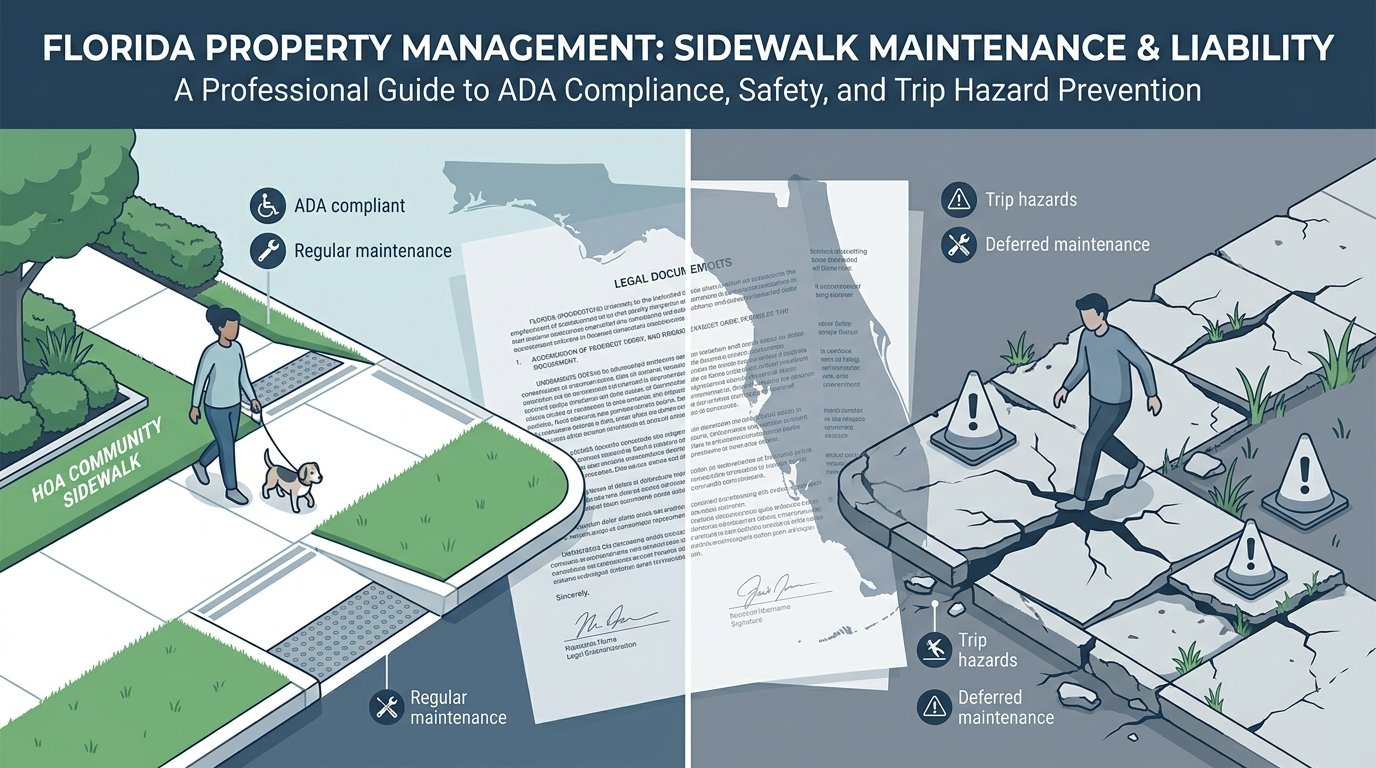
Florida premises liability law holds property owners and managers responsible for maintaining safe walking surfaces. For homeowners associations, this responsibility extends to all common areas, including sidewalks, walkways, and pedestrian pathways throughout the community.
Under Florida Statute 768.0755, property owners must address known dangerous conditions or those that should have been discovered through reasonable inspection. HOA board responsibilities specifically include:
- Regular inspection of all common area sidewalks
- Documentation of known hazards and repair timelines
- Prompt remediation of trip hazards exceeding safe thresholds
- Maintenance of adequate liability insurance coverage
- Compliance with ADA accessibility standards for public accommodations
The critical question many boards face: what constitutes a dangerous condition? Florida courts have consistently ruled that vertical displacements of one-half inch or greater create actionable trip hazards. Some jurisdictions apply even stricter standards, with municipalities like Miami-Dade County requiring repairs at the quarter-inch threshold.
Trip Hazard Liability: Why HOAs Are Prime Targets
HOA communities present unique liability exposure because of high pedestrian traffic, aging infrastructure, and deep insurance pockets. Personal injury attorneys actively pursue trip-and-fall cases against associations because they typically carry substantial liability policies—often $1 million or more.
Florida premises liability sidewalks cases hinge on three elements: the existence of a dangerous condition, actual or constructive knowledge of that condition, and failure to remedy or warn about the hazard. HOAs are particularly vulnerable on the “knowledge” element because:
Board members and property managers conduct regular property inspections, creating documentation that plaintiffs can use to prove awareness of hazards. Maintenance records, meeting minutes, and resident complaints all become evidence that the association knew or should have known about dangerous sidewalk conditions.
The 2025 Florida Supreme Court decision in Homeowners Association Management v. Patterson reinforced that HOAs cannot delegate away their duty of care. Even when contracting with property management companies, the association retains ultimate responsibility for sidewalk safety hoa compliance.
Real Costs: What Trip-and-Fall Claims Actually Cost HOAs
The financial impact of sidewalk liability extends far beyond settlement amounts. Consider the total cost burden:
Direct Settlement or Judgment Costs: The median settlement for trip-and-fall cases in Florida reached $87,500 in 2025, according to insurance industry data. Cases involving elderly victims or permanent injuries routinely exceed $200,000.
Insurance Premium Increases: A single claim can trigger premium increases of 25-40% that persist for three to five years. For a mid-sized HOA paying $15,000 annually for liability coverage, one incident could add $50,000 in additional premium costs over five years.
Legal Defense Costs: Even when HOAs successfully defend claims, legal fees average $25,000-$75,000 per case. These costs typically come from deductibles or reserves, impacting the community’s financial health.
Special Assessments and Lost Value: When reserves prove insufficient to cover settlements and repairs, boards must levy special assessments on homeowners. These unexpected costs create dissatisfaction and can negatively impact property values throughout the community.
ADA Compliance: The Federal Layer of Liability
Beyond state premises liability, HOAs must comply with the Americans with Disabilities Act (ADA) for sidewalks and walkways in common areas. The 2010 ADA Standards for Accessible Design establish specific requirements:
- Maximum running slope of 1:20 (5%) for accessible routes
- Maximum cross slope of 1:48 (2.08%)
- Minimum continuous clear width of 36 inches
- Vertical level changes limited to 1/4 inch, or 1/2 inch if beveled
- Stable, firm, and slip-resistant surfaces
ADA violations expose HOAs to federal complaints and Department of Justice enforcement actions. Unlike personal injury claims, ADA cases don’t require proof of actual injury—the mere existence of non-compliant conditions creates liability. Settlements in ADA accessibility cases typically range from $15,000 to $75,000, plus mandatory remediation costs.
Trip and Fall Prevention: Proactive Strategies for HOA Boards
Smart HOA boards adopt systematic approaches to sidewalk maintenance hoa that reduce liability while controlling costs.
Establish Regular Inspection Protocols
Document quarterly walkthrough inspections of all community sidewalks. Use consistent measurement tools to identify vertical displacements and document findings with photographs, GPS coordinates, and dates. This creates a defensible record of due diligence while enabling prioritized repair planning.
Create a Repair Prioritization System
Not all hazards pose equal risk. Prioritize repairs based on:
- Severity of displacement (1/2 inch or greater requires immediate attention)
- Location (high-traffic areas near mailboxes, pools, and clubhouses take priority)
- Demographics (communities with elderly residents face higher fall risk)
- Lighting conditions (poorly lit areas increase hazard severity)
Implement Interim Safety Measures
While awaiting permanent repairs, mark hazards with high-visibility paint or temporary warning signs. These stopgap measures demonstrate good faith efforts to protect residents, though they don’t eliminate liability.
Sidewalk Repair Solutions: Cutting vs. Grinding vs. Replacement
When facing sidewalk repair needs, HOA boards typically consider three approaches, each with distinct cost, timeline, and performance implications.
Complete Replacement: Traditional removal and replacement of concrete panels costs $8-$15 per square foot in Florida. For a typical HOA with 10,000 square feet of damaged sidewalks, this represents $80,000-$150,000. The process requires 3-7 days per project area, creates significant debris and noise disruption, and produces substantial landfill waste.
Grinding: Surface grinding reduces trip hazards by smoothing down raised sections. While less expensive at $3-$6 per square foot, grinding creates sloped transitions that may not meet ADA standards. The process also weakens the concrete surface, creates dust issues, and produces cosmetically unappealing results with visible scars and color mismatches.
Precision Concrete Cutting: The patented cutting technology removes precise strips of concrete to eliminate vertical displacements while maintaining full concrete strength and ADA compliance. At $2-$4 per square foot, cutting costs 70-90% less than replacement while completing projects in hours rather than days.
The cutting method’s clean, professional finish maintains property aesthetics—a crucial consideration for HOAs where curb appeal directly impacts home values. Unlike grinding, cutting doesn’t weaken the concrete or create ongoing maintenance issues.
Environmental and Practical Advantages
Florida HOAs increasingly prioritize sustainable practices that resonate with environmentally conscious residents. Precision cutting eliminates the demolition waste associated with replacement—a single sidewalk replacement project can generate 15-20 tons of concrete debris destined for landfills.
The minimal disruption factor proves equally important. HOA boards face resident complaints when traditional replacement projects block access for days, create dust and noise, and leave communities looking like construction zones. Cutting technology typically completes repairs within 2-4 hours per location with no curing time, allowing immediate pedestrian access.
Insurance Considerations and Documentation
Proactive sidewalk maintenance directly impacts insurance costs and claim outcomes. Carriers increasingly require evidence of systematic inspection and maintenance programs as a condition of coverage. HOAs should:
Maintain detailed records of all inspections, repairs, and maintenance decisions. When claims arise, this documentation proves the association exercised reasonable care. Include photographs, repair invoices, and board meeting minutes discussing sidewalk safety.
Review insurance policies annually to ensure adequate coverage limits. As settlement values increase, yesterday’s $1 million policy may prove insufficient. Consider umbrella policies for additional protection.
Notify carriers promptly of incidents. Florida’s insurance regulations require timely reporting, and delays can jeopardize coverage.
Case Study: Proactive Management Saves Florida HOA $180,000
A 250-unit community in Palm Beach County faced deteriorating sidewalks throughout the property. Initial estimates for complete replacement exceeded $220,000, requiring a special assessment that would burden homeowners with $880 each.
The board instead implemented precision concrete cutting for identified trip hazards, addressing 8,500 square feet of problematic sidewalks for $28,500. The project completed in three days with minimal resident disruption. More importantly, the repairs eliminated liability exposure that had generated two prior trip-and-fall claims totaling $95,000 in settlements and legal fees.
The total savings—$191,500 in avoided replacement costs plus prevention of future claims—demonstrated how strategic sidewalk repair protects both residents and reserves.
Board Member Protection: Personal Liability Concerns
Florida Statute 617.0834 provides limited liability protection for volunteer HOA board members acting in good faith. However, this protection doesn’t extend to gross negligence or willful misconduct. Boards that ignore known hazards or delay repairs without justification expose individual members to personal liability claims.
The business judgment rule protects board decisions made with reasonable investigation and good faith. Documenting the decision-making process—obtaining multiple repair quotes, consulting with attorneys or engineers, and recording deliberations in minutes—establishes the reasonable care that shields board members from personal exposure.
Taking Action: Your Sidewalk Safety Action Plan
Florida HOA boards should implement these steps immediately:
- Schedule comprehensive sidewalk inspections within 30 days
- Identify and measure all vertical displacements exceeding 1/4 inch
- Obtain repair quotes using multiple methods (cutting, grinding, replacement)
- Prioritize hazards based on severity and pedestrian traffic
- Address immediate hazards within 60 days
- Develop a multi-year plan for remaining repairs
- Review insurance coverage and claims history with your carrier
Partner With Proven Expertise
Florida Sidewalk Solutions has protected HOA communities throughout Florida for over 20 years using patented Precision Concrete Cutting technology. Our approach eliminates trip hazards while saving associations 70-90% compared to replacement costs. We understand the unique liability concerns facing HOA boards and deliver ADA-compliant repairs with minimal disruption to residents.
Don’t wait for a lawsuit to force action. Contact Florida Sidewalk Solutions today for a complimentary property assessment and discover how precision cutting can protect your community, your residents, and your reserves. Our Florida-based team delivers the expertise and results that keep your sidewalks safe and your liability exposure minimal.