
A single trip-and-fall lawsuit can cost more than fixing every sidewalk on your property. For Florida property managers, ADA sidewalk compliance isn’t just a legal checkbox—it’s a critical risk management strategy that protects both visitors and your budget. Yet many properties across the state remain vulnerable to costly lawsuits and penalties due to non-compliant sidewalks with dangerous trip hazards.
Understanding your obligations under the Americans with Disabilities Act and Florida law is essential for anyone responsible for commercial properties, homeowner associations, municipal facilities, or educational institutions. The consequences of neglect extend far beyond fines, potentially including expensive litigation, injured pedestrians, and damaged reputations.
Understanding ADA Sidewalk Requirements in Florida
The Americans with Disabilities Act establishes clear standards for pedestrian pathways to ensure accessibility for people with disabilities. These federal requirements apply to Florida properties just as they do nationwide, but property managers must also navigate state-specific regulations and enforcement.
Key ADA Standards for Sidewalks
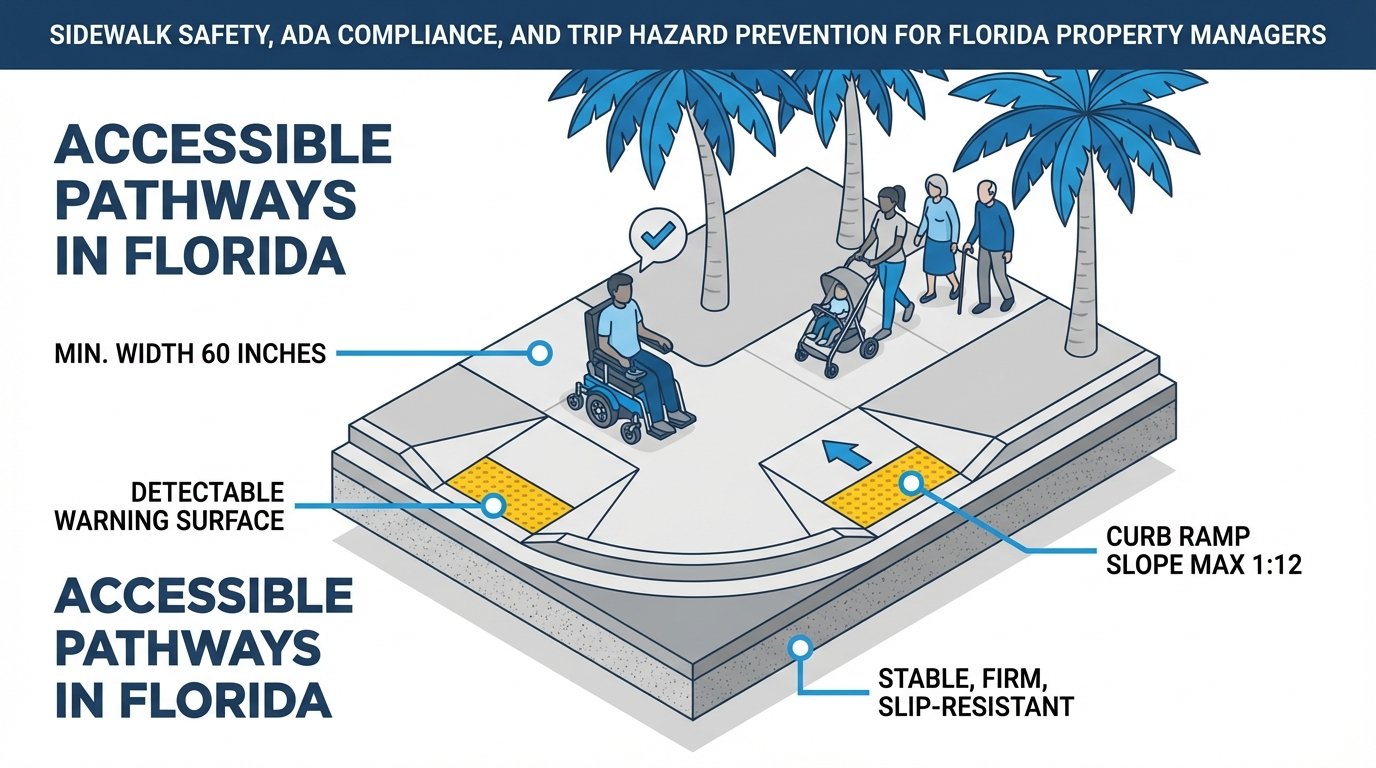
ADA compliant sidewalks must meet specific technical requirements:
- Maximum vertical displacement: No more than 1/4 inch between adjacent surfaces, or 1/2 inch if beveled with a slope no greater than 1:2
- Minimum width: At least 36 inches wide for accessible routes
- Maximum cross slope: Not exceeding 1:48 (2%)
- Surface requirements: Stable, firm, and slip-resistant materials
- Running slope: Generally no steeper than 1:20 (5%), otherwise requiring ramp specifications
The 1/4 inch threshold is where most Florida properties fail compliance. Tree roots, soil settlement, and ground shifting create uneven concrete slabs that exceed this limit, transforming ordinary walkways into liability nightmares. These raised sections become trip hazards that endanger everyone but particularly impact individuals using wheelchairs, walkers, or who have visual impairments.
Who Must Comply?
ADA compliance requirements affect a broad range of Florida properties:
- Commercial properties and retail centers
- Office buildings and business parks
- Homeowner associations and condominium complexes
- Municipal sidewalks and public facilities
- Educational institutions from elementary schools to universities
- Healthcare facilities and medical offices
- Places of public accommodation including restaurants and entertainment venues
Private residential properties serving single families are generally exempt, but once a property serves multiple residents or the public, ADA obligations typically apply.
The Real Cost of Non-Compliance
Ignoring ADA sidewalk violations exposes property managers to significant financial and legal risks that far exceed the cost of proactive repairs.
Lawsuit Settlements and Judgments
Trip-and-fall lawsuits arising from sidewalk hazards routinely result in substantial settlements. Medical expenses, lost wages, pain and suffering, and legal fees quickly accumulate. Settlement amounts for serious injuries often reach six figures, with some cases resulting in verdicts exceeding one million dollars when permanent disabilities occur.
Florida property managers face particular vulnerability because plaintiffs can pursue claims under both personal injury law and ADA violations. This dual exposure increases both the likelihood of litigation and potential damages.
Federal Fines and Legal Action
The Department of Justice can impose civil penalties for ADA violations. First violations can result in fines up to $75,000, with subsequent violations reaching $150,000. Beyond monetary penalties, court orders may require expensive emergency repairs under compressed timelines, eliminating the opportunity to plan cost-effective solutions.
Insurance Implications
Properties with documented trip hazards face increased insurance premiums or policy cancellations. Some insurers now require regular sidewalk inspections and documented maintenance programs. After a single claim, securing affordable liability coverage becomes significantly more challenging.
Common Causes of Sidewalk Trip Hazards in Florida
Florida’s unique environmental conditions accelerate sidewalk deterioration and create compliance challenges distinct from northern states.
Tree root growth represents the leading cause of uneven concrete sidewalks across Florida. The state’s year-round growing season allows root systems to expand continuously, lifting and tilting concrete slabs. Popular landscape trees like live oaks, maples, and palms create particularly aggressive root pressure.
Soil composition and settlement patterns also contribute significantly. Sandy soils prevalent throughout much of Florida provide unstable substrate for concrete, allowing slabs to shift and settle unevenly over time. Heavy rains and seasonal water table fluctuations wash away supporting soil, creating voids beneath sidewalk sections.
Poor initial installation compounds these natural factors. Inadequate base preparation, insufficient reinforcement, and improper joint placement create weak points where differential movement occurs.
Traditional Repair Methods: Limitations and Drawbacks
Property managers traditionally face limited options for addressing sidewalk trip hazards, each with significant disadvantages.
Complete Sidewalk Replacement
Demolishing and replacing concrete sections solves the immediate problem but imposes massive costs. Replacement projects typically run $8-15 per square foot in Florida, making even small repairs expensive. A standard commercial property sidewalk repair can easily exceed $50,000.
Beyond direct costs, replacement creates substantial disruption. Jackhammering generates noise complaints from tenants and neighbors. Heavy equipment damages landscaping. Curing time extends project duration to multiple days or weeks, forcing pathway closures that inconvenience everyone and potentially violate accessibility requirements by eliminating accessible routes.
Environmental impact is also considerable. Concrete demolition sends thousands of pounds of material to landfills, while producing new concrete generates significant carbon emissions.
Concrete Grinding
Grinding down raised edges addresses the immediate trip hazard at lower cost than replacement, typically ranging from $3-8 per linear foot. However, grinding creates an unsightly bevel with rough, discolored surfaces that announce the repair to everyone passing by.
The ground surface often measures 6-12 inches wide, creating a visually prominent patch that degrades property aesthetics. For upscale communities, retail centers, or professional campuses, this appearance issue becomes a serious concern affecting property values and tenant satisfaction.
Grinding also removes significant concrete material, potentially weakening slab edges and creating points where future cracking may initiate. The rough surface texture can become a slip hazard when wet and accumulates dirt and debris.
The Superior Solution: Precision Concrete Cutting for Trip Hazard Repair
Modern concrete cutting technology offers Florida property managers a better approach to sidewalk trip hazard removal that addresses both compliance requirements and practical concerns.
The patented cutting method removes precisely the raised portion exceeding ADA thresholds, creating a small, clean cut rather than a wide beveled grind. Advanced diamond-blade equipment makes surgical cuts that eliminate the hazard while preserving the surrounding concrete integrity and appearance.
Cost Savings That Transform Budgets
Concrete sidewalk repair using precision cutting costs 70-90% less than complete replacement. This dramatic difference allows property managers to address entire properties rather than postponing repairs due to budget constraints. Preventive maintenance becomes financially feasible, eliminating the costly emergency repairs that occur when small problems escalate into major failures or lawsuits.
Speed and Minimal Disruption
Most cutting projects complete within hours rather than days or weeks. Sidewalks return to service immediately after cutting—no curing time required. This rapid turnaround minimizes tenant complaints, maintains accessible routes throughout the process, and allows properties to schedule work around peak usage periods.
The process generates minimal noise and no heavy equipment traffic. Landscaping remains undisturbed. Normal property operations continue without interruption.
Professional Appearance
Precision cuts measure only 1-2 inches wide compared to the 6-12 inch grinding bevels. The clean cut blends with existing concrete joints, maintaining the professional appearance essential for commercial properties, upscale communities, and public facilities. Visitors often cannot identify repaired sections, preserving aesthetic appeal and property values.
Environmental Responsibility
Cutting removes minimal material, generating almost no waste compared to demolition’s tons of rubble. No new concrete production means avoiding the substantial carbon footprint of cement manufacturing. For properties pursuing green certifications or sustainability goals, this environmental advantage carries significant value.
Creating an ADA Compliance Action Plan
Property managers should implement a systematic approach to achieving and maintaining ADA compliant sidewalks.
Step 1: Conduct Comprehensive Inspections
Document all sidewalk conditions throughout your property. Identify vertical displacements exceeding 1/4 inch and other potential hazards. Photograph problem areas and maintain detailed records.
Step 2: Prioritize Repairs
Address high-traffic areas first, particularly main entrances, parking lot connections, and pathways to essential facilities. Consider both liability exposure and usage patterns when establishing priorities.
Step 3: Choose Cost-Effective Solutions
Evaluate cutting versus replacement for each situation. In most cases, precision cutting provides optimal results at minimal cost, reserving replacement only for structurally failed sections.
Step 4: Implement Preventive Maintenance
Schedule annual inspections to identify emerging issues before they become ADA violations. Address problems promptly while they remain small and inexpensive to fix.
Step 5: Document Everything
Maintain records of inspections, repairs, and compliance efforts. This documentation demonstrates good-faith compliance efforts if disputes arise and helps defend against allegations of negligence.
Why Florida Experience Matters
Florida’s unique conditions require specialized knowledge that generic concrete contractors often lack. Providers with extensive Florida-specific experience understand how the state’s soil conditions, vegetation, climate patterns, and building practices create distinctive challenges.
Companies offering proven solutions backed by decades of Florida projects bring invaluable expertise. They recognize which trees cause the most root problems, how seasonal rains affect concrete stability, and which repair approaches deliver lasting results in Florida’s environment. This specialized knowledge prevents repeated repairs and ensures compliance solutions that endure.
Take Action to Protect Your Property and Budget
Every day of delayed action leaves your property vulnerable to lawsuits, injuries, and regulatory penalties. The good news? Achieving ADA compliance doesn’t require depleting your maintenance budget or disrupting property operations.
Modern trip hazard repair technology makes comprehensive sidewalk safety both affordable and practical. Property managers across Florida are discovering that precision cutting allows them to finally address those problematic sidewalks they’ve been postponing—at a fraction of the cost they anticipated.
Don’t wait for an injury or lawsuit to force emergency action. Contact Florida Sidewalk Solutions today for a comprehensive property assessment. Our team will identify all ADA compliance issues, explain your options, and provide transparent pricing that fits your budget. With over 20 years of Florida-specific experience and proven Precision Concrete Cutting technology, we’ll help you eliminate liability risks while preserving your property’s appearance and your peace of mind.
Protect your residents, visitors, and budget with professional sidewalk trip hazard removal that meets ADA standards. Schedule your free property inspection now and discover how affordable compliance can be.